
Views: 264 Author: Rchemsell Publish Time: 2026-10-03 Origin: Site


Content Menu
● What Is GHK-Cu and Why Does Dosage Matter?
● Why Topical GHK-Cu Has the Strongest Human Evidence
● GHK-Cu Topical Concentration: A Formulator's Framework
>> Start With the Finished-Product Objective
>> Avoid Treating Concentration as the Only Performance Lever
>> Build a Practical Development Ladder
● Formulation Compatibility and Stability Checklist
● How to Qualify a GHK-Cu Peptide Supplier
>> Essential Supplier Documents
>> Questions Procurement Teams Should Ask
● Common GHK-Cu Content Errors to Avoid
● Safety, Claims, and Regulatory Boundaries
● Why Rchemsell for Custom GHK-Cu Peptide Projects?
>> 1. What is GHK-Cu in cosmetic products?
>> 2. What is the best GHK-Cu concentration for a serum?
>> 3. Is topical GHK-Cu the same as injectable GHK-Cu?
>> 4. How can I verify GHK-Cu peptide quality?
>> 5. Is Copper Tripeptide-1 considered safe in cosmetics?
GHK-Cu dosage is not a one-size-fits-all number. For cosmetic and laboratory research, the meaningful starting point is usually the finished topical formulation—its concentration, stability, delivery system, and verified identity—not an injectable "mg per dose" protocol. Current human evidence is concentrated in topical skin applications, while published human evidence is insufficient to establish the safety or efficacy of self-administered injectable GHK-Cu for cosmetic purposes.
For Rchemsell's global customers, this guide explains how cosmetic brands, formulators, and research teams can approach GHK-Cu topical concentration, supplier qualification, and custom peptide development responsibly. Rchemsell provides peptide synthesis, analytical testing, lyophilization, packaging, and global logistics support for laboratory-research and cosmetic-industry customers, including OEM, ODM, and custom peptide synthesis projects.
Important notice: This content is for cosmetic formulation, ingredient-development, and laboratory-research reference only. It is not medical advice and does not provide instructions for injection, self-administration, diagnosis, treatment, or prevention of disease.
GHK-Cu, also known as copper tripeptide-1, is a copper complex of the tripeptide glycyl-L-histidyl-L-lysine. In cosmetic ingredient development, it is commonly explored for skin-conditioning, anti-aging, scalp-care, and appearance-focused applications.
The word "dosage" can create confusion because it means different things across different product categories:
| Application context | Relevant measurement | Main development question |
|---|---|---|
| Topical cosmetic serum or cream | Percentage concentration in final formula | Is the ingredient stable, compatible, and tolerable at the intended use level? |
| Raw-material procurement | Assay, purity, identity, metal-complex specification | Is the supplied material truly the intended copper peptide and fit for formulation work? |
| Cell or ex vivo research | Molar concentration and exposure conditions | Does the research design use an appropriate, reproducible test concentration? |
| Injectable use | Clinical and regulatory evaluation | This is outside the scope of cosmetic formulation guidance and should not be extrapolated from topical research |
The key principle is route specificity. A topical cosmetic formulation is designed for local application to the skin surface. Its performance depends on formulation architecture, contact time, barrier condition, packaging, and the interaction between GHK-Cu and the rest of the formula. It should not be treated as evidence for systemic or injectable use.
GHK-Cu has been studied in topical cosmetic and dermatological contexts for decades. Older controlled studies summarized in peer-reviewed reviews reported improvements in visible markers of photoaged skin, including the appearance of fine lines, skin density, firmness, and elasticity after consistent topical use over several weeks.
For example, a review of the clinical literature described:
- A 12-week facial-cream study involving 71 women with photoaged skin, reporting improvements in skin density and thickness, laxity, clarity, fine lines, and wrinkle depth.
- A 12-week eye-area study involving 41 women, in which the GHK-Cu product reportedly outperformed placebo and a vitamin K comparator for several appearance-related outcomes.
- A thigh-skin study in which collagen-production improvements were observed in 70% of women using a GHK-Cu cream, compared with 50% using a vitamin C cream and 40% using a retinoic-acid cream. These findings should be interpreted cautiously because product formulas, endpoints, and study designs vary.
However, a recent review also highlights an important reality for responsible B2B marketing: despite longstanding interest in GHK-Cu and related peptides, the modern clinical evidence base remains limited, and more robust, well-controlled studies are needed.
For cosmetic brands, the correct claim strategy is therefore not "GHK-Cu reverses aging" or "GHK-Cu repairs skin." A more defensible approach is to use cosmetic-language claims supported by appropriate finished-product testing, such as:
- "Helps improve the appearance of skin firmness."
- "Supports smoother-looking skin."
- "Helps reduce the visible appearance of fine lines."
- "Designed to support a refined, hydrated-looking complexion."
These claims still require substantiation for the specific finished product, not merely reliance on raw-material literature.
There is no universally correct GHK-Cu concentration for every serum, cream, eye product, mask, or scalp formula. The right level depends on the target market, delivery system, raw-material specification, regional regulations, intended claims, and product testing plan.
Instead of copying a concentration from a competitor's website, formulators should build a documented decision process.
A high-end facial serum and a scalp-care tonic may use different formulation approaches because they have different consumer expectations, application patterns, and compatibility requirements.
Before choosing a GHK-Cu level, define:
1. Target application area
Face, eye contour, neck, scalp, body, or post-procedure cosmetic care.
2. Product format
Water-based serum, emulsion, gel, ampoule, mask, cream, scalp essence, or encapsulated system.
3. Primary consumer claim
Hydration, visible firmness, wrinkle appearance, scalp comfort, or overall skin conditioning.
4. Use frequency
Once daily, twice daily, rinse-off, leave-on, or professional-use format.
5. Target customer profile
Mature skin, sensitive skin, dry skin, men's grooming, premium anti-aging, or salon/professional channels.
A common formulation mistake is assuming that a higher percentage automatically produces a better product. In practice, the nominal concentration is only one variable.
Topical performance can also be affected by:
- Ingredient purity and identity
- Copper-peptide complex integrity
- Formula pH
- Water activity and oxidative environment
- Solvent system and emulsifier selection
- Use of chelators or other metal-interacting ingredients
- Preservative compatibility
- Delivery technology
- Air and light exposure during shelf life
- Primary packaging, especially airless versus repeated-open packaging
Research has reported that GHK-Cu may be susceptible to degradation under alkaline and oxidative stress, while showing stability in water and buffers within tested pH conditions. This makes formulation screening, stress testing, and packaging selection especially important for cosmetic developers.
A disciplined cosmetic-development program can use the following sequence:
| Stage | Goal | Suggested evidence |
|---|---|---|
| Raw-material qualification | Confirm identity and suitability | COA, HPLC purity, MS identity, appearance, moisture, residual solvents where applicable |
| Bench formulation | Confirm compatibility | pH screening, color stability, odor, viscosity, precipitation, accelerated stability |
| Pilot production | Confirm repeatability | Batch-to-batch checks, microbial testing, packaging compatibility |
| Safety evaluation | Assess consumer tolerance | Patch testing or HRIPT where appropriate, dermatologist-supervised testing |
| Claim substantiation | Support marketing claims | Instrumental testing, expert grading, consumer perception studies |
| Scale-up and launch | Maintain control | Release specifications, retain samples, stability monitoring, traceability documentation |
This approach is more valuable than publishing a simplistic "best GHK-Cu dosage" statement. It helps brands build products that are reproducible, compliant, and credible in front of distributors, retailers, and informed consumers.
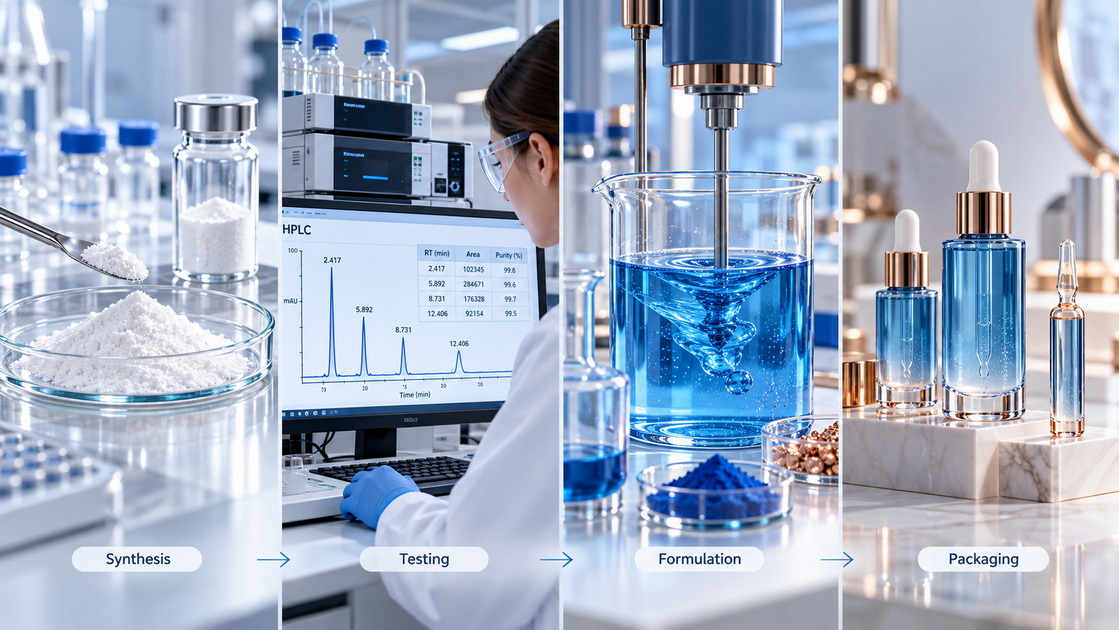
Because GHK-Cu is a copper-containing peptide complex, cosmetic developers should evaluate compatibility early rather than waiting until commercial production.
- Is the raw material supplied as GHK-Cu/Copper Tripeptide-1 with a clearly defined specification?
- Has identity been verified with mass spectrometry?
- Is purity supported by HPLC or UHPLC chromatographic analysis?
- Does the formula remain visually uniform during accelerated stability testing?
- Does the characteristic blue color remain consistent without unacceptable discoloration?
- Is there evidence of precipitation, odor shift, viscosity change, or loss of assay over time?
- Does the packaging minimize oxygen exposure and repeated contamination?
- Does the formula remain compatible with fragrances, botanical extracts, acids, antioxidants, surfactants, and preservatives?
- Has the final product undergone microbial and consumer-tolerance evaluation?
The blue color associated with GHK-Cu can be useful for product differentiation, but it should not be used as proof of potency or identity. Visual appearance alone cannot replace analytical verification. A blue solution may still have unacceptable impurity levels, inadequate copper complexation, or degradation products that require chromatography and identity testing to assess.
For a cosmetic brand, contract manufacturer, distributor, or research laboratory, buying a peptide should never be reduced to comparing price per gram. A lower-cost material can create much larger downstream risks: failed stability testing, inconsistent color, batch variation, delayed launches, rejected finished goods, or claims that cannot be substantiated.

A reliable GHK-Cu supplier should be prepared to provide relevant documentation based on the intended application and customer requirements:
- Certificate of Analysis (COA) for each batch
- HPLC or UHPLC chromatogram demonstrating stated purity
- Mass spectrometry data for molecular identity confirmation
- Batch number, manufacturing date, and retest or expiry information
- Storage and transportation recommendations
- Product specification sheet
- Safety data sheet where applicable
- Packaging and labeling information
- Traceability records
- Custom synthesis or scale-up documentation for OEM/ODM projects
- Information on lyophilization and moisture-control procedures when supplied as a powder
Rchemsell supports this development chain with custom peptide synthesis, production, analytical testing, lyophilized packaging, and logistics coordination. For B2B buyers, the central question is not only "Can the supplier make GHK-Cu?" but also "Can the supplier consistently document what was made, verify it, package it appropriately, and reproduce it at the next order?"
Before placing a larger order, ask the supplier:
1. What is the exact product specification and target purity?
2. Which analytical methods confirm identity and purity?
3. Is each batch tested, or is a generic sample COA provided?
4. What are the acceptance criteria for purity, water content, and appearance?
5. How is the copper complex controlled or characterized?
6. What packaging protects the lyophilized peptide during transport and storage?
7. Can the supplier support gram-scale, kilogram-scale, or staged scale-up?
8. Can the supplier provide OEM, ODM, private-label, or custom-synthesis support?
9. What change-control process applies if raw materials, processes, or specifications change?
10. How are global shipment conditions and customs documents managed?
Many online GHK-Cu articles weaken trust by blending cosmetic research, animal data, in vitro findings, and injectable claims as though they were interchangeable.
Avoid these errors:
- Presenting injection instructions as cosmetic education. Topical human data do not validate injectable use.
- Claiming disease treatment or wound healing for a cosmetic product. Cosmetic marketing should focus on appearance and skin-conditioning language unless the product is regulated and authorized for medical claims.
- Using raw-material evidence as proof for a finished formula. A 1% serum, a cream, and an encapsulated gel can perform differently.
- Using "99% purity" without supporting documents. Purity should be traceable to a batch-specific analytical result.
- Treating color as a quality test. Blue color may be expected, but chromatography and mass spectrometry provide meaningful quality evidence.
- Claiming that more GHK-Cu always means better results. Formula stability, delivery, tolerance, and substantiation matter as much as concentration.
The Cosmetic Ingredient Review Expert Panel concluded that Copper Tripeptide-1 and related ingredients were safe under the cosmetic practices of use and concentrations covered by its assessment. The assessment cited low use concentrations and available safety data, including negative irritation and sensitization findings under the reviewed conditions.
This does not mean every GHK-Cu product is automatically safe for every user. Finished-product safety depends on the complete formula, concentration, contaminants, preservatives, fragrance, exposure area, skin condition, and instructions for use.
For brands, practical risk-management steps include:
- Conducting stability and compatibility testing on the finished formula
- Using appropriate preservative and microbial-control systems
- Performing patch testing or other suitable human safety assessments
- Including clear instructions and warnings
- Avoiding unsubstantiated drug-like claims
- Consulting qualified regulatory professionals for the target market
Consumers with known sensitivities, damaged skin barriers, or conditions that affect copper metabolism should seek advice from an appropriate healthcare professional before trying unfamiliar cosmetic products.

Rchemsell is positioned to support brands and laboratories that need more than a catalog ingredient. The company offers an integrated peptide-development pathway for cosmetic and research customers:
- Custom peptide synthesis for project-specific sequences and specifications
- High-purity peptide production, typically targeted at 98%–99% purity based on project requirements
- Analytical quality control, including appropriate purity and identity verification
- Lyophilization and packaging designed for peptide handling and transport
- OEM and ODM cooperation for global beauty and laboratory customers
- Custom packaging and order configurations for product-development and procurement needs
- One-stop supply support from synthesis and testing to packaging and shipment
For cosmetic brands, the advantage is operational: a peptide supplier should help reduce the handoffs between development, testing, packaging, and logistics. That can improve documentation control, accelerate formulation screening, and make scale-up more predictable.
The best GHK-Cu "dosage" strategy for cosmetic development is not an aggressive concentration claim. It is a controlled formulation-and-quality program: choose an evidence-aligned topical use case, qualify the peptide with batch-specific analytical data, test stability in the real formula, substantiate finished-product claims, and communicate benefits without overstating the science.
GHK-Cu remains a compelling premium cosmetic peptide because it has a meaningful history in topical skin research. But the strongest brands will differentiate themselves through transparent specifications, responsible claims, robust testing, and repeatable manufacturing—not hype.
GHK-Cu, often listed as Copper Tripeptide-1, is a copper complex of the tripeptide glycyl-L-histidyl-L-lysine. It is used in cosmetic research and formulations focused on skin conditioning, visible signs of aging, and scalp-care applications.
There is no universal best concentration. The appropriate level depends on the formula type, ingredient specification, pH, delivery system, target application area, stability data, safety evaluation, and desired consumer claims. Brands should validate the finished formula rather than copying a percentage from another product.
No. Topical cosmetic use and injectable administration are fundamentally different routes with different evidence, safety considerations, regulatory requirements, and exposure profiles. Published human evidence is mainly related to topical skin applications; it should not be used to justify injection protocols.
Ask for a batch-specific COA, chromatographic purity data such as HPLC, mass-spectrometry identity confirmation, storage information, and clear batch traceability. The blue appearance of GHK-Cu may be expected, but it does not replace analytical testing.
The Cosmetic Ingredient Review Expert Panel concluded that Copper Tripeptide-1 and related ingredients were safe under the cosmetic use conditions reviewed in its assessment. However, safety of a finished product depends on its entire formulation and how it is used.
1. [Topically Applied GHK as an Anti-Wrinkle Peptide — PubMed] — Recent review noting interest in GHK-Cu and Pal-GHK, while emphasizing the limited availability of clinical studies for these topical peptides. [pubmed.ncbi.nlm.nih]
2. [Regenerative and Protective Actions of the GHK-Cu Peptide in the Light of the New Gene Data — PMC] — Review summarizing historical topical studies, including 8- and 12-week cosmetic studies of GHK-Cu formulations. [pmc.ncbi.nlm.nih]
3. [GHK Peptide as a Natural Modulator of Multiple Cellular Pathways in Skin Regeneration — PMC] — Review of mechanistic and clinical literature on GHK/GHK-Cu in skin-related contexts. [pmc.ncbi.nlm.nih]
4. [Safety Assessment of Tripeptide-1, Hexapeptide-12, Their Metal Salts and Fatty Acyl Derivatives — International Journal of Toxicology] — Cosmetic safety assessment that includes Copper Tripeptide-1. [journals.sagepub]
5. [Cosmetic Ingredient Review: Safety Assessment Documentation] — CIR supplemental documentation for the reviewed peptide ingredient group. [cir-safety]
6. [People Are Injecting Copper Peptides Ahead of the Science — NPR] — Reporting on the distinction between established topical cosmetic use and the lack of published human evidence for injectable copper-peptide use. [npr]
7. [Copper Peptide Formulation: Stability and Packaging Guide — MedPak Solutions] — Industry-oriented discussion of formulation stability, pH, oxidation, compatibility, and packaging considerations. [medpaksolutions]


