
Views: 241 Author: Rchemsell Publish Time: 2026-10-09 Origin: Site


Content Menu
● What Is GHK-Cu, and How Does It Differ From GHK?
>> Why Copper Peptides Interest Cosmetic Developers
● What Does the Evidence Say About GHK-Cu Topical Serum Benefits?
>> Laboratory Findings and Human Outcomes Are Different Evidence Categories
>> What the Early Human Studies Actually Show
● Can GHK-Cu Penetrate the Skin?
>> Small Molecular Size Does Not Guarantee Delivery
>> Copper Detection Is Not Always Intact Peptide Detection
● GHK-Cu Serum vs Cream: Which Format Is Better?
● How to Interpret GHK-Cu Serum Concentration
>> Define the Percentage Before Comparing Products
>> Why Higher Concentration Is Not Automatically Better
● GHK-Cu Formulation Stability: What Should Be Tested?
>> Published Stability Findings Are Not Universal Shelf-Life Guarantees
>> Build a Finished-Product Stability Plan
>> Blue Color Is an Observation, Not a Certificate
● Can GHK-Cu Be Formulated With Vitamin C, Acids, or Retinoids?
● What Should B2B Buyers Require From a GHK-Cu Supplier?
>> Separate Raw-Material Purity From Finished-Serum Performance
>> A Practical Supplier Qualification Checklist
● Cosmetic Claims and Research-Use Materials Must Stay Separate
● Working With Rchemsell on Peptide Development
>> 1. Is GHK-Cu the Same as GHK?
>> 2. Is a 1% GHK-Cu Serum Always the Best Choice?
>> 3. Does Blue Color Prove Copper Peptide Quality?
>> 4. Is GHK-Cu Better Than Retinol?
>> 5. Can Research Peptide Powder Be Used Directly as Skincare?
A GHK-Cu topical serum combines a copper-binding peptide with a cosmetic delivery system. For brands, formulators, and procurement teams, evaluating a copper peptide serum requires more than checking its blue color or advertised concentration. The meaningful questions concern ingredient identity, formulation stability, skin-delivery evidence, safety, and the claims supported by the finished product.
GHK-Cu has attracted attention through laboratory research and small human studies. However, findings from one cream, delivery system, or experimental model cannot automatically validate every serum containing the ingredient.
My recommendation is to make verification the starting point. Separate what is known about the molecule from what has been demonstrated for your selected raw material and final formulation.
This guide explains how to assess topical GHK-Cu, avoid misleading comparisons, and establish practical requirements for cosmetic development and peptide sourcing.

GHK is glycyl-L-histidyl-L-lysine, a tripeptide made from three amino acids. GHK-Cu is its complex with copper(II). These names are related, but they do not describe identical chemical materials.
A recent review lists GHK at approximately 340.4 Da and a commonly described GHK-Cu complex at approximately 402.9 Da. Commercial specifications must still identify the actual supplied form, including relevant composition and quantity definitions.
For buyers, this distinction affects:
- Material identification.
- Concentration calculations.
- Analytical interpretation.
- Comparisons between supplier quotations.
- Matching an ingredient to published research.
"Copper peptide" is a broader description, not a complete purchasing specification. Request the precise ingredient identity rather than relying on a category name.
Cellular research has investigated GHK-Cu in extracellular-matrix processes, including collagen-related activity and interactions with matrix-remodeling pathways. These findings provide a scientific rationale for cosmetic research.
They do not establish that every commercial serum produces the same effects.
A formulation must preserve the relevant ingredient, deliver it appropriately, remain microbiologically acceptable, and support its intended use. Biological plausibility is a starting point, not finished-product proof.
GHK-Cu literature includes cellular experiments, animal research, skin-permeation studies, and human cosmetic evaluations. Each addresses a different question.
| Evidence category | Useful question | Important limitation |
|---|---|---|
| Cellular research | Can the material influence a biological pathway? | Does not reproduce normal consumer application |
| Animal research | Does an effect occur in the studied model? | Cannot directly establish human cosmetic outcomes |
| Skin-permeation research | Where does measured material travel or remain? | Depends on the skin model, vehicle, and analytical method |
| Human product study | Does a specific formulation improve measured outcomes? | Results do not automatically transfer to another formula |
A credible article should identify the evidence category before describing a benefit.
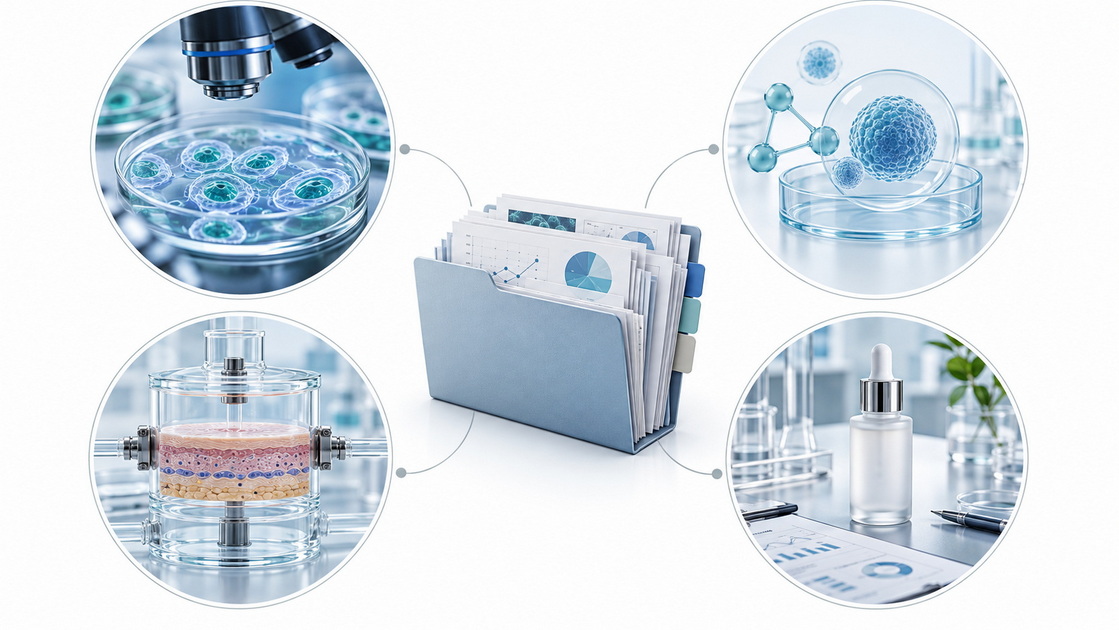
The Abdulghani pilot study is frequently cited in copper peptide marketing. The newer BioImpacts review describes 20 participants evaluated over one month, with different creams applied to thigh sites. It reports increased procollagen synthesis in 70% of participants receiving the copper-binding peptide cream, compared with 50% for vitamin C and 40% for retinoic acid.
Those percentages describe the proportion showing the reported response. They do not mean collagen increased by 70%, nor do they prove universal superiority over retinoids.
A 2015 review also summarizes 12-week facial and eye-cream studies. Some supporting references are conference proceedings or a book chapter, rather than readily assessable full clinical trial reports. That limits how confidently their methods and results can be independently evaluated.
For a new GHK-Cu serum, use this literature to guide development—not to claim that an untested product has already reproduced those outcomes.
Both GHK and the commonly described copper complex are relatively small. Nevertheless, molecular weight alone cannot establish effective skin penetration.
The BioImpacts review identifies hydrophilicity and charge as important barriers. It also describes substantially different results across isolated skin layers, synthetic epidermis, and human-skin experimental systems.
This matters because a statement such as "below 500 Da, therefore easily absorbed" oversimplifies the problem.
GHK-Cu can undergo ligand exchange. Measuring copper in a skin layer does not necessarily demonstrate that an unchanged copper-peptide complex reached that location.
The review discusses studies that measured copper and peptide separately, reflecting the analytical difficulty of tracking the complex.
When reviewing supplier delivery claims, ask:
1. Which skin model was used?
2. Was the tested material identical to the proposed ingredient?
3. Was copper, peptide, or the intact complex measured?
4. Was the test performed with the final formulation?
5. Did the study measure surface retention, skin deposition, or complete permeation?
These questions provide a stronger basis for comparison than broad "deep absorption" claims.
Neither format is automatically superior.
A serum can offer lightweight application and flexible positioning. A cream offers a different sensory experience and formulation architecture. Their performance depends on composition, ingredient compatibility, delivery behavior, packaging, and stability—not simply product viscosity.
| Development consideration | Serum | Cream |
|---|---|---|
| Product experience | Often selected for lightweight positioning | Often selected for richer application |
| Formulation design | May use aqueous, gel, or other systems | Commonly involves an emulsion system |
| Compatibility review | Evaluate the complete ingredient combination | Also evaluate emulsifiers and phase behavior |
| Evidence requirement | Test the proposed formula | Test the proposed formula |
| Purchasing implication | Ingredient quality remains essential | Ingredient quality remains essential |
Choose the format around the intended user experience and verified performance.
Do not claim that a serum necessarily penetrates better than a cream without comparative evidence for the actual formulations.
"1% GHK-Cu" can be ambiguous if the supplier does not explain the calculation.
Does it mean:
- 1% of a defined raw material by weight?
- 1% of an ingredient solution containing a smaller active fraction?
- A measured concentration of the target ingredient?
- A nominal addition before manufacturing losses?
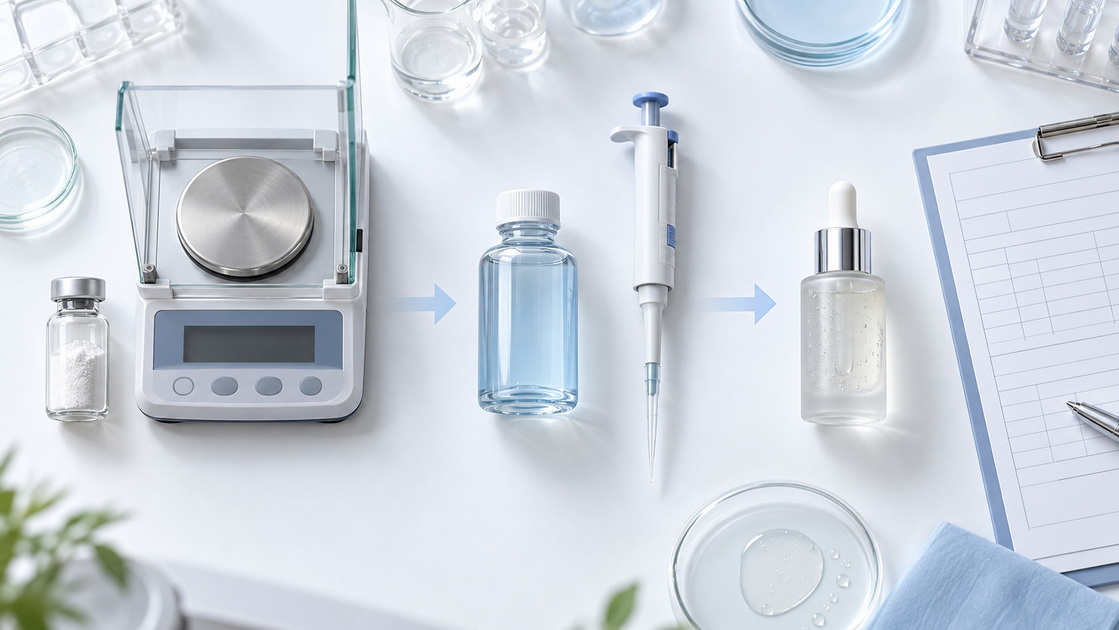
For illustration, adding 1 gram of a defined powder to a final 100-gram formulation produces a nominal 1% w/w ingredient addition.
However, that is not automatically a measured 1% concentration of intact GHK-Cu throughout shelf life. Ingredient composition, processing, and degradation must be considered.
Likewise, adding 1% of a premix containing 1% active produces a nominal 0.01% active level, not 1%.
These are arithmetic examples, not recommended use levels.
The available literature does not establish one universally optimal concentration for every copper peptide serum. Formulation and delivery remain important, and the newer review highlights gaps in clinical and preformulation evidence.
Select development levels through qualified formulation work, safety assessment, stability testing, and product-specific performance evaluation.
Avoid treating a competitor's label percentage as a complete development specification.
A preformulation study summarized in the BioImpacts review found no detectable degradation in certain aqueous solutions at pH 5.5 and 7.4 over 14 days at 60°C. The same discussion reports degradation under oxidative stress and different behavior with selected carrier ingredients.
These findings are useful for identifying variables to investigate.
They do not establish a universal pH window, storage temperature, or commercial expiry date for all serums.
A practical development plan should consider:
- Ingredient assay and relevant degradation monitoring.
- pH and appearance.
- Viscosity and physical stability.
- Microbiological quality and preservation.
- Packaging compatibility.
- Relevant temperature, light, and transport exposures.
The exact protocol should reflect the formulation and intended market. Cosmetic safety substantiation is a broader responsibility than maintaining the peptide's chromatographic purity.
For aqueous multidose products, discuss appropriate preservation testing with a qualified laboratory. Do not assume the copper ingredient adequately preserves the product.
A blue appearance may be consistent with a copper-containing formulation, but it does not independently confirm identity, concentration, or stability.
Use color as one monitored product attribute. Confirm important quality conclusions with appropriate analytical methods, especially because GHK-Cu measurement can be technically challenging.
Compatibility should be evaluated for the exact formulation.
"Vitamin C" includes different materials and formulation environments. Acid systems vary in pH, buffering, and concentration. Retinoid products also differ substantially.
A blanket statement that copper peptides must never coexist with these categories is too broad. So is a claim of universal compatibility.
The available preformulation evidence shows that oxidative conditions and specific excipients can influence stability. It does not validate every commercial ingredient combination.
For OEM or ODM development:
1. Identify each ingredient precisely.
2. Screen combinations under controlled conditions.
3. Assess changes analytically and physically.
4. Evaluate the preserved, packaged formula.
5. Set usage instructions from the completed product assessment.
Consumer layering advice cannot substitute for this work.

A raw-material HPLC result describes the tested sample under its analytical method. It does not establish finished-product delivery, tolerability, shelf life, or cosmetic efficacy.
For copper-complex materials, discuss complementary identity and composition evidence rather than treating one chromatogram as complete characterization. The literature describes separate analytical approaches for peptide and copper measurement.
Request confirmation of:
- Exact material identity and supplied form.
- Batch-specific specifications and results.
- Chromatographic evidence and method information.
- Appropriate identity testing.
- Quantity or assay basis.
- Relevant copper-composition information.
- Packaging and storage instructions.
- Retest or expiry basis.
- Application-specific additional testing.
Not every project requires an identical testing package. Agree on requirements before production and ensure the delivered documentation matches the supplied lot.
A research-use peptide powder is not automatically a consumer-ready serum.
For the United States, FDA distinguishes cosmetics from drugs partly through intended use. Claims to treat disease or affect body structure or function can cause a product marketed as a cosmetic to be classified as a drug.
Therefore, statements about healing wounds, treating inflammatory skin conditions, or restoring hair growth should not be casually repurposed into cosmetic product copy.
MoCRA also requires the responsible person to maintain adequate safety-substantiation records. Ingredient literature does not eliminate finished-product responsibilities.
Review requirements separately for each destination market.
According to the company information supplied for this article, Rchemsell supports peptide synthesis, quality testing, lyophilized packaging, transportation, OEM, ODM, and custom synthesis, with stated peptide purity levels of 98%–99%.
These are company-provided statements, not independently verified certifications.
For a GHK-Cu project, confirm product availability and the specific analytical package rather than assuming that every general capability applies to this ingredient.
Send Rchemsell your intended application, required material form, quantity basis, target specifications, destination market, and documentation needs. For cosmetic development, also define which party will perform formulation validation, safety assessment, stability testing, and claims review.
Request an application-specific proposal before committing to production.
No. GHK is the tripeptide; GHK-Cu is a copper complex. Their molecular identities and analytical requirements differ. Specify which material you need when purchasing.
No universal best concentration is established by the sources reviewed. Clarify the percentage basis, then evaluate the complete formulation through appropriate development and testing.
No. Appearance cannot replace identity, content, or stability testing. Color is useful as a monitored attribute, not independent proof of quality.
The small early comparative study does not establish universal superiority. Product selection requires attention to formulation, measured outcomes, tolerability evidence, and claim substantiation.
Research labeling does not establish suitability for consumer cosmetic use. A finished product requires appropriate formulation, safety support, labeling, and compliance review.
1. PSPeptides Research Team. "The Best GHK-Cu Topical Serum for Proven Skin Results." Published April 9, 2026. Original article reviewed for topic coverage, claims, and information gaps. Its commercial claims were not treated as independent scientific validation. [pspeptides]
2. Mortazavi, S. M., Mohammadi Vadoud, S. A., and Moghimi, H. R. "Topically Applied GHK as an Anti-Wrinkle Peptide: Advantages, Problems and Prospective." BioImpacts, 2025;15:30071; published online April 28, 2024. DOI: 10.34172/bi.30071. Main source for molecular distinctions, early human-study details, permeability limitations, analytical challenges, and formulation evidence. [bi.tbzmed.ac]
3. Pickart, L., Vasquez-Soltero, J. M., and Margolina, A. "GHK Peptide as a Natural Modulator of Multiple Cellular Pathways in Skin Regeneration." BioMed Research International, 2015:648108. DOI: 10.1155/2015/648108. Source for biological research context and historical facial-study summaries. These summaries were distinguished from independently reviewed primary trial reports. [pmc.ncbi.nlm.nih]
4. U.S. Food and Drug Administration. "Cosmetics & U.S. Law." Content current as of August 17, 2026. Authoritative source for U.S. cosmetic and drug distinctions, claims implications, and MoCRA safety-substantiation responsibilities. [fda]


