
Views: 248 Author: Rchemsell Publish Time: 2026-10-08 Origin: Site


Content Menu
● HPLC-Verified Peptides vs COA-Only Peptides: What Is the Difference?
>> What Are HPLC-Verified Peptides?
>> What Are COA-Only Peptides?
>> Side-by-Side Procurement Comparison
● What HPLC Peptide Purity Can—and Cannot—Tell You
>> Chromatographic Purity Is Method-Dependent
>> HPLC Purity Does Not Independently Establish Identity
>> HPLC Does Not Replace Application-Specific Testing
● Why 99% Purity May Not Mean 99% Usable Peptide
>> An Illustrative Procurement Calculation
● What Should a Batch-Specific Peptide Quality Package Include?
>> Read the Chromatogram Beyond the Main Peak
● A Six-Step Workflow for Verifying Peptide Suppliers
>> Step 1: Define the Intended Application
>> Step 2: Set Acceptance Criteria Before Quotation
>> Step 3: Review Representative Documentation
>> Step 4: Evaluate the Actual Supplied Lot
>> Step 5: Use Independent Verification Where Risk Justifies It
>> Step 6: Track Performance Across Repeat Orders
● Research Peptides vs Cosmetic Peptides: Different Buying Priorities
>> Cosmetic Development Buyers
● How to Discuss Quality Requirements With Rchemsell
● Request Evidence Before You Approve the Order
>> 1. Are HPLC-Verified Peptides Always Better Than COA-Only Peptides?
>> 2. Is 98%–99% HPLC Purity Enough for B2B Purchasing?
>> 3. Should Buyers Require Mass Spectrometry?
>> 4. Can a COA Be Genuine Without an Attached Chromatogram?
>> 5. Does HPLC Verification Mean Third-Party Testing?
When comparing HPLC-verified peptides vs COA-only peptides, B2B buyers should require a batch-specific Certificate of Analysis, traceable chromatographic evidence, appropriate identity testing, and specifications matched to the intended application. A high purity number alone does not establish peptide identity, usable peptide content, or suitability for research or cosmetic development.
The distinction is not "testing versus paperwork." A Certificate of Analysis, or COA, can summarize legitimate HPLC testing. The real question is whether its results are supported by accessible, interpretable evidence linked to the material you receive.
My purchasing recommendation is to prioritize traceability: connect the product, production lot, analytical sample, test method, and release decision. That evidence chain is more useful than choosing between two marketing labels.
For laboratory procurement teams, cosmetic formulators, and private-label buyers, this approach makes supplier comparisons more meaningful.
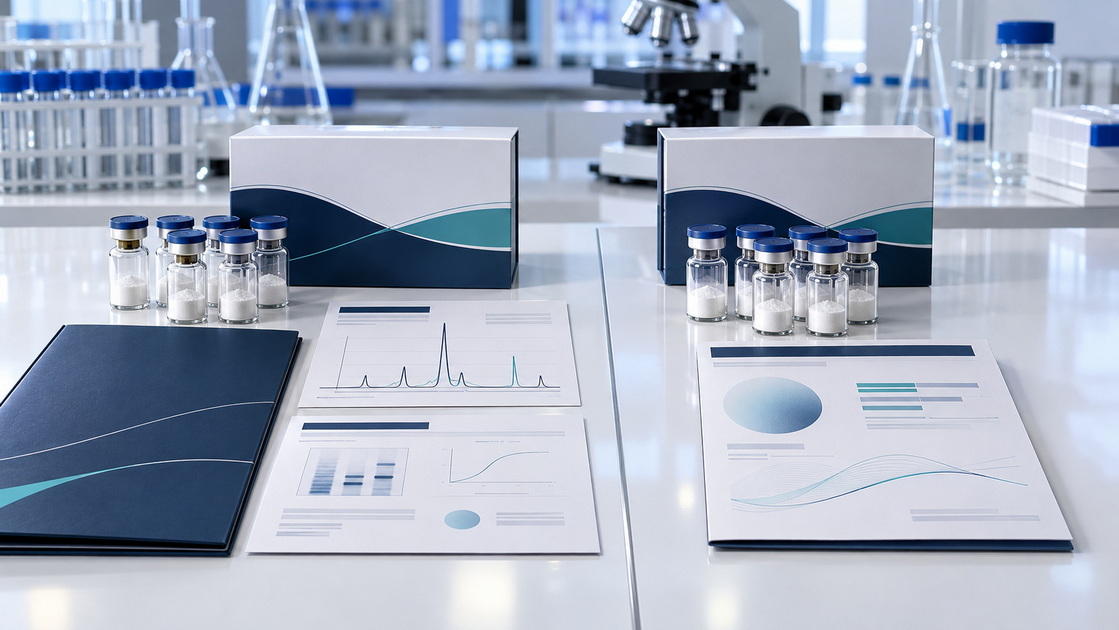
High-performance liquid chromatography separates sample components under defined analytical conditions. For synthetic peptides, reversed-phase HPLC is widely used to assess purity by comparing the main peak area with the integrated areas of other detected peaks. UV detection commonly operates around 210–220 nm.
However, "HPLC-verified" is not a complete specification.
Buyers still need to know which batch was tested, which method was used, how peaks were integrated, and whether the main peak represents the intended peptide. An attractive chromatogram without that context provides limited assurance.
For this comparison, "COA-only peptides" means products supplied with a results summary but without accompanying analytical evidence available for buyer review.
That does not prove the supplier skipped testing. Some suppliers retain detailed records internally and provide them upon request.
A useful COA should identify the material and batch, list relevant tests and acceptance limits, and report results. FDA guidance describes these features for pharmaceutical API documentation; they also offer a practical documentation model, although pharmaceutical requirements do not automatically apply to research or cosmetic materials.
| Evaluation point | HPLC evidence available | COA only, without supporting data |
|---|---|---|
| Reported purity | Buyer can review chromatogram and integration | Buyer sees the summarized result |
| Method transparency | Conditions can be assessed if supplied | Depends on details recorded on the COA |
| Batch linkage | Stronger when sample and lot identifiers match | Possible, but requires document verification |
| Identity assurance | Requires suitable identity evidence beyond purity | Depends on the identity test reported |
| Investigation support | More evidence for discussing unexpected results | Additional records may need requesting |
| Purchasing decision | Evaluate evidence quality, not the label | Resolve evidence gaps before acceptance |
Neither category guarantees quality. A reliable supplier may issue a concise COA backed by excellent records, while a weak supplier may circulate a generic chromatogram.
A reported result of 99% HPLC purity generally describes the target peak's proportion of integrated detector response under the stated method.
It is not automatically 99% of the powder's total weight. Water, salts, and counterions are not adequately accounted for by a conventional peptide UV purity calculation.
The method also needs sufficient selectivity to distinguish the target from relevant impurities. ICH Q2(R2) identifies specificity/selectivity as a central analytical consideration and describes approaches such as demonstrating absence of interference or comparing results with an orthogonal procedure._Guideline_2023_1130.pdf)
For buyers, the practical implication is straightforward: ask whether the method is suitable for this peptide, not merely whether an HPLC instrument was used.
Purity and identity answer different questions:
- Purity: What proportion of the detected material corresponds to the assigned target?
- Identity: Is that target consistent with the peptide ordered?
Mass spectrometry is commonly used alongside reversed-phase chromatography to support synthetic peptide identity. More complex structural questions may require additional characterization rather than molecular mass alone.
Request calculated and observed mass, together with the intended sequence and modifications. For challenging sequences, discuss whether further structural evidence is necessary.
HPLC purity does not independently establish microbiological quality, endotoxin level, residual solvent content, formulation stability, or cosmetic safety.
Those are separate questions requiring appropriate methods and acceptance criteria. For cosmetics marketed in the United States, MoCRA requires the responsible person to maintain adequate safety-substantiation records; a peptide purity certificate alone does not fulfill that broader responsibility.
This distinction deserves a separate purchasing discussion because it directly affects concentration calculations and price comparisons.
Net peptide content describes the peptide fraction of the total material, excluding non-peptidic contributions such as moisture and counterions. It can include peptide impurities, so it is not interchangeable with target-peptide purity. Quantitative amino acid analysis or elemental analysis may be used to determine it.
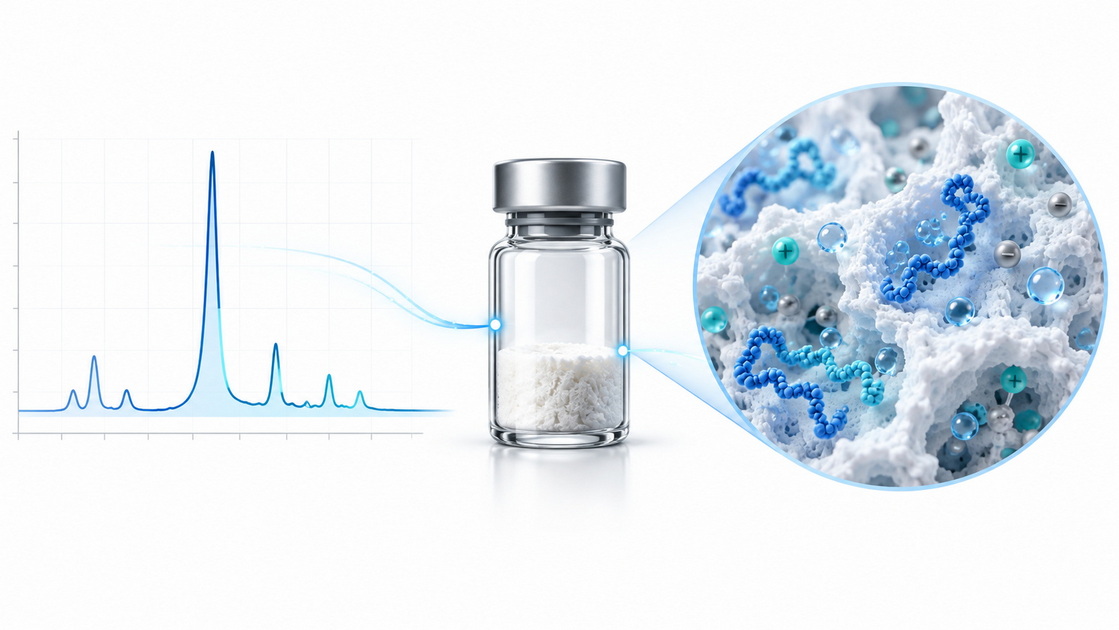
Consider a hypothetical lot with:
- Gross powder weight: 100 mg.
- Net peptide content: 80%.
- HPLC purity: 99%.
Using the supplier's stated analytical definitions, an approximate target-peptide amount would be:
100 mg×0.80×0.99=79.2 mg
This is an illustration, not Rchemsell batch data. Sigma-Aldrich explains the relationship between gross material, peptide content, and peptide purity; buyers should confirm the calculation basis and avoid multiplying twice if a reported assay already measures target-peptide content directly.
A useful commercial comparison therefore considers documented target-peptide quantity, not just price per gram of powder.
For concentration-sensitive research or formulation work, ask whether the quoted quantity means gross lyophilized weight, total peptide content, or assayed target peptide.
Rather than requesting "all certificates," define a focused evidence package before ordering.
| Document or result | What buyers should check |
|---|---|
| Batch-specific COA | Product identity, lot number, specifications, results, release authorization |
| HPLC chromatogram | Sample identification, axes, peaks, integration, reported purity |
| Analytical method information | Column, mobile phases, gradient, detection wavelength, sample preparation |
| Identity report | Appropriate identity method and agreement with expected material |
| Content information | Meaning of supplied weight and any assay or net-content result |
| Additional tests | Application-driven requirements agreed before production |
| Packaging records | Lot linkage, supplied quantity, storage and handling instructions |
These recommendations adapt established peptide analytical practices and documentation principles into a practical purchasing checklist. They are not a universal regulatory specification for every research or cosmetic peptide.
A useful review checks whether:
1. The sample identifier matches the ordered lot.
2. The complete analytical run is shown.
3. The purity calculation corresponds to the integration table.
4. Minor peaks are handled consistently.
5. Method details are sufficient for technical discussion.
6. Results were generated for the supplied material rather than a historical reference batch.
A small chromatogram embedded in a brochure is not equivalent to a traceable batch report.

State whether the material is for analytical research, cell-based experiments, cosmetic formulation development, or another specified purpose.
Do not assume one testing package fits every application.
Specify sequence, modifications, salt form, quantity basis, purity threshold, identity requirements, and any additional testing.
Separate mandatory requirements from optional characterization.
Before placing a large order, request a sample COA and analytical report. Use them to assess reporting quality, not as evidence for the future production batch.
Require documents matching the shipment. Confirm that sample identifiers, lot numbers, and material descriptions agree.
Consider external testing when qualifying a new supplier, investigating inconsistent results, or purchasing material for a particularly sensitive application.
Independent testing should use a suitable method and an agreed sampling approach. In pharmaceutical manufacturing, supplier-report reliance is subject to specific verification requirements; those rules should not be presented as automatically governing all research purchases.
Compare documentation completeness, analytical trends, delivery handling, and responsiveness to technical questions.
A supplier's consistency over time is more informative than one impressive purity result.

Research buyers should align characterization with experimental sensitivity.
For quantitative experiments, content information may be as important as chromatographic purity. For identity-sensitive work, chromatographic and mass-spectrometric evidence should be considered together.
Also define how discrepancies will be investigated before committing to repeat orders.
Cosmetic buyers need raw-material characterization, but also evidence relevant to the intended finished formulation.
A highly purified peptide does not automatically establish compatibility, finished-product stability, or safety. In the United States, cosmetic safety substantiation must address the product and its use conditions through scientifically robust supporting evidence.
For OEM or ODM projects, distinguish the peptide ingredient specification from the finished-product evaluation plan.
According to the company background supplied for this article, Rchemsell is a Chinese peptide manufacturer serving laboratory research and cosmetic customers. Its stated capabilities include peptide synthesis, quality testing, lyophilized packaging, transportation support, OEM, ODM, and custom peptide synthesis, with reported purity levels of 98%–99%.
These are company-provided statements, not independently verified findings from the external references.
The useful next step is to translate those capabilities into an order-specific agreement:
- Which purity specification applies to the selected peptide?
- Will the supplied lot include its own chromatogram?
- Which identity test will be performed?
- Is the quoted quantity gross weight or measured peptide content?
- Which additional tests are available and separately priced?
- How will packaging, storage, and shipment requirements be documented?
Availability should be confirmed for each project rather than assumed from a general service description.
The strongest buying standard combines a batch-specific COA, interpretable HPLC evidence, suitable identity testing, and application-matched specifications.
For a Rchemsell quotation, submit your peptide sequence, modifications, intended application, required quantity, and acceptance criteria. Request confirmation of the available batch documentation, content-testing options, packaging conditions, and any additional testing before production begins.
That turns a purity claim into a reviewable purchasing agreement.
No. The labels do not establish quality. A concise COA may summarize reliable testing, while an untraceable chromatogram may offer little assurance. Compare batch linkage, method suitability, and access to supporting records.
Not by itself. Acceptance depends on intended use, identity, content requirements, and relevant impurities. Chromatographic purity and net peptide content measure different aspects of the material.
Usually it is useful for supporting synthetic peptide identity alongside chromatography. However, the appropriate identity package depends on molecular complexity, and mass alone does not resolve every structural question.
Yes. A COA can legitimately summarize analytical results. Buyers should establish whether supporting records exist and whether they can obtain the actual batch evidence needed for qualification.
No. The phrase does not identify who performed the analysis. Ask whether testing was internal or external and whether the reported sample was traceably linked to the shipment.
1. Bachem. "Quality Control of Amino Acids & Peptides: A Guide." Technical source for peptide HPLC purity, typical UV detection wavelengths, and the distinction between purity and net peptide content. [bachem]
2. Sigma-Aldrich. "Peptide Sample Amount Determination." Technical explanation of chromatographic purity, peptide content, and calculation of the approximate amount of correct peptide. [sigmaaldrich]
3. Biosynth. "Analytical Methods and Quality Control Testing of Peptides." Source for RP-HPLC, ESI-MS, quantitative amino acid analysis, elemental analysis, and net peptide content determination. [biosynth]
4. International Council for Harmonisation. "ICH Q2(R2): Validation of Analytical Procedures," final guideline, adopted November 2023. Source for analytical specificity/selectivity and the use of complementary procedures. Its regulatory scope should not be confused with a mandatory standard for every research peptide purchase. [database.ich]_Guideline_2023_1130.pdf)
5. U.S. Food and Drug Administration. "Questions and Answers on Current Good Manufacturing Practice Requirements—Control of Components and Drug Product Containers and Closures." Source for pharmaceutical COA content and supplier-analysis verification principles. [fda]
6. Electronic Code of Federal Regulations. "21 CFR § 211.84—Testing and Approval or Rejection of Components, Drug Product Containers, and Closures." Pharmaceutical regulatory reference for component identity testing and qualified reliance on supplier analytical reports. [ecfr]
7. U.S. Food and Drug Administration. "Modernization of Cosmetics Regulation Act of 2022." Source for cosmetic safety-substantiation responsibilities and scientifically robust supporting evidence. [fda]
8. Bachem. "Analytical Capabilities." Source for complementary peptide characterization techniques, including mass spectrometry, sequencing, and structural analysis. [bachem]


