
Views: 251 Author: Rchemsell Publish Time: 2026-10-02 Origin: Site


Content Menu
● What Changes During Lyophilization?
● Lyophilized vs Liquid Peptides at a Glance
● Why Peptides Degrade in Storage
>> Chemical changes depend on the sequence
>> Physical changes can alter the usable concentration
>> Freeze–thaw is a workflow problem
● The Overlooked Difference: Purity vs Content
● How to Test the Two Formats Fairly
● Storage and Handling Practices That Matter
>> For lyophilized research peptides
● Choosing a Format for Your Workflow
● What to Ask a Peptide Supplier
>> 1. Are lyophilized peptides always stable at room temperature?
>> 2. Can I store all peptide solutions at 4 °C for one week?
>> 3. Is a 99% pure lyophilized peptide 99% active peptide by weight?
>> 4. Should frozen liquid stocks be divided into small vials?
>> 5. Is a clear solution proof that a peptide has not degraded?
For most long-term research storage, a properly packaged lyophilized peptide is the better starting choice than a routine liquid peptide solution. Removing most of the water can reduce several routes of degradation and avoids storing the entire supply in a ready-to-use solution. It does not, however, make a peptide permanently stable. The sequence, residual moisture, container, temperature, and handling history still determine whether the material remains fit for a particular assay.
A liquid peptide solution has a different advantage: it can be ready for repeatable dispensing without a new dissolution step each time. A well-designed liquid formulation may be the right format when its stability has been demonstrated for the intended storage period and analytical use. The practical decision is therefore not "powder is always good; liquid is always bad." It is which format has evidence of stability under your actual workflow.
This article addresses laboratory research materials. General handling guidance here is not a shelf-life claim for a particular Rchemsell peptide, a sterile-use instruction, or evidence that a research material is suitable for human use.
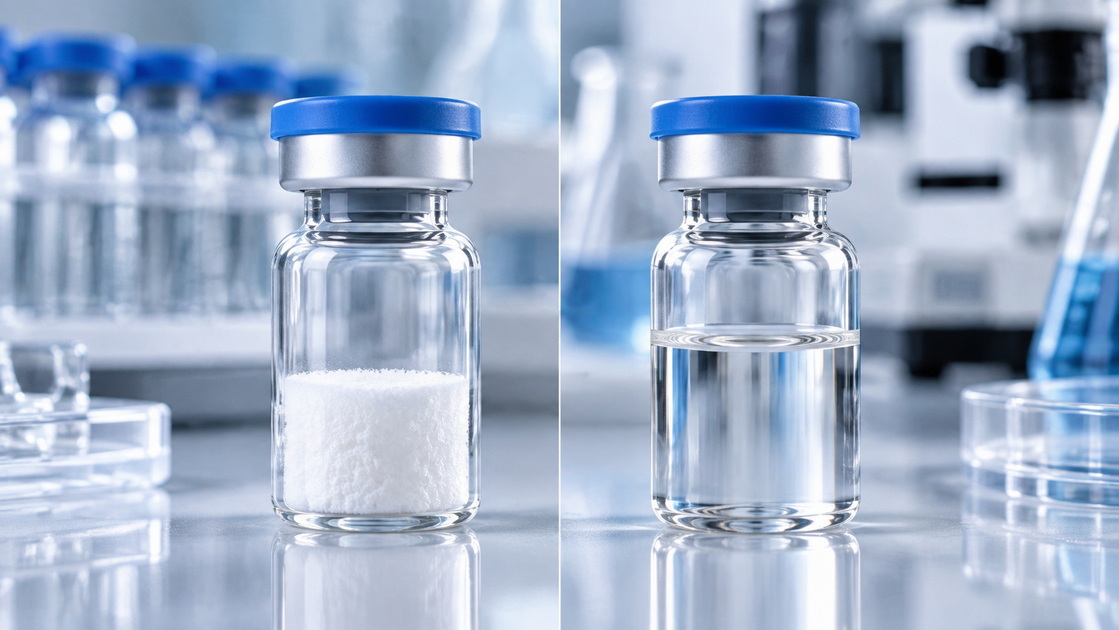
Lyophilization, or freeze-drying, turns a peptide solution into a dry cake or powder by removing water under controlled conditions. The resulting material is sealed for storage and later dissolved for its intended research assay. Because many chemical changes proceed more readily in water, suppliers commonly recommend the dry format for extended peptide storage.
The word "dry" is relative, however. A lyophilized vial can still contain residual moisture. The material may also take up moisture when the cold vial is opened in humid room air. GenScript advises storing lyophilized peptides tightly capped, protected from bright light, and generally at −20 °C; it also notes that stability varies with sequence. MilliporeSigma recommends allowing a cold vial to reach room temperature before opening it to reduce condensation.
Liquid products add another set of variables. The peptide is already exposed to a solvent system whose pH, buffer components, oxygen, concentration, and container can affect stability. Researchers reviewing peptide formulations identify chemical pathways such as hydrolysis, deamidation, and oxidation, alongside physical changes such as adsorption, aggregation, and precipitation. The importance of each pathway depends on the peptide and formulation.
| Decision factor | Lyophilized peptide | Liquid peptide solution |
|---|---|---|
| Long-term storage | Usually the more suitable starting format, subject to product-specific evidence | Requires demonstrated stability for the exact formulation and period |
| Water exposure | Reduced after effective drying and sealing | Continuous exposure in aqueous formulations |
| Preparation before an assay | Requires dissolution and handling | May be ready to dispense or dilute |
| Main handling concern | Moisture uptake, repeated opening, incomplete dissolution | Freeze–thaw, contamination, adsorption, precipitation, and formulation changes |
| Consistency across experiments | Depends on measured content and a reproducible dissolution method | Depends on concentration stability and consistent dispensing |
| Packaging decision | Vial seal, residual moisture, headspace, and vial size matter | Container compatibility, headspace, seal, and formulation matter |
| Best fit | Longer-term inventory or infrequently used research material | Defined short-term workflows or stability-supported working stocks |
This table compares common research-use situations, not individual products. A carefully validated liquid formulation can be stable for its stated life, while a poorly dried or repeatedly opened lyophilized vial can lose quality. Do not assign the same expiry date to every peptide in either column.
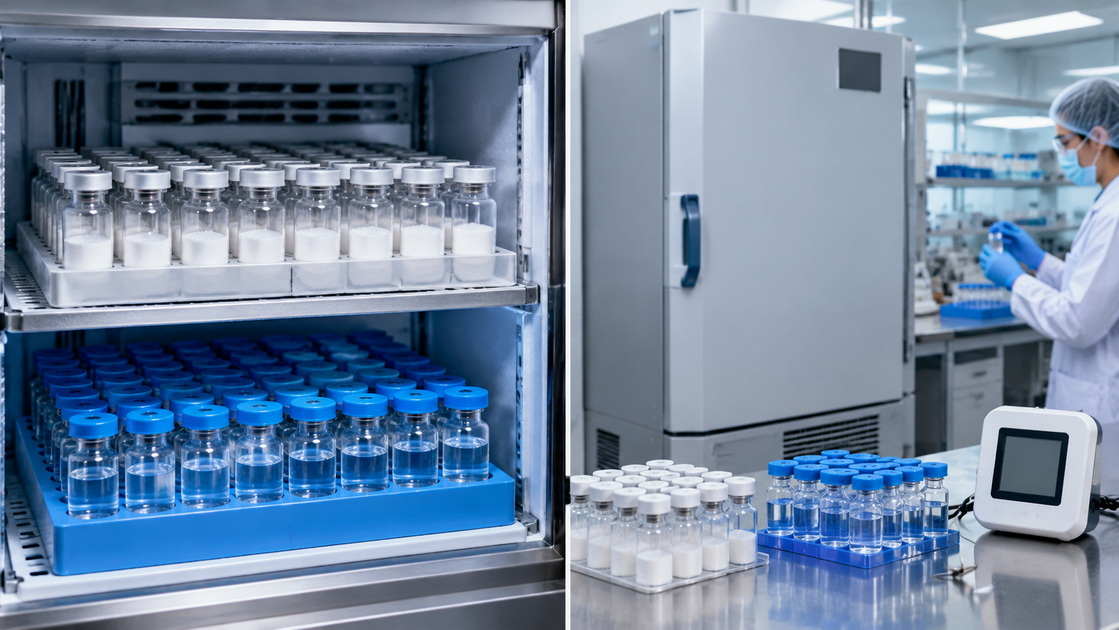
As a general rule, lyophilized peptides are more stable than their counterparts in solution. Both MilliporeSigma and GenScript make that distinction in their handling guidance. MilliporeSigma recommends the lyophilized form at −20 °C or −80 °C to minimize degradation, while GenScript warns that the shelf life of peptides in solution is much more limited.
That general rule is not a universal number of months or years. A sequence with oxidation-sensitive residues, an unsuitable formulation, or an inadequately sealed vial may require different controls. Conversely, solution-stability research shows that formulation choices—including buffer and pH optimization—can improve liquid-peptide stability. Require data for the specific sequence and presentation rather than repeating a general shelf-life claim.
Understanding the principal failure modes makes the format decision more useful than comparing freezer temperatures alone.
Peptides can undergo hydrolysis, deamidation, oxidation, and other chemical modifications. MilliporeSigma notes, for example, that certain sequences containing asparagine or glutamine are susceptible to deamidation, while cysteine and methionine can be vulnerable to oxidation. These are possibilities to investigate, not a prediction that every peptide containing those residues will fail at the same rate.
Exposure to water, oxygen, light, and an unsuitable pH can change which pathway matters most. A buffer that works for one sequence may be inappropriate for another. That is why "dissolve in water and refrigerate" is an inadequate universal specification for a research programme involving multiple peptides.
A liquid can appear clear while some peptide has adsorbed to the vial or tube. Other formulations can aggregate or precipitate, leaving less dissolved material available for an assay. A 2023 review identifies adsorption, aggregation, and precipitation among the physical stability concerns in aqueous peptide formulations.
For a research buyer, this creates a distinction between label concentration and measured, recoverable concentration. The latter matters when calibrators or experimental comparisons must be consistent over time. A consensus paper on peptides used in mass-spectrometry assays stresses characterization of peptide content, stability, and handling—not just nominal weight or chromatographic purity.
Repeatedly removing one large liquid stock from a freezer may be convenient for purchasing, but inconvenient for stability control. Supplier guidance recommends single-use or small working aliquots to avoid repeated freeze–thaw cycles. The same principle reduces repeated opening and environmental exposure of dry stock.
Aliquot size should reflect the real experiment: how much material does the laboratory use in one session, and how often? A large vial sold at an attractive unit price may produce more waste if most of it must be repeatedly handled.
A "98%–99% purity" statement can be useful, but it does not answer how much usable peptide is in a vial. A chromatographic purity figure describes the relative signal of detected components under a particular analytical method. The weighed contents of a lyophilized vial can also include water, counterions, or other formulation constituents.
A consensus paper on peptide standards distinguishes chemical purity from net peptide content. It notes that amino acid analysis can help quantify the latter for applicable research standards, while mass spectrometry helps establish identity. Buyers should therefore ask what the supplier means by "1 mg peptide": total powder mass, measured peptide content, or another defined quantity.
This question is particularly important when comparing a lyophilized vial with a premade solution. The liquid label may state a concentration, but procurement should ask how that concentration was assigned, whether it was checked after filling, and whether it remains within the agreed specification through the claimed storage period.
For Rchemsell's stated 98%–99% purity range, avoid presenting that range as a verified result for every product or lot. Request a lot-specific certificate of analysis and clarify its identity, purity, content, and stability methods before publishing a product-level claim.
For a research laboratory that routinely orders the same peptide, a small comparative study can produce more useful evidence than a generic storage chart. This is a proposed validation plan, not a report of experiments performed by Rchemsell.
1. Choose one well-characterized lot. Confirm its identity and baseline quality using methods appropriate to the intended assay.
2. Prepare matched presentations. Obtain a properly packaged lyophilized portion and a defined liquid formulation from material with documented origin. Record any differences in excipients, containers, and fill quantities.
3. Define realistic storage conditions. Include the temperatures, light exposure, handling frequency, and intended holding periods relevant to the laboratory. Follow product-specific instructions rather than imposing one condition on every sequence.
4. Set time points in advance. Reserve unopened units for each measurement so that sampling itself does not confound the comparison.
5. Measure more than one outcome. Consider identity, purity, measured concentration or recovery, relevant impurities, visible precipitation, and assay performance.
6. Document handling. Record freezer excursions, vial opening, dissolution, transfers, and freeze–thaw events.
7. Set acceptance criteria before seeing results. Decide what level of change would make the material unsuitable for its intended research use.
A liquid aliquot can be more convenient on assay day, but convenience should not hide a decline in measured recovery. Conversely, the dry product may look unchanged while its content or impurity profile has shifted. Fit-for-purpose measurements decide the outcome.
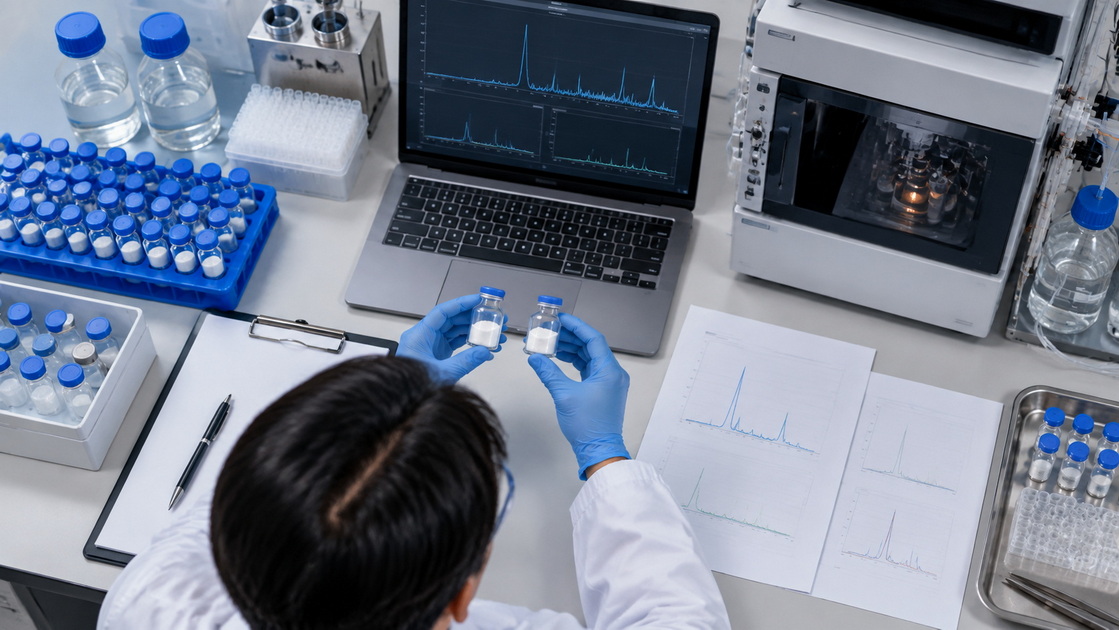
Keep the vial sealed and protected from moisture and bright light under the supplier's product-specific storage conditions. General supplier guidance commonly recommends frozen storage, with −20 °C or colder frequently cited for extended storage; the appropriate condition for a particular lot remains its documented specification.
Before opening a frozen vial, allow it to reach room temperature while still sealed. This helps limit condensation on the cold material. If the project will use small amounts over many sessions, request smaller sealed fills rather than repeatedly opening one bulk vial.
Do not assume lyophilization compensates for inadequate packaging. Ask whether the quoted presentation has a suitable seal, controlled residual moisture, and packaging that protects the product during the proposed shipment.
Use the solvent or buffer demonstrated to suit the peptide and assay. Do not adopt a general pH recommendation as a substitute for checking the sequence, solubility, and downstream analytical method. A solution formulated for one application may interfere with another.
When longer storage of a solution is unavoidable, supplier guidance recommends splitting it into small aliquots and avoiding repeated freeze–thaw. Check container compatibility and monitor for changes in measured concentration, not only obvious cloudiness.
The often-quoted guidance that a peptide solution may remain stable for up to about a week at 4 °C is a broad rule from MilliporeSigma, not a validated seven-day shelf life for every sequence. The same guidance warns that inherently unstable peptides may need different handling.
The most efficient format depends on how long you will store the material and how you will use it.
- Long-term stock or infrequent use: Start by evaluating lyophilized material in suitably sized, unopened vials.
- Daily, short-term assay work: A properly characterized liquid working stock may reduce preparation steps, provided it stays within the validated use period.
- Multi-site research: Favor packaging and instructions that each laboratory can reproduce; define the dissolution method and analytical acceptance criteria.
- Quantitative calibration: Require clarity about peptide content, recovery, and concentration assignment in addition to chromatographic purity.
- A sequence known to be difficult in solution: Ask the supplier to investigate solubility and stability for the specific peptide rather than selecting a generic solvent.
There is also a hybrid approach: hold most of the inventory as small lyophilized units and prepare only the liquid working portions needed for near-term experiments. This limits how much stock is exposed to the risks associated with repeated solution storage, while preserving the practical convenience of a liquid during a defined assay window.
For cosmetics R&D, distinguish a research peptide supplied for laboratory formulation work from an approved cosmetic ingredient or finished consumer product. Storage evidence for a standalone peptide does not automatically establish stability after incorporation into a cosmetic formula.

When requesting a quotation for lyophilized peptides or liquid peptide solutions, provide the sequence or product identifier, intended research application, planned storage period, approximate use per experiment, and analytical requirements. Then ask:
- What are the lot-specific identity, purity, and content results?
- What form is supplied, and what excipients or counterions are present?
- How were the proposed storage conditions and use period established?
- What are the container, closure, fill size, and packaging options?
- What evidence is available for shipping conditions or excursions?
- Can the supplier provide smaller sealed aliquots or a defined liquid formulation?
- Which part of testing, filling, and packaging occurs at the named facility?
Rchemsell describes synthesis, testing, lyophilized packaging, shipping, and custom OEM/ODM support as part of its offering in the company background supplied for this article. Those statements should be confirmed for the specific peptide, lot, destination, and requested presentation. No product-specific Rchemsell stability study or independent verification of its 98%–99% purity claim was supplied for this comparison.
For a practical quotation, send Rchemsell the peptide identifier, research use, desired format, vial size, target quantity, destination, and expected storage period. Request a batch-specific analytical package and ask which storage claims are supported by data before selecting dry stock, liquid stock, or a combination.
No. Removing water generally improves storage prospects, but temperature, residual moisture, oxygen exposure, packaging, and sequence still matter. Follow the product-specific conditions; general supplier guidance commonly recommends frozen storage for longer-term research inventory.
No universal seven-day guarantee exists. MilliporeSigma describes about a week at 4 °C as general guidance while noting that inherently unstable sequences may require different handling. Use verified, product-specific stability information for critical experiments.
Not necessarily. Chromatographic purity and net peptide content measure different things. Water, counterions, and formulation components may contribute to the vial's weighed mass. Request a clear definition of the quantity on the label.
Usually yes, when the workflow would otherwise repeatedly thaw and refreeze a bulk stock. Size each aliquot to the planned experiment and confirm the container and storage method suit the peptide.
No. Some chemical changes or losses through adsorption may not be obvious by eye. Use relevant analytical measurements and assay-performance checks where stability matters.
1. [MilliporeSigma, "Peptide Stability and Potential Degradation Pathways"]. General comparison of lyophilized and solution stability; sequence-dependent degradation pathways. [sigmaaldrich]
2. [MilliporeSigma, "Handling and Storage Guidelines for Peptides and Proteins"]. Vial handling, moisture control, aliquoting, freezer storage, and qualified general guidance for refrigerated solutions. [sigmaaldrich]
3. [GenScript, "Peptide Storage and Handling Guidelines"]. Supplier guidance on lyophilized storage, sequence-sensitive handling, and solution aliquots. [genscript]
4. [Nugrahadi et al., "Designing Formulation Strategies for Enhanced Stability of Therapeutic Peptides in Aqueous Solutions: A Review," "Pharmaceutics", 2023]. Review of chemical and physical degradation in peptide solutions and formulation strategies. Its therapeutic-formulation discussion is used here for underlying stability principles, not as approval guidance for research materials. [pmc.ncbi.nlm.nih]
5. [Hoofnagle et al., "Recommendations for the Generation, Quantification, Storage and Handling of Peptides Used for Mass Spectrometry-Based Assays," "Clinical Chemistry", 2016]. Consensus recommendations on characterization, peptide content, aliquoting, and fit-for-purpose research standards. [pmc.ncbi.nlm.nih]


