
Views: 273 Author: Rchemsell Publish Time: 2026-10-17 Origin: Site


Content Menu
● Peptide Bulk Orders vs Small Trial Orders at a Glance
● What Risks Should Peptide Buyers Actually Measure?
>> Inventory and Continuity Risk
● When Small Trial Orders Reduce Supply Risk
>> Testing a New Peptide Specification
>> Supporting Uncertain Development Demand
● When Peptide Bulk Orders Make More Sense
>> A Qualified Lot Supports Consistency
>> Repeated Small Orders Create Excessive Overhead
● Why Purity Alone Cannot Decide Order Size
>> HPLC Purity and Net Peptide Content Are Different
>> Agree on a Fit-for-Purpose Specification
● The Overlooked Pitfall: Approving a Sample Without Linking It to Production
>> Create a Sample-to-Production Agreement
● Compare Total Procurement Cost, Not Just Price Per Milligram
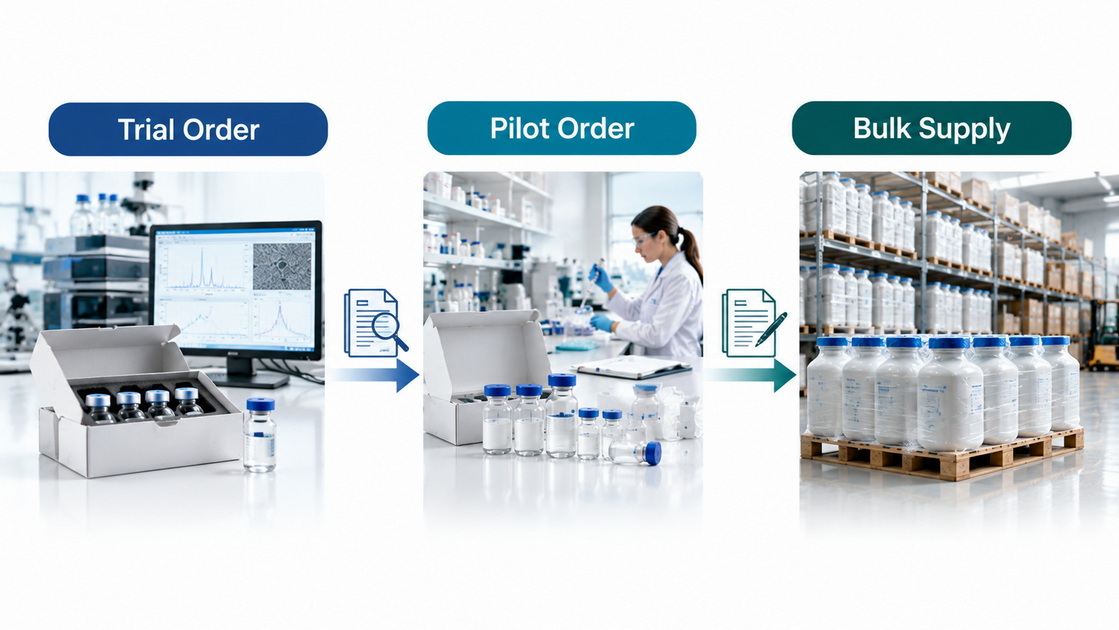
● A Lower-Risk Purchasing Model: Trial, Pilot, Then Bulk
>> Stage 1: Define the Intended Use
>> Stage 2: Qualify the Documents
>> Stage 3: Evaluate a Trial Order
>> Stage 4: Place a Pilot Purchase
>> Stage 5: Authorize Controlled Bulk Supply
● Reduce Inventory Exposure With Scheduled Releases
● Storage and Packaging Can Change the Buying Decision
● How Rchemsell Fits Into a Staged Procurement Strategy
● FAQ
>> 1. Does a successful trial mean we can skip testing the bulk lot?
>> 2. What if the trial and bulk material come from different batches?
>> 3. How much peptide should a trial order contain?
>> 4. Can a 99% research peptide be used directly in cosmetics?
>> 5. Is one large lot safer than several smaller lots?
Small trial orders usually reduce risk when qualifying an unfamiliar peptide supplier, testing a new specification, or evaluating an uncertain application. Peptide bulk orders become more practical after quality, demand, stability, and delivery performance have been demonstrated.
For most laboratories and cosmetic-development businesses, the strongest strategy is not choosing one permanently. It is moving through a controlled sequence: trial order, pilot purchase, and qualified bulk supply.
My recommendation is to prioritize qualification over order size. A small shipment without meaningful testing can provide false confidence. A large order supported by strong specifications and verified performance may be commercially sensible.
This guide compares both purchasing approaches and explains how to build a procurement process that protects quality, cash flow, and supply continuity.
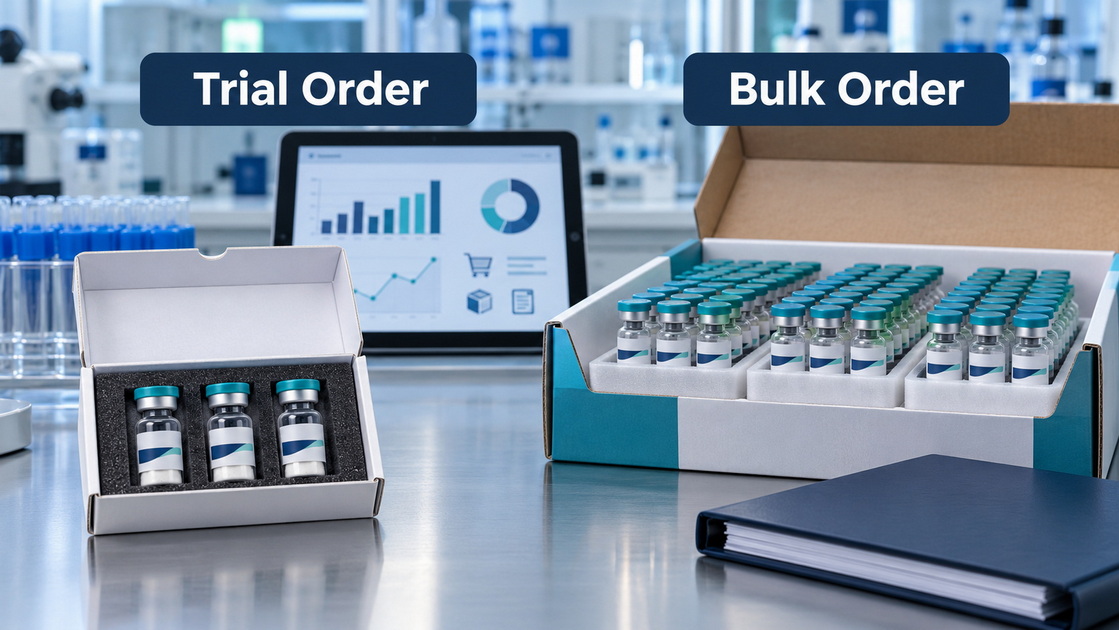
"Small" and "bulk" are relative terms. A small quantity of a complex custom peptide may represent a substantial commitment, while a larger quantity of a standard catalog product may be routine.
Define orders by their purpose, financial exposure, and expected consumption—not by an arbitrary weight threshold.
| Consideration | Small Trial Orders | Peptide Bulk Orders |
|---|---|---|
| Primary purpose | Qualify a supplier or application | Support established consumption |
| Initial financial exposure | Lower | Higher |
| Unit price | May be higher | May benefit from negotiated pricing |
| Testing economics | Testing can be expensive relative to quantity | Testing costs may be spread across more material |
| Inventory exposure | Lower | Greater if demand or stability is uncertain |
| Supply continuity | Frequent reordering may increase dependency | More stock can provide a buffer |
| Batch consistency | Multiple orders may introduce additional lots | One qualified lot can support more work |
| Main limitation | One sample does not prove repeatability | One failed lot can affect more operations |
Neither strategy eliminates risk. Each changes where that risk sits.
The first question is whether the supplied material matches the agreed specification.
For research peptides, that may require identity confirmation, chromatographic purity, and application-relevant composition information.
Do not make the purchasing decision from a product name and a purity percentage alone.
A peptide can meet its analytical specification yet fail to perform as expected in a particular research method or cosmetic formulation.
Material qualification and application qualification are separate decisions.
For cosmetic projects, formulation compatibility and safety assessment remain necessary. A research-reagent designation does not establish suitability for consumer use.
Too much inventory can tie up cash and create exposure to uncertain demand or unsuitable storage.
Too little inventory can interrupt experiments or production while another order is manufactured, tested, and delivered.
The goal is to balance these risks against the consequences of interruption.
A trial order creates an opportunity to evaluate more than the material.
Assess whether the supplier:
- Answers technical questions clearly.
- Identifies the manufacturing entity.
- Provides batch-specific documentation.
- Meets the agreed delivery schedule.
- Uses suitable packaging.
- Investigates discrepancies constructively.
A successful shipment is useful evidence, but it should not become automatic approval for unrestricted purchasing.
Use trial quantities when changing a sequence, modification, chemical form, purity requirement, or analytical method.
The purchase should answer a defined question.
For example: does the delivered material meet the agreed identity and composition requirements, and does it perform adequately in the intended research workflow?
Without a decision criterion, a trial becomes a sample collection exercise rather than qualification.
Small orders are useful when a laboratory or cosmetic-development team has not yet established consumption.
They can limit unused inventory while the project evaluates feasibility, formulation, or commercial interest.
However, order enough material to complete the planned analytical review and application work. An undersized sample can force another purchase before the original question is resolved.
Bulk purchasing is easier to justify when the buyer has reliable consumption records and a stable specification.
Use actual usage, planned projects, and realistic lead times—not an optimistic sales forecast alone.
A larger quantity from one released lot can reduce the number of lot changes during a research program.
That can simplify comparison and traceability. It does not remove the need for receiving checks, controlled storage, or application monitoring.
Also consider concentration risk: if the lot later proves unsuitable, a larger proportion of the available inventory may be affected.
Each shipment can involve purchasing, documentation review, receiving, and testing.
Bulk purchasing may reduce repeated administrative work, but compare the savings against storage costs and the consequences of rejected material.
A lower unit price is not automatically a lower total procurement cost.
Chromatographic purity generally describes the proportion of the desired peptide relative to detected impurities under the stated method.
Net peptide content accounts for the proportion of peptide material relative to contributions such as water and counterions.
These measurements are not interchangeable.
A high HPLC purity result therefore does not establish the same numerical proportion of the desired peptide in the gross weighed material.
Depending on the project, the specification may address:
- Sequence and modifications.
- Identity-testing method.
- HPLC method and acceptance criteria.
- Peptide-content basis.
- Counterion information.
- Water content.
- Relevant residual impurities.
- Packaging and storage conditions.
- Retest or stability information.
Not every project needs the same testing package. Define the requirements with the laboratory, formulation team, and qualified regulatory advisers where appropriate.
Neither a research COA nor a purity claim establishes sterility, injectable suitability, or pharmaceutical approval.
A trial is much less informative if the subsequent bulk order has an unclear relationship to the approved material.
Ask whether the trial sample:
- Comes from the proposed production lot.
- Represents a separate development batch.
- Uses the same manufacturing and purification approach.
- Is tested using the same methods.
- Has the same chemical form and packaging specification.
A different lot is not inherently unacceptable. The problem is an undocumented change.
Record:
1. Sample identification and batch number.
2. Approved specification.
3. Analytical methods.
4. Known differences between sample and production.
5. Required checks on the bulk lot.
6. Changes requiring buyer approval.
This prevents "the sample passed" from becoming a substitute for production-lot release.
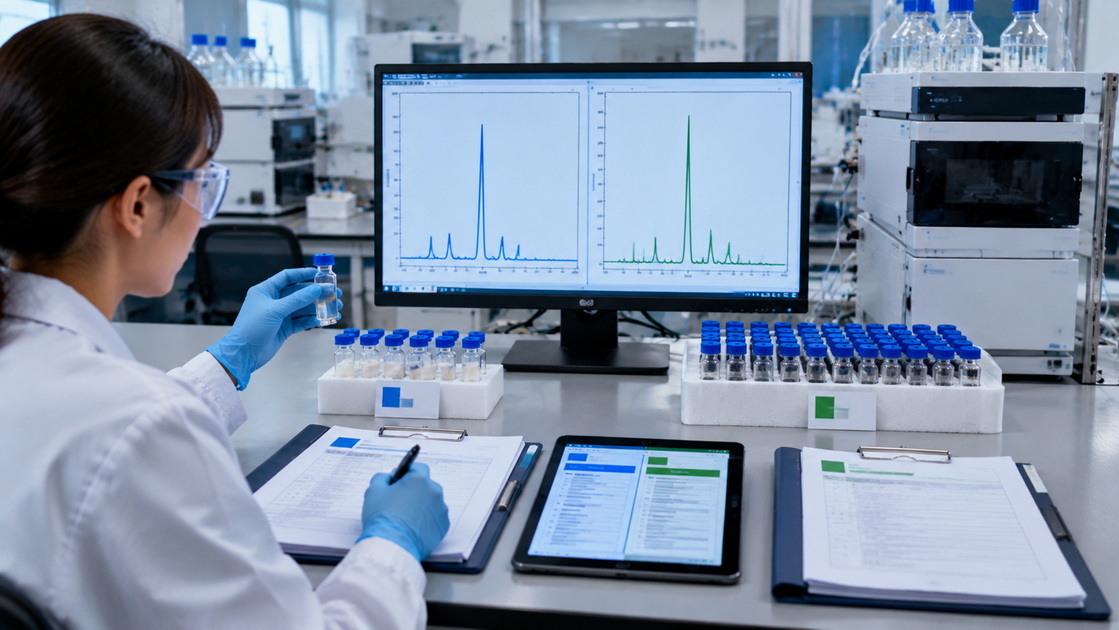
A useful planning model is:
Total procurement cost=Material+Testing+Transport+Storage+Administration+Expected loss
Expected loss can include rejected material, expiry, interrupted work, and investigation costs. Treat uncertain estimates as planning assumptions rather than precise predictions.
| Cost Element | Questions for the Buyer |
|---|---|
| Material | Are quotations based on equivalent specifications and quantity definitions? |
| Testing | Which tests are included, and which require independent work? |
| Shipping | What packaging and conditions are justified? |
| Inventory | Can the quantity be consumed within its supported use period? |
| Administration | How many orders and receiving reviews are required? |
| Failure | What would rejection or delay cost the project? |
Normalize chemical form, documentation, and content basis before comparing quotations.
Identify whether the material is for laboratory research or a specified cosmetic-development project.
Confirm applicable import, handling, and market requirements before purchase. Do not assume that one peptide is suitable for every use because the supplier serves several industries.
Review the specification, example analytical records, supplier identity, traceability arrangements, and proposed delivery terms.
Resolve inconsistencies before requesting a sample.
Assess the actual lot against agreed criteria.
Use independent verification where the project's risk justifies it, and record both analytical results and supplier performance.
A pilot order tests a more realistic quantity and workflow.
Evaluate release timing, packaging consistency, receiving procedures, application performance, and issue handling.
Define the approved specification, lot-release requirements, change notification, delivery schedule, and remedies.
Approval should remain conditional on continuing performance.
A blanket purchase agreement or scheduled delivery arrangement can offer a middle path between isolated small orders and immediate delivery of a large quantity.
Possible benefits include purchasing predictability and smaller on-site inventories.
However, clarify:
- Whether material is already manufactured.
- Where it is stored.
- When ownership transfers.
- Whether releases come from one lot.
- How remaining shelf life is determined.
- Whether testing is repeated.
- What happens if demand changes.
Reserved production capacity is not the same as physically available stock. Supplier-held inventory is not automatically risk-free.
Lyophilized peptides can absorb moisture, and peptide stability varies with sequence, chemical form, and handling.
General handling guidance is useful, but it does not replace product-specific storage and shipping instructions.
Before placing a bulk order, assess whether packaging can reduce unnecessary reopening of the entire quantity.
Ask about:
- Suitable pack sizes.
- Container and closure compatibility.
- Traceability of subdivided material.
- Moisture protection.
- Storage requirements.
- Supported shipping conditions.
Do not assume that every peptide requires the same cold-chain arrangement or that freeze-drying establishes a universal shelf life.

Rchemsell describes itself as a Chinese manufacturer serving research and cosmetic-peptide markets. It advertises 98%–99% purity, HPLC and mass-spectrometry testing, custom synthesis, trial orders, bulk supply, and OEM/ODM services.
The company information supplied for this article also describes support from synthesis and quality testing through lyophilization, packaging, and transport.
These services can support a staged purchasing discussion, but capability claims should become project-specific commitments.
Request a quotation covering:
- Trial, pilot, and bulk quantities.
- Batch-specific analytical deliverables.
- Sample-to-production relationships.
- Packaging options.
- Available capacity and lead times.
- Change-control requirements.
- Investigation and replacement terms.
Communication flexibility is most valuable when responsibilities and response expectations are documented.
For cosmetic projects, separately establish ingredient suitability and finished-product safety obligations. A supplier's research purity claim is not a consumer-product safety assessment.
Small trial orders are generally the better starting point for unfamiliar suppliers, new specifications, and uncertain projects.
Bulk orders become more defensible when demand, analytical quality, application performance, storage, and delivery reliability are established.
The most resilient strategy is staged purchasing supported by clear acceptance criteria.
No. The production lot must meet the agreed release requirements. A trial supports supplier qualification but does not establish that every later lot is equivalent.
Request the differences, batch-specific records, and any necessary comparability checks. Different batches are normal; undocumented differences are the concern.
Enough to complete the planned analytical review, application work, and justified reserve. There is no universal trial quantity.
Not on the strength of that claim alone. Ingredient suitability, formulation compatibility, safety substantiation, and destination-market requirements need separate assessment.
It can reduce lot changes but concentrates exposure if the lot is unsuitable. Consider both consistency and the consequences of failure.
1. Bachem — "Quality Control of Amino Acids & Peptides: A Guide." Technical basis for identity, chromatographic purity, water assessment, and peptide-content distinctions. [bachem]
2. Bachem — "FAQ: Frequently Asked Questions." Explanation of HPLC purity and net peptide content. [bachem]
3. Bachem — "Handling and Storage Guidelines for Peptides." Guidance on moisture sensitivity, lyophilized material, and sequence-dependent stability; not a universal product-specific shipping specification. [bachem]
4. Bachem — "Peptide Purification Process & Methods: An Overview." Background on purification, analytical review, and lyophilization. [bachem]
5. U.S. Food and Drug Administration — "Cosmetic Ingredients." Source for U.S. cosmetic ingredient safety responsibilities and the distinction between market availability and premarket approval. [fda]
6. Personal Care Products Council — "MoCRA Fact Sheet," March 2025. Industry summary of U.S. cosmetic safety-substantiation and other compliance obligations. [personalcarecouncil]
7. Rchemsell — Official company website. Supplier-published descriptions of purity, analytical testing, trial and bulk supply, and customization services; not independent verification of an individual lot. [rchemsell]


