
Views: 273 Author: Rchemsell Publish Time: 2026-10-12 Origin: Site


Content Menu
● What Is a Peptide Certificate of Analysis?
>> A Specification Is Not an Actual Result
● Step 1: Match the COA to the Product and Batch
>> Distinguish a Sample COA From Batch Evidence
● Step 2: Understand What HPLC Peptide Purity Means
>> Read the Chromatogram, Not Only the Percentage
>> Compare Results Under Comparable Methods
● Step 3: Interpret Mass Spectrometry Correctly
>> Check the Mass Convention and Acceptance Criterion
● Step 4: Separate Peptide Purity From Peptide Content
>> Why This Changes Concentration Calculations
● Step 5: Identify Tests Your Experiment Actually Needs
>> Endotoxin Is Not a Purity Measurement
>> Counterion Information Can Be Essential
● Does Research Always Require 99% Peptide Purity?
● Verify Which Material Was Actually Tested
● How to Evaluate In-House and Third-Party Testing
● A COA Is Evidence at a Point in Time
● A Practical COA Acceptance Checklist
● Working With Rchemsell on Peptide Documentation
>> 1. Does 99% HPLC purity mean 99% of the vial weight is target peptide?
>> 2. Is HPLC plus mass spectrometry sufficient for every project?
>> 3. Can I accept a manufacturer-issued COA?
>> 4. What if my COA reports only "conforms"?
>> 5. Does a recent test date establish current stability?
Understanding peptide purity and how to read a COA helps researchers distinguish meaningful analytical evidence from an impressive-looking percentage. A peptide Certificate of Analysis should connect a specific batch to defined tests, acceptance criteria, and measured results.
For laboratories purchasing 98%–99% purity peptides, the key question is not simply whether the number is high enough. It is whether the documentation supports identity, concentration calculations, impurity assessment, and suitability for the intended experiment.
My recommended approach is traceability: start with the sample identity, examine what each test actually measures, and then identify any application-specific gaps.
This guide explains how to evaluate peptide COAs without confusing chromatographic purity with overall product quality.

A peptide COA records analytical results for an identified material or batch.
A useful document typically includes:
- Product name or reference code.
- Peptide sequence and relevant modifications.
- Batch or lot number.
- Test methods or method references.
- Acceptance specifications.
- Actual results.
- Issue date and authorized approval.
Supporting chromatograms and mass spectra may appear in separate reports rather than on the certificate itself.
A COA is important evidence, but it does not independently prove that the vial you received contains the tested sample. That connection depends on manufacturing records, labeling, sampling, and shipment traceability.
"Purity: ≥98%" can describe a release requirement rather than the measured value.
A clearer presentation separates the two:
| Test | Specification | Example result |
|---|---|---|
| HPLC purity | ≥98.0% | 98.7% |
| Identity | Consistent with assigned peptide | Conforms, with supporting spectrum |
| Peptide content | Defined by agreement | Reported value and method |
| Additional tests | Application-specific limits | Actual result or reporting threshold |
These are illustrative entries, not Rchemsell batch data.
Check the lot number against the vial label, packing list, and shipment documents.
For custom synthesis, confirm:
- Full amino-acid sequence.
- N-terminal and C-terminal chemistry.
- Intended stereochemistry.
- Cyclization or disulfide requirements.
- Labels, conjugates, or other modifications.
- Requested salt form.
A terminal modification can change molecular mass and experimental behavior. A correct product name alone is insufficient when multiple versions exist.
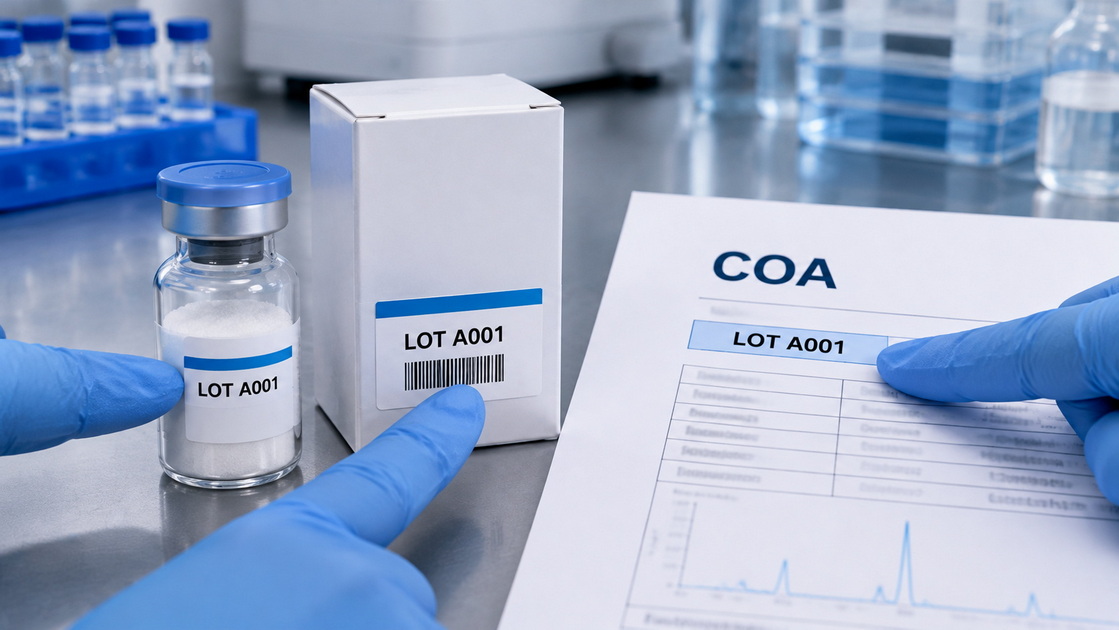
A representative COA helps evaluate a supplier's reporting format. It does not establish the quality of your shipment.
Request the released batch document before using the material. If the supplier repacks a larger batch into smaller vials, ask how the repacked units remain linked to the tested material.
Analytical HPLC separates components under defined conditions. UV detection commonly monitors peptides around 210–220 nm.
Reported purity generally represents the assigned main peak's area relative to the integrated chromatographic signal included in the calculation:
Area purity=Assigned target peak area/Total included peak area×100%
This is not automatically a mass percentage of the entire powder.
Water, counterions, and residual solvents may require separate testing. Different compounds can also produce different detector responses.
Review the complete relevant chromatogram and integration report.
Check whether:
- The target peak is clearly assigned.
- Nearby peaks appear adequately separated.
- Peak shoulders suggest possible unresolved components.
- The reporting range is sufficient.
- The method or method identifier is available.
A visually clean main peak does not prove the absence of co-eluting impurities.
Conversely, a shoulder or extra peak does not establish fraud. It warrants technical clarification.
A 99.2% result from one method is not necessarily superior to a 98.8% result from another.
Column chemistry, gradient, detection wavelength, integration rules, and method sensitivity affect what is resolved and reported.
For critical comparisons, ask whether both lots can be evaluated under the same suitable method.
Mass spectrometry measures mass-to-charge ratios. Proper interpretation can establish that the observed molecular mass is consistent with the intended peptide.
It provides valuable identity evidence, but a mass match does not prove every structural feature.
Some sequence isomers or stereoisomers share molecular mass. Disulfide connectivity may also require additional characterization.
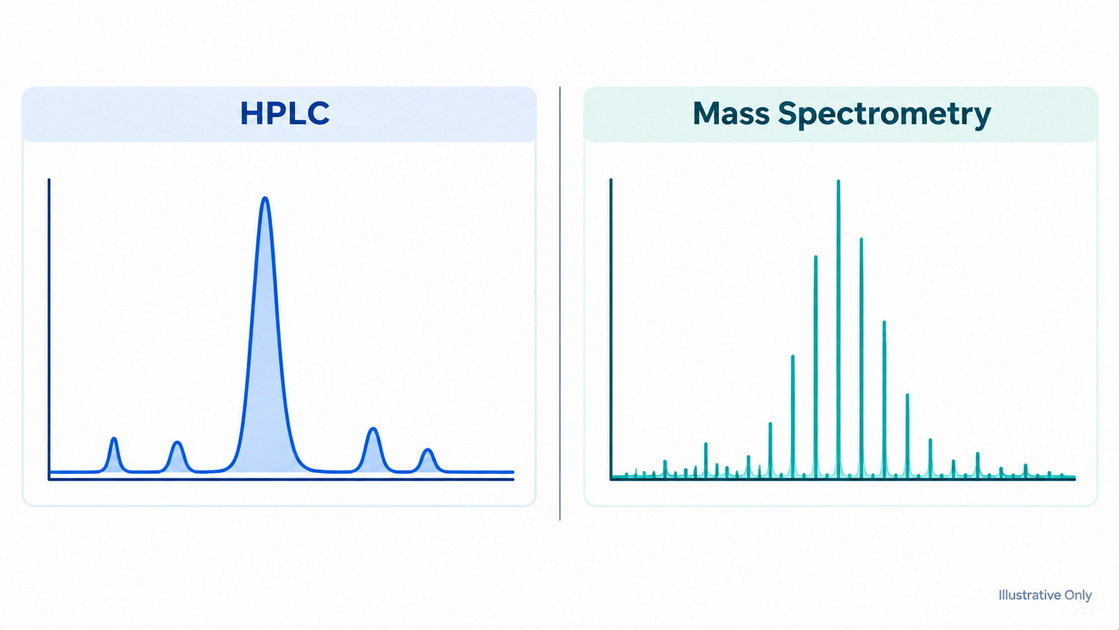
Ask whether the report presents:
- Neutral molecular mass.
- Charged ion signals.
- Monoisotopic or average mass.
- Deconvoluted mass.
Do not compare an ion's mass-to-charge value directly with a neutral molecular weight.
Avoid a universal "within a few daltons" acceptance rule. Appropriate tolerance depends on the instrument, method, mass convention, and analytical purpose.
For demanding projects, additional fragmentation, mapping, or stereochemical analysis may be appropriate.
Purity and content answer different questions.
Chromatographic purity describes the relative signal of the assigned peptide under a method. Peptide content describes how much peptide material is present relative to the gross sample.
Definitions vary. A reported net peptide content can include target peptide and peptide-related impurities, depending on the supplier's method and convention.
Suppose a hypothetical vial contains 10 mg of gross powder, with 80% net peptide content and 99% chromatographic purity.
Under an applicable supplier-defined correction convention:
10×0.80×0.99=7.92 mg
That is an estimated target-peptide amount—not 9.9 mg simply because the HPLC result is 99%.
The calculation assumes the content definition and purity correction are appropriate. HPLC area does not universally translate exactly into mass fraction.
Request the method and calculation guidance before preparing quantitative stocks.
Not every peptide COA needs every possible test. Requirements should reflect the research risk.
| Quality attribute | Main question | When it may matter |
|---|---|---|
| Counterion identity and amount | Which salt components are present? | Concentration correction and sensitive assays |
| Water content | How much moisture contributes to weight? | Quantitative preparation |
| Residual solvents | Which process solvents remain? | Solvent-sensitive experiments |
| Endotoxin | Could contamination confound responses? | Endotoxin-sensitive cell assays |
| Microbiological attributes | What contamination controls are required? | Studies with defined microbial requirements |
| Solubility and stability | Will the material remain usable? | Stock preparation and extended experiments |
A 99% HPLC result does not establish low endotoxin.
For sensitive experiments, agree on a relevant limit, measurement basis, and suitable assay. The final concentration and exposure conditions matter.
Similarly, low endotoxin does not mean sterile, and sterility does not establish chemical identity.
Trifluoroacetate or other counterions can contribute to powder weight and influence experimental conditions.
If salt form matters, specify it before synthesis. Do not infer counterion identity from the HPLC mobile phase.
No universal threshold applies to every research application.
Supplier guidance recognizes different purity requirements for different uses, including quantitative applications below 99%.
A well-characterized 98% lot may be suitable when its impurities do not interfere and its content is appropriately established.
A higher purity specification may be useful when closely related impurities affect activity, small differences must be resolved, or the material serves as a carefully characterized reference.
The relevant question is whether additional purification reduces a meaningful experimental risk.
A batch-specific COA can still leave an important question unanswered: was testing performed on material representative of the final packaged product?
Ask whether the sample came from:
- A purification fraction.
- A pooled intermediate.
- The final lyophilized batch.
- A repacked or relabeled batch.
An earlier-stage result should not automatically be treated as final-product evidence.
For critical orders, agree on sampling and testing responsibility in advance. Additional third-party analysis is most useful when the tested sample is clearly linked to the delivered material.
In-house testing is not inherently invalid. Its usefulness depends on qualified methods, controlled records, appropriate equipment, and transparent reporting.
Independent testing can strengthen verification, but it does not remove sampling or traceability risks.
ISO/IEC 17025 accreditation addresses laboratory competence within a defined scope.
Verify the laboratory through its accreditation body's official directory. Confirm that the relevant analytical activity is covered—not merely that the laboratory holds some form of accreditation.
A logo on a report does not prove that every result was issued within accredited scope.
A release COA does not guarantee unchanged quality after transport, storage, or dissolution.
Request handling guidance appropriate to the sequence, modification, packaging, and intended use.
There is no universal 28-day refrigerated stability period for all peptide solutions. Stability depends on solvent, pH, concentration, temperature, light, and peptide chemistry.
Record receipt and preparation conditions. If a stock changes appearance or performance, investigate rather than relying solely on its original release percentage.
Before approving a peptide for research:
1. Match the product and batch identifiers.
2. Confirm sequence and modifications.
3. Separate specifications from measured results.
4. Review chromatographic evidence.
5. Check mass interpretation and identity criteria.
6. Establish content requirements.
7. Define application-specific contamination limits.
8. Verify the tested sample's production stage.
9. Confirm storage and handling instructions.
10. Document approval and unresolved questions.
Classify missing information as a clarification request first. Reject material when it fails the agreed specification or cannot be adequately qualified—not merely because its certificate uses a different layout.
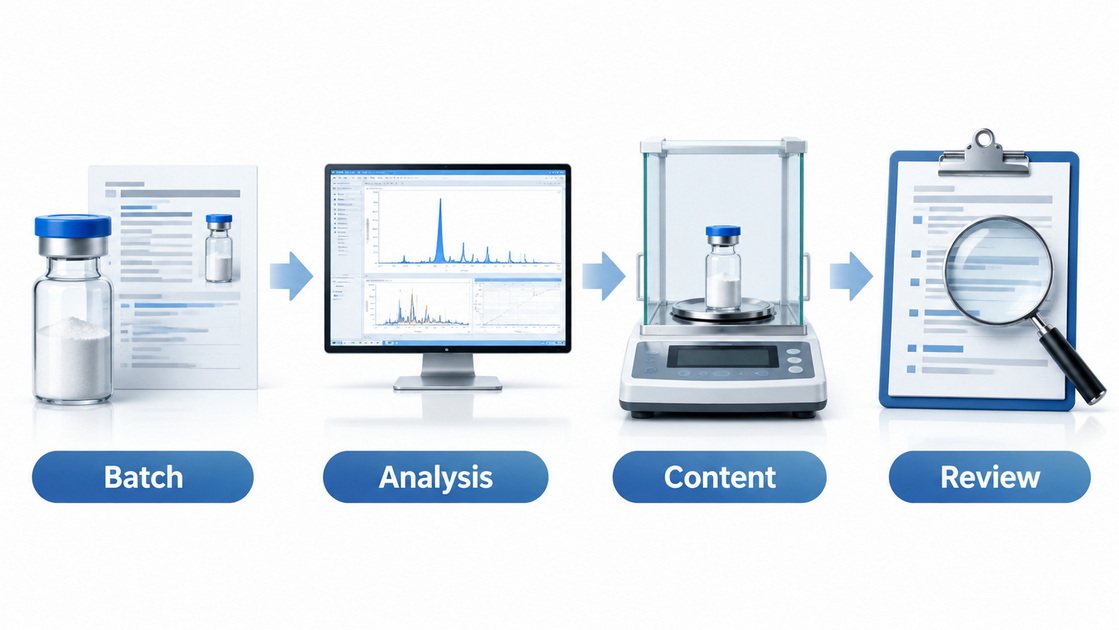
Rchemsell's supplied company background describes peptide synthesis, testing, lyophilized packaging, shipping, and OEM/ODM services for research and cosmetic-industry customers.
Translate its stated 98%–99% purity range into an agreed specification for your sequence.
Provide the intended application, modifications, quantity, salt form, and required documents. Ask which tests are available, how results are reported, and how packaging remains linked to the released batch.
Cosmetic ingredient qualification is a separate process. A research COA alone does not establish suitability for a finished cosmetic product.
A useful peptide COA connects the delivered batch with appropriate analytical evidence.
Review purity, identity, content, and application-specific attributes together. Treat high percentages as results to interpret—not comprehensive guarantees.
No. HPLC purity generally describes integrated detector signal. Gross weight may include water, counterions, and other components.
No. They provide valuable purity and identity evidence, but some applications need content, stereochemical, structural, or contamination testing.
Yes, when its traceability and analytical controls are suitable. Independent verification may be appropriate for higher-risk work.
Request the acceptance criterion and supporting result where needed. Numerical purity should normally be distinguishable from the minimum specification.
No. Review storage history and relevant stability information. Test date alone does not prove continued suitability.
1. [PSPeptides — Peptide Purity: How to Read a COA]
Original article supplied for restructuring. Its universal 99% threshold, vial-weight interpretation, complete-identity claim from mass matching, blanket distrust of in-house testing, and general solution-stability period were not adopted as established facts. No identifiable reader comments appeared in the retrieved content. [pspeptides]
2. [Bachem — Quality Control of Amino Acids and Peptides: A Guide]
Supports the distinction between purity, identity, content, non-peptidic components, and application-dependent quality requirements. [bachem]
3. [Bachem — Frequently Asked Questions]
Supports interpretation of HPLC-UV purity and the need to distinguish it from total sample composition. [bachem]
4. [Bachem — Peptide Purification Process and Methods]
Supports reversed-phase separation, UV monitoring, fraction selection, and subsequent lyophilization. [bachem]
5. [GenScript — AccuPep QC Testing]
Supports separate testing of identity, content, water, counterions, endotoxin, solubility, and stability, including the importance of method-specific content definitions. [genscript]
6. [GenScript — Recommended Peptide Purity]
Supports application-dependent purity selection rather than a universal 99% research threshold. Supplier guidance is not presented as regulatory authorization. [genscript]
7. [European Medicines Agency — Guideline on the Development and Manufacture of Synthetic Peptides]
Scientific guidance informing the discussion of identity, impurity characterization, stereochemistry, analytical control, and stability. Its medicinal-product scope is distinct from routine research-reagent purchasing. [ema.europa]
8. [PubMed — Enantiomeric Purity Analysis of Synthetic Peptide Therapeutics]
Peer-reviewed analytical research supporting the need for dedicated stereochemical analysis when relevant. [pubmed.ncbi.nlm.nih]
9. [ILAC — About ILAC] and [ILAC MRA and Signatories]
Official sources for laboratory accreditation, accredited-facility directories, and verification of competence for specific testing activities. [ilac]


