
Views: 235 Author: Rchemsell Publish Time: 2026-10-20 Origin: Site


Content Menu
● Semax vs Selank: What the Original Comparison Needed to Clarify
>> Semax: An ACTH-Related Synthetic Heptapeptide
>> Selank: A Tuftsin-Related Synthetic Heptapeptide
● Semax vs Selank Comparison Table
● What BDNF Findings Actually Mean
>> The Evidence Includes Rat Brain Experiments
>> Why Model, Tissue, and Timing Matter
● More Than a Simple GABA Explanation
>> Gene Expression Does Not Prove a Direct Receptor Mechanism
>> What the 62-Patient Study Shows
● Is There Direct Human Research Comparing Semax and Selank?
● Semax and Selank Safety: What Buyers Should Not Assume
>> Regulatory Warnings Deserve More Weight Than Retail Reassurance
>> Different Mechanisms Do Not Establish Safe Combination Use
● Purity Is Not Peptide Content
>> What an HPLC Result Can—and Cannot—Tell You
>> Identity Requires Complementary Evidence
● Storage and Stability: Avoid Universal Shelf-Life Claims
● A Practical Procurement Framework for Rchemsell Customers
>> Define the Material Before Requesting a Quote
>> Keep Research and Cosmetic Claims Separate
>> 1. Is Semax Better Than Selank for Focus?
>> 2. Does Selank Work Like a Benzodiazepine?
>> 3. Are Semax and Selank Proven Safe Together?
>> 4. Does 99% Purity Mean a Peptide Is Sterile?
>> 5. Can Research-Grade Semax or Selank Be Used in Cosmetics?
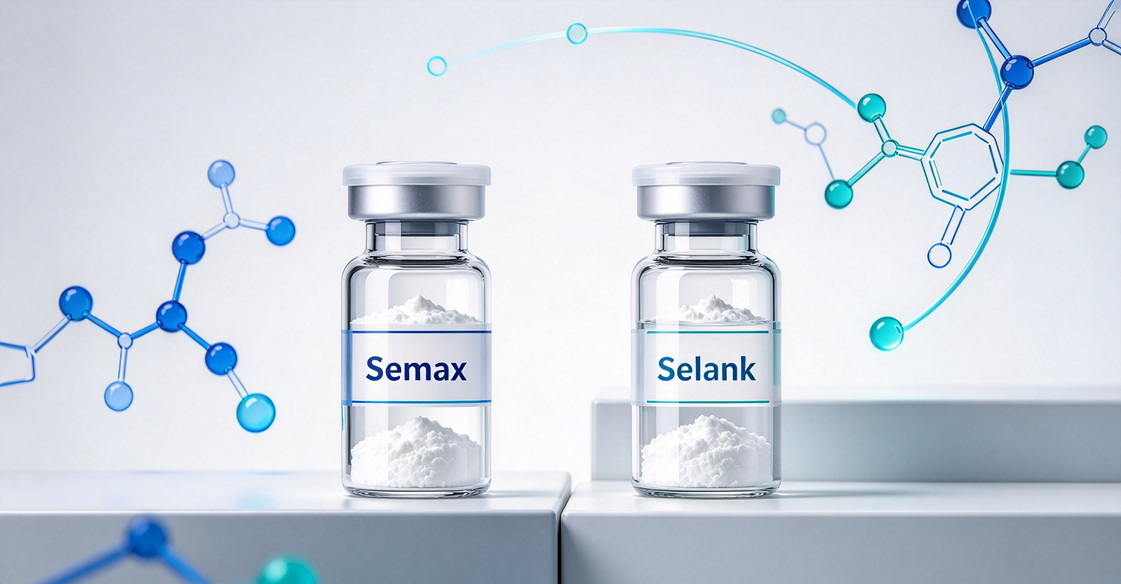
Semax vs Selank is a comparison between two synthetic seven-amino-acid peptides with different origins and overlapping neuroscience research interests. Semax has been investigated in neurotrophic signaling, cognition, and experimental brain-injury models. Selank has been studied in anxiety-related conditions, neurotransmission, and stress-associated responses.
Neither peptide should be presented as a proven, universally safe cognitive enhancer. Their published literature includes laboratory experiments, animal studies, and limited human investigations. These evidence categories answer different questions and should not be treated as interchangeable.
For laboratory buyers, the most useful comparison combines biological context with characterization: confirming the peptide's identity, purity, content, and suitability for the intended experiment.
This guide examines the evidence while explaining what researchers should request from a manufacturer such as Rchemsell before purchasing Semax or Selank research materials.
The source article provides a broad introduction, but several claims require stronger qualification.
First, the distinction "Semax builds neural connections; Selank removes anxiety interference" is a marketing simplification. It does not adequately represent the complexity of their experimental findings.
Second, small studies and animal experiments cannot establish that either peptide reliably improves focus in healthy people.
Third, different proposed mechanisms do not demonstrate that combining the peptides is effective or safe. Claims about an established combination protocol require direct supporting evidence.
Finally, fixed shelf lives, adverse-event percentages, and expected regulatory classifications should not be repeated without product-specific documentation or identifiable authoritative sources.
No separate customer comments were supplied with this assignment. Personal testimonials are therefore not invented or presented as clinical evidence.
Semax has the sequence Met-Glu-His-Phe-Pro-Gly-Pro, commonly abbreviated MEHFPGP.
It contains an ACTH-derived sequence combined with a Pro-Gly-Pro segment. Although publications often describe it as an ACTH(4–10) analog, buyers should specify the actual sequence rather than relying on shorthand descriptions.
Semax research has examined neurotrophic factors, signaling changes, learning-related outcomes, and experimental neurological injury.
These research directions do not establish a general-purpose cognitive benefit across populations.
Selank has the sequence Thr-Lys-Pro-Arg-Pro-Gly-Pro, abbreviated TKPRPGP.
Its sequence combines the tuftsin-related tetrapeptide with Pro-Gly-Pro. Published investigations include anxiety-related outcomes, neurotransmission-associated gene expression, and enkephalin-related mechanisms.
Its biological background differs from Semax, but their investigated effects are not confined to two completely separate pathways.
| Comparison point | Semax | Selank |
|---|---|---|
| Common sequence | MEHFPGP | TKPRPGP |
| Peptide length | Seven amino acids | Seven amino acids |
| Structural background | ACTH-related analog | Tuftsin-related analog |
| Frequently studied areas | Neurotrophic signaling, cognition-related models, experimental brain injury | Anxiety-related outcomes, neurotransmission, stress-related responses |
| Representative laboratory evidence | BDNF-associated findings in rat brain studies | Neurotransmission-related gene-expression findings in rats |
| Human research discussed here | Small functional-connectivity investigation | Small clinical comparison and functional-connectivity investigation |
| Main interpretation limit | Experimental signals do not establish broad human cognitive benefits | Limited findings do not establish universal anxiolytic efficacy or long-term safety |
| Procurement priority | Confirm sequence, identity, impurities, content, and stability | Confirm sequence, identity, impurities, content, and stability |
This table describes research emphasis, not a ranking of clinical effectiveness.
Brain-derived neurotrophic factor, or BDNF, helps regulate neuronal survival and synaptic function. It is relevant to neuroscience research, but a change in BDNF is not automatically equivalent to a clinically meaningful improvement in memory.
A 2006 study investigated Semax-associated changes in BDNF and TrkB expression in the rat hippocampus.
Another 2006 investigation reported increased BDNF protein in rat basal forebrain and examined specific Semax binding.
These findings support further investigation of neurotrophic signaling. They do not establish that a commercial research vial will produce a predictable improvement in human attention.
A biological response may depend on:
- The experimental species.
- The brain region examined.
- The timing of measurement.
- The analytical endpoint.
- The experimental condition.
- The peptide's formulation and quality.
For this reason, statements such as "Semax increases brain BDNF by a fixed percentage" can be misleading without identifying the particular experiment.
My recommendation is to read the original study's methods before adopting a headline number as a research expectation.
Gamma-aminobutyric acid, or GABA, is an important inhibitory neurotransmitter. Selank has been investigated in relation to GABAergic signaling, but describing it as a fully established, precisely targeted GABA treatment overstates the available evidence.
A 2016 rat study examined 84 genes involved in neurotransmission after Selank or GABA exposure.
The investigators reported time-dependent changes in gene expression. The panel included genes associated with receptors, transporters, and other signaling components.
These observations are biologically informative. However, gene-expression changes alone do not establish a direct receptor-binding mechanism or predict clinical effectiveness.
A 2008 study compared Selank in 30 patients with medazepam in 32 patients with generalized anxiety disorder or neurasthenia.
The abstract reported similar anxiolytic effects and additional findings relating to asthenia and psychostimulation.
This is human evidence, but it remains one relatively small investigation in specified clinical populations. It cannot establish equivalent outcomes in healthy users, all anxiety disorders, or long-term use.
The abstract also does not justify universal claims that sedation, dependence, or withdrawal are impossible.
Yes. It would be inaccurate to claim that no study has examined both peptides within the same human investigation.
A 2020 study assessed resting-state functional connectivity in 52 healthy participants receiving Semax, Selank, or placebo.
The investigators examined regions including the amygdala and dorsolateral prefrontal cortex and reported shared and distinct connectivity findings.
However, this was not a definitive trial establishing which peptide improves everyday focus or treats anxiety more effectively.
The distinction matters:
- A brain-imaging change is a mechanistic observation.
- A validated clinical improvement is a different outcome.
- Durable effectiveness requires appropriate follow-up.
- Comparative safety requires adequate exposure and monitoring.
A small imaging study cannot answer all four questions.

The absence of a reported adverse event is not proof that the event cannot occur.
Limited participant numbers, short observation periods, and incomplete reporting can all restrict what a study reveals about safety.
The U.S. Food and Drug Administration has identified potential safety concerns involving compounded Semax and Selank acetate.
Its published discussion highlights possible immunogenicity associated with aggregation and peptide-related impurities for certain administration routes. It also identifies insufficient human safety information.
These warnings do not mean every research experiment is inappropriate. They do mean that reassuring phrases such as "no dependency risk" or "minimal side effects" require much stronger qualification.
A compounding nomination, evaluation, or advisory discussion is also not equivalent to drug approval.
A proposed Semax–Selank combination should not be described as proven simply because the peptides have different research backgrounds.
Biological pathways interact. A plausible hypothesis about complementary effects is not direct evidence of clinical benefit or compatibility.
This article therefore does not provide self-administration instructions, dosing schedules, or combination recommendations.
For research buyers, this distinction can matter as much as the biological comparison.
A high chromatographic purity result does not necessarily mean that the same percentage of the vial's total mass is the target peptide.
High-performance liquid chromatography can characterize a sample's chromatographic profile under specified conditions.
A reported area percentage depends on the method, detector, integration, and substances detected. It is not automatically a complete mass balance.
A lyophilized material may also contain water, counterions, or other components that require separate assessment.
Consequently, two products advertised at the same purity may deliver different peptide content per unit mass.
A useful supplier review should ask:
1. Does the sequence match the purchase specification?
2. Does mass spectrometry support the expected identity?
3. Is the chromatogram available?
4. How is purity calculated?
5. Is peptide content measured separately?
6. What counterion and moisture information is supplied?
No single percentage answers every quality question. Agree on the analytical package before ordering.
Statements such as "all reconstituted peptides remain stable for 30 days" should not be accepted without supporting data.
Stability depends on the particular material, formulation, container, environmental exposure, and definition of acceptable change.
Researchers should distinguish among:
- Chemical integrity.
- Aggregation.
- Physical appearance.
- Assay performance.
- Microbiological quality, where relevant.
A clear-looking solution is not proof that the peptide remains unchanged.
Request storage instructions linked to the supplied product and ask whether they are supported by stability data. Do not assume that freeze-drying guarantees sterility or a particular shelf life.
For solution-based experiments, establish handling conditions within an appropriate laboratory protocol rather than copying an administration-oriented recipe.
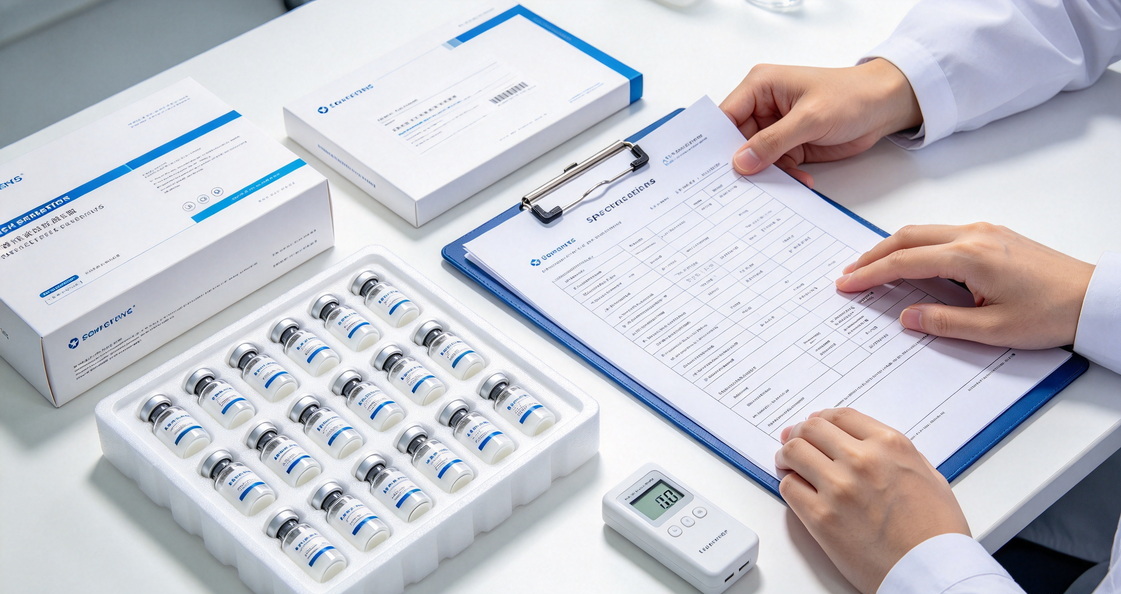
Rchemsell describes its business as supporting peptide synthesis, testing, lyophilized packaging, shipping, OEM, ODM, and custom synthesis, with stated purity targets of 98%–99%.
These are company-provided capabilities, not independently audited findings in this article.
A research inquiry should specify:
- Exact amino-acid sequence.
- Terminal modifications, if any.
- Salt or counterion requirements.
- Quantity and packaging format.
- Purity and content requirements.
- Required analytical methods.
- Intended laboratory application.
- Documentation and shipping requirements.
Modified derivatives should not automatically be treated as interchangeable with the original peptides used in published studies.
Serving cosmetic-industry customers does not establish that every peptide is suitable or legally permitted as a cosmetic ingredient.
For any proposed cosmetic application, assess ingredient status, intended function, safety substantiation, and destination-market requirements separately.
For Semax and Selank, neuroscience findings should not be repurposed as evidence of skincare efficacy.
Semax and Selank differ in sequence, structural background, and research emphasis. Neither is adequately described by a simple "focus versus calm" slogan.
A stronger decision combines careful literature interpretation with documented material quality.
Available evidence does not establish a universal winner for improving focus in healthy people. The peptides have different research histories, but small studies and mechanistic observations are insufficient for that broad conclusion.
Selank has been compared with medazepam and studied in relation to GABAergic signaling. That does not establish identical receptor pharmacology, equivalent clinical performance, or freedom from all benzodiazepine-associated risks.
The evidence reviewed here does not establish comprehensive combination safety or clinical benefit. Different proposed mechanisms are not a substitute for direct combination studies.
No. Chromatographic purity, sterility, endotoxin testing, and peptide content address different attributes. A research-grade purity claim does not establish suitability for administration.
Research-grade designation does not establish cosmetic suitability. Ingredient status, formulation compatibility, safety assessment, intended claims, and destination-market rules require separate evaluation.
1. [PSPeptides Research Team — "Semax vs Selank: Best Proven Nootropic Guide 2026," April 13, 2026]. Original article reviewed for topic coverage and claims requiring qualification; not treated as independent clinical substantiation. [pspeptides]
2. [Dolotov and colleagues — "Semax, an Analog of ACTH(4–10) With Cognitive Effects, Regulates BDNF and TrkB Expression in the Rat Hippocampus." Brain Research, 2006]. Preclinical investigation of hippocampal neurotrophic signaling. [sciencedirect]
3. ["Semax, an Analogue of Adrenocorticotropin (4–10), Binds Specifically and Increases Levels of Brain-Derived Neurotrophic Factor Protein in Rat Basal Forebrain." Journal of Neurochemistry, 2006; 97:82–86]. Rat-brain binding and BDNF investigation. [onlinelibrary.wiley]
4. ["Selank Administration Affects the Expression of Some Genes Involved in GABAergic Neurotransmission." Frontiers in Pharmacology, 2016; 7:31]. Rat frontal-cortex study examining a panel of 84 neurotransmission-related genes. [pmc.ncbi.nlm.nih]
5. [Zozulia and colleagues — "Efficacy and Possible Mechanisms of Action of a New Peptide Anxiolytic Selank in the Therapy of Generalized Anxiety Disorders and Neurasthenia." 2008; 108(4):38–48]. Comparative study involving 62 patients; PubMed identifies it as a randomized controlled trial. [pubmed.ncbi.nlm.nih]
6. [Panikratova and colleagues — "Functional Connectomic Approach to Studying Selank and Semax Effects." Doklady Biological Sciences, 2020; 490(1):9–11]. Functional-connectivity investigation involving 52 healthy participants. [pubmed.ncbi.nlm.nih]
7. ["Semax and Selank Inhibit the Enkephalin-Degrading Enzymes From Human Serum." PubMed record]. Laboratory evidence identifying both peptide sequences and examining enkephalin-degrading enzymes. [pubmed.ncbi.nlm.nih]
8. [U.S. Food and Drug Administration — "Certain Bulk Drug Substances for Use in Compounding That May Present Significant Safety Risks," content current April 22, 2026]. Official discussion of Semax and Selank acetate, including immunogenicity concerns and gaps in human safety information. [fda]


