
Views: 261 Author: Rchemsell Publish Time: 2026-09-02 Origin: Site


Content Menu
● How Subcutaneous Peptide Delivery Works
>> Potential Research Advantages of SubQ Delivery
>> Variables That Can Alter SubQ Results
● How Intramuscular Peptide Delivery Works
>> Potential Research Advantages of IM Delivery
>> IM Delivery Requires More Control
● Pharmacokinetics: Focus on Exposure Profiles, Not Simplified Claims
>> The PK Parameters That Matter
>> A Practical Research Example
● Injection Site Is a Hidden PK Variable
● Quality Control Before Route Selection
>> What Professional Buyers Should Request
>> Why Purity Is Not the Whole Story
● Safe Practice and Regulatory Boundaries
>> Research-Use Positioning for Peptide Suppliers
● How to Choose a Route for a Study
● Partner With Rchemsell for Custom Peptide Development
>> 1. What is the main difference between subcutaneous and intramuscular peptide injection?
>> 2. Is intramuscular peptide delivery always faster than subcutaneous delivery?
>> 3. Does the subcutaneous injection site affect peptide pharmacokinetics?
>> 4. What documents should I request when buying research peptides?
>> 5. Is 99% peptide purity sufficient for every project?
When researchers compare subcutaneous vs intramuscular peptide injection, they are not simply choosing between two anatomical locations. They are selecting a delivery route that can influence absorption speed, exposure profile, local tolerability, and the reproducibility of an experimental protocol.
Subcutaneous, or SubQ/SC, administration places a peptide formulation into the fatty tissue beneath the skin. Intramuscular, or IM, administration places it into skeletal muscle. Because muscle is generally more vascular than subcutaneous tissue, IM delivery can produce a more rapid systemic appearance for some compounds. However, the real-world pharmacokinetic outcome depends on the specific peptide, formulation, concentration, injection site, local blood flow, lymphatic uptake, study population, and handling conditions.
For laboratories, cosmetic R&D teams, and peptide-development partners, the most important principle is simple: the administration route should follow the study protocol and the available primary evidence for the specific molecule being evaluated.
Rchemsell supports research and cosmetic-industry customers with peptide synthesis, analytical testing, lyophilization, packaging, and global logistics. For custom peptide programs, route-of-administration considerations should be discussed early because they affect formulation targets, concentration planning, stability requirements, and the analytical documentation needed for reliable downstream research.
Important notice: This article is for laboratory, formulation-development, and scientific education purposes. It is not medical advice, dosing guidance, or a recommendation for self-administration. Any clinical or human-use protocol must be designed and supervised by appropriately qualified healthcare and research professionals.
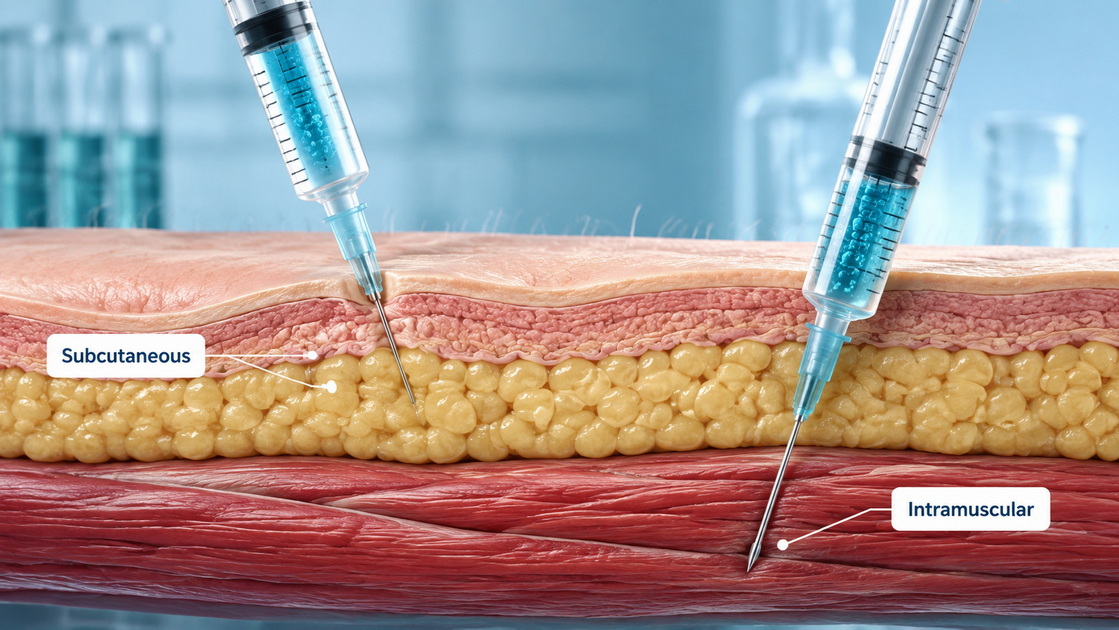
| Factor | Subcutaneous Injection | Intramuscular Injection |
|---|---|---|
| Target tissue | Fatty tissue below the skin | Skeletal muscle |
| Typical absorption pattern | Often slower and more gradual | Often faster because of muscle vascularity |
| Main research value | Sustained or less abrupt exposure profiles | Faster systemic exposure or local muscle-focused studies |
| Injection-site sensitivity | Can vary by abdomen, thigh, or upper arm | Can vary by muscle choice, needle depth, body composition, and activity |
| Technical complexity | Generally less complex in clinical practice | Requires accurate anatomical landmarking and trained administration |
| Key reproducibility concern | Site-related differences in local blood/lymph flow and tissue physiology | Achieving true IM placement and avoiding neurovascular structures |
| Quality-system implication | Requires controlled concentration, sterility, and stability | Requires the same controls plus heightened attention to trained procedure and site consistency |
The table is deliberately high level. A peptide cannot be assigned to SubQ or IM solely because another peptide behaves well by that route. Molecule-specific evidence always comes first.
Subcutaneous administration deposits a formulation into the tissue layer between the dermis and underlying muscle. From there, absorption may occur through local capillaries and, for larger biologic molecules, through lymphatic pathways. The resulting absorption profile is influenced by formulation properties and the physiology of the chosen site.
For peptide and small-protein products, the injection site can matter more than many protocols assume. A review of clinical pharmacokinetic data found that 9 of 18 evaluated peptides or small proteins showed injection-site-dependent pharmacokinetics after subcutaneous administration. Molecules with rapid absorption, faster elimination, or lower plasma protein binding appeared more susceptible to site-related differences.
- Potentially smoother exposure: A subcutaneous depot may support a less abrupt absorption profile than IM delivery for some formulations.
- Protocol practicality: SC administration is frequently used for approved peptide and protein therapeutics, so there is substantial clinical-development experience with this route.
- Useful for repeated-dose studies: When an investigational design requires consistent timing and repeated administration, a carefully standardized SubQ protocol may be operationally practical.
- Formulation flexibility: Lyophilized peptide products can be designed for reconstitution studies where concentration, excipient compatibility, and solution stability are controlled before evaluation.
A reliable SubQ protocol should record more than the route itself. Researchers should document:
1. Exact administration site such as abdomen, thigh, or upper arm.
2. Site rotation plan and whether the same site is used throughout the study.
3. Reconstitution solvent, concentration, and final injection volume.
4. Time between reconstitution and administration.
5. Storage temperature and light exposure after reconstitution.
6. Subject or model characteristics that may affect local tissue thickness and circulation.
7. Any local reaction or visible formulation change.
This level of documentation is essential because a site change may become a hidden study variable. If researchers change both the injection site and the formulation concentration at once, they may not be able to determine which factor caused a difference in exposure or outcome.
Intramuscular delivery places a formulation in the depth of a selected muscle. Muscle tissue is generally well supplied with blood, which is why IM administration can support faster absorption for many injectable medicines compared with subcutaneous administration.
However, IM delivery is not simply "faster SubQ." It introduces distinct procedural and anatomical risks. Needle length, injection angle, body composition, muscle selection, and landmark accuracy can determine whether a dose actually reaches muscle tissue. If an intended IM injection remains in the subcutaneous layer, the resulting pharmacokinetic profile may differ substantially from the planned protocol.
The NIH's StatPearls review notes that the vascularity of larger muscles can enable drugs to reach systemic circulation quickly. It also emphasizes that appropriate landmarks, trained personnel, aseptic precautions, and correct needle selection are central to reducing complications.
- Faster initial absorption potential: IM administration may be appropriate when a study needs to characterize a more rapid early exposure phase.
- Higher-volume feasibility in clinical contexts: Muscle may accommodate a larger injection volume than subcutaneous tissue, although permissible volume must be determined by the approved or study-specific protocol.
- Local tissue research applications: IM administration may be evaluated when a study specifically investigates local muscle exposure, tissue response, or depot behavior.
- Useful comparator route: A route-comparison study can help developers understand whether pharmacodynamic outcomes track with differences in rate of absorption.
For research teams, true IM placement should not be assumed. The literature notes that body composition, injection site, needle length, and operator technique all influence whether a planned injection reaches muscle.
That makes IM protocols especially dependent on:
- Qualified personnel.
- Validated anatomical landmarking.
- Site-specific training records.
- Consistent procedural timing.
- Documentation of local adverse observations.
- Clear exclusion criteria for individuals or models with contraindications relevant to the protocol.
A common oversimplification is that SC is always "slow" and IM is always "fast." The direction of the difference may be biologically plausible, but the size and relevance of that difference cannot be generalized across every peptide.
A better scientific question is:
How does route selection change Cmax, Tmax, AUC, variability, and local tolerance for this exact peptide formulation under this exact protocol?
| PK Parameter | Why It Matters in Peptide Research |
|---|---|
| Cmax | The maximum observed concentration; useful when peak exposure may affect response or tolerability |
| Tmax | The time to peak concentration; helps characterize onset and absorption speed |
| AUC | Total systemic exposure over time; useful for comparing relative bioavailability |
| Half-life | Helps determine the duration of measurable systemic exposure |
| Inter-subject variability | Shows whether a route or site produces consistent results across the study population |
| Local tolerability | Captures redness, discomfort, induration, irritation, or other site observations |
For a development program, route selection should therefore be supported by a comparative PK plan rather than general internet claims. A well-designed exploratory study may compare SC and IM routes while holding peptide identity, lot, concentration, reconstitution method, assay method, storage conditions, and sampling schedule constant.

Imagine a cosmetic-peptide development team evaluating an experimental peptide for systemic exposure profiling. The team tests the same well-characterized peptide lot in two controlled arms:
- Arm A uses a defined SC site and standardized reconstitution.
- Arm B uses a validated IM site and trained clinical personnel.
- Both arms use the same analytical assay, sample collection windows, and stability criteria.
The value of this design is not to prove that one route is universally better. Its value is to identify whether the specific formulation produces different Cmax, Tmax, AUC, variability, or local tolerability under controlled conditions.
Route selection alone is not enough. Injection site selection can change pharmacokinetic outcomes even within the same route.
The FDA-affiliated review of clinical PK evidence found that site-related differences were present for a meaningful proportion of SC peptides and small proteins. The mechanisms may include differences in local blood flow, lymphatic flow, pre-systemic catabolism, and tissue physiology.

For peptide research, the injection route is only one variable. Product identity, purity, integrity, sterility strategy, and stability data are equally important. A route-comparison experiment cannot produce reliable conclusions if the peptide material changes between lots or degrades during handling.
When sourcing peptides for laboratory research or cosmetic R&D, ask suppliers for documentation that supports lot-level traceability:
- Certificate of Analysis (COA) with peptide identity, purity, lot number, and test methods.
- HPLC chromatogram to document chromatographic purity.
- LC-MS or mass-spectrometry data to support molecular identity.
- Peptide content and water-content information where relevant to the intended study.
- Residual solvent and impurity specifications appropriate to the material and application.
- Lyophilization and packaging specifications that protect material during storage and transport.
- Stability guidance based on the supplier's available data and product format.
- Chain-of-custody and shipping records for temperature-sensitive materials where applicable.
Rchemsell provides one-stop peptide development and supply support, including custom peptide synthesis, analytical testing, lyophilized packaging, and logistics coordination. With reported purity targets of 98%–99%, the company can support OEM, ODM, and custom peptide programs; however, buyers should still define acceptance specifications based on the intended application rather than relying on purity as the only quality indicator.
A "99% purity" result does not by itself answer every critical question. Buyers should also consider:
- Is the correct molecular species present?
- Are known impurities identified and controlled?
- Is the material stable through the planned storage and shipping conditions?
- Does the test method match the product specification?
- Is the batch documentation traceable to the exact container received?
- Does the intended application require additional microbiological, endotoxin, or formulation testing?
For cosmetic formulations, researchers should further assess compatibility with the final vehicle, pH, preservatives, fragrance systems, emulsifiers, and packaging materials. A peptide that appears stable as a lyophilized powder may behave differently after it is incorporated into a finished topical, ampoule, serum, or other cosmetic prototype.
Safe injection practice is not optional. The CDC's core rule is clear: "One Needle, One Syringe, Only One Time." It recommends aseptic technique, a new sterile syringe and needle for each patient, proper vial handling, and disposal of used equipment after use.
For IM administration in particular, the potential complications include persistent pain, abscess, vascular injury, and nerve injury when anatomical landmarks or technique are inadequate.
This is why manufacturers, research suppliers, and marketers should avoid publishing consumer-style "how to inject" instructions for unapproved or research-only peptides. Instead, responsible educational content should direct clinical procedures to qualified professionals and approved protocols.
For a supplier serving laboratories and cosmetic-industry customers, an appropriate message is:
- Rchemsell supplies materials for research, analytical development, and cosmetic formulation applications according to the agreed product specifications.
- Custom peptide projects require a clear brief covering sequence, purity, modification, scale, packaging, and analytical requirements.
- Any human administration, clinical investigation, therapeutic claim, or medical use must comply with applicable laws, ethical review requirements, and professional supervision.
This positioning is more credible than implying that laboratory-grade peptides are interchangeable with approved medicines or clinically validated formulations.
Use the following evidence-led decision process.
1. Start with the primary literature. Identify the route used in peer-reviewed studies for the exact peptide, analog, formulation, and intended model.
2. Define the research question. Are you studying systemic exposure, local tissue response, formulation performance, cosmetic compatibility, or comparative PK?
3. Set measurable endpoints. Specify Cmax, Tmax, AUC, local tolerability, biomarker response, or other predefined outcomes.
4. Control the material. Use a documented lot with verified identity and purity, then retain reference samples where appropriate.
5. Standardize handling. Record reconstitution conditions, dilution, storage duration, temperature, and container type.
6. Standardize the procedure. Keep route, site, personnel training, timing, and sampling schedule consistent.
7. Analyze variability, not only averages. A route with a favorable mean result may still be unsuitable if it creates excessive subject-to-subject variability.
8. Document limitations. Do not claim clinical superiority unless the study design, ethics approval, and evidence genuinely support it.

Selecting between subcutaneous vs intramuscular peptide injection is ultimately a formulation and study-design decision—not a generic rule. Strong peptide research begins with a clearly defined protocol and a supplier able to deliver consistent, well-documented material.
Rchemsell supports global laboratories and cosmetic innovators with:
- Custom peptide synthesis and sequence modification.
- High-purity peptide production, typically targeted at 98%–99% according to project requirements.
- Analytical support, including identity and purity testing.
- Lyophilized powder preparation and packaging options.
- OEM, ODM, and private-label project coordination.
- Export-oriented packaging and logistics support for global customers.
Subcutaneous administration places a formulation into fatty tissue beneath the skin, while intramuscular administration places it into skeletal muscle. The difference can affect absorption rate, exposure profile, local tolerability, and procedural complexity. The actual effect must be confirmed for the specific peptide and formulation being studied.
Not always in a predictable or clinically meaningful way. Muscle's vascularity can support faster absorption for many injectable products, but the outcome depends on the molecule, formulation, dose volume, site, tissue characteristics, and study design. Route comparisons should be confirmed with molecule-specific PK data.
Yes. A review of clinical pharmacokinetic data found that injection-site-dependent PK differences occurred in 50% of the evaluated peptides and small proteins included in the analysis. Researchers should standardize and document the site when exposure reproducibility is important.
Request a lot-specific COA, HPLC purity data, LC-MS identity data, specifications, packaging details, storage guidance, and traceability records. Depending on the project, you may also need residual solvent, moisture, stability, microbiological, or endotoxin-related documentation.
No. Purity is important, but it is not the only quality criterion. Buyers also need confirmation of identity, impurity profile, stability, lot consistency, suitable packaging, and compatibility with the intended research or cosmetic formulation.
1. Zou P, Wang F, Wang J, et al. "Impact of Injection Sites on Clinical Pharmacokinetics of Subcutaneously Administered Peptides and Proteins." "Journal of Controlled Release", 2021. Review of clinical PK data for SC peptides, small proteins, and biologics, including site-dependent variability. [Read the PubMed record]. [pubmed.ncbi.nlm.nih]
2. Centers for Disease Control and Prevention (CDC). "Preventing Unsafe Injection Practices." Guidance on aseptic technique, single-use needles and syringes, vial safety, and disposal. [Read CDC injection-safety guidance]. [cdc]
3. Gutierrez JJP, Munakomi S. "Intramuscular Injection." "StatPearls, NCBI Bookshelf", updated 2023. Covers IM anatomy, procedural considerations, vascularity, landmarks, risks, and complications. [Read the NCBI Bookshelf chapter]. [ncbi.nlm.nih]
4. World Health Organization (WHO). "Injection Safety." WHO overview of injection-safety principles and safer syringe practices for intramuscular, intradermal, and subcutaneous injections. [Read WHO injection-safety information]. [who]
5. World Health Organization (WHO). "WHO Guideline on the Use of Safety-Engineered Syringes for Intramuscular, Intradermal and Subcutaneous Injections in Health Care Settings." Guidance addressing prevention of injection-related harm and infection risk. [Read the WHO guideline]. [who]
6. PSPeptides Research Team. "Subcutaneous vs Intramuscular Peptide Injection." Original page reviewed during the content gap analysis; used as the starting point for restructuring, safety-boundary clarification, and evidence strengthening. [Read the original article]. [pspeptides]


