
Views: 222 Author: Rchemsell Publish Time: 2026-10-18 Origin: Site


Content Menu
● What Makes a Reliable Peptide Sciences Alternative?
>> Do Not Choose by Manufacturing Location Alone
● Why 98%–99% Is Only Part of the Picture
>> Purity and Peptide Content Are Different
>> Identity Requires Separate Evidence
● How to Review a Peptide Certificate of Analysis
>> In-House Testing Versus Independent Testing
● Research Peptides and Cosmetic Peptides Need Different Specifications
>> Laboratory Research Priorities
>> Cosmetic Development Priorities
● A Five-Step Workflow for Switching Peptide Suppliers
>> 1. Record Your Existing Material Specification
>> 2. Compare Documents Before Samples
>> 3. Order a Qualification Quantity
>> 4. Run a Controlled Comparison
● Storage and Shipping: Avoid Universal Rules
● Why Consider Rchemsell for Custom Peptide Sourcing?
>> Custom Synthesis, OEM, and ODM: Clarify the Scope
● Compare Total Project Cost, Not Just Price per Vial
● Turn Customer Feedback Into Verifiable Questions
● Start Your Peptide Project With a Clear Technical Brief
>> 1. What should I prioritize when choosing a Peptide Sciences alternative?
>> 2. Is 99% purity always better than 98% purity?
>> 3. Does a COA prove that a peptide is sterile?
>> 4. Can research peptide powder be used directly in cosmetics?
>> 5. Does Rchemsell provide custom peptide synthesis and private-label services?
Finding a reliable Peptide Sciences alternative requires more than comparing catalogs and advertised purity. For laboratory researchers and cosmetic development teams, the real challenge is choosing a supplier that can deliver the correct material, meaningful documentation, and consistent support as projects evolve.
My recommendation is to start with the application, not the supplier's headline claims. A peptide suitable for an exploratory assay may require different specifications from an ingredient intended for cosmetic formulation development.
This guide explains how to evaluate research peptide suppliers, qualify replacement materials, and assess custom manufacturing options. It also introduces Rchemsell's stated capabilities while distinguishing company information from independently established technical principles.

A dependable alternative should reduce uncertainty across three areas: material identity, application suitability, and supply continuity.
A familiar product name does not establish equivalence. Neither does a higher purity percentage automatically make one supplier better for every project.
Before comparing prices, define:
- The exact peptide sequence and terminal modifications.
- Required quantity and acceptable purity.
- Salt form, counterion, and content requirements.
- Intended laboratory or cosmetic application.
- Required documentation and additional testing.
- Packaging, delivery destination, and storage conditions.
This specification becomes the basis for an objective comparison. Without it, buyers can mistake products with different compositions or documentation levels for interchangeable materials.
Domestic and international suppliers can both provide useful materials. Manufacturing location affects logistics and communication, but it does not independently demonstrate product quality.
Ask who performs synthesis, purification, testing, and packaging. Determine whether these activities occur within one organization or involve subcontractors.
A transparent Chinese peptide manufacturer with suitable documentation may fit a project better than a local reseller with limited technical visibility. The reverse can also be true.
Purity matters, but it must be interpreted correctly.
Analytical high-performance liquid chromatography, or HPLC, commonly estimates peptide purity from the relative areas of detected peaks. Results depend on the method, separation conditions, detection wavelength, and integration approach.
A reported result therefore describes performance under a particular analytical method. It does not answer every question about the powder inside a vial.
Peptide content describes the proportion of peptide material relative to non-peptide components such as moisture and counterions. Chromatographic purity describes the target peptide relative to detected impurities under the method used.
Consequently, a vial labeled "99% purity" should not automatically be treated as containing 99% target peptide by total powder weight.
For quantitative work, request the relevant content or assay information. Where concentration accuracy matters, establish the calculation basis before preparing solutions.
Mass spectrometry can support molecular identity by comparing observed and expected mass. It complements chromatographic analysis rather than replacing it.
Neither a matching mass nor a clean chromatogram alone proves every structural feature. More demanding projects may require additional characterization.
Also distinguish chemical purity from sterility, endotoxin status, and biological activity. These are separate attributes requiring appropriate evidence.

Treat a certificate of analysis, or COA, as a batch record—not a marketing badge.
The most useful document connects the supplied material to identifiable tests and acceptance criteria.
| Review item | What to check | Why it matters |
|---|---|---|
| Product identity | Name, sequence, modifications, and salt form | Prevents specification mismatches |
| Batch identification | Lot number matching the supplied label | Establishes traceability |
| Purity result | Method, result, and acceptance criterion | Makes the percentage interpretable |
| Identity testing | Expected and observed molecular mass | Supports identity assessment |
| Content information | Measurement basis, where required | Supports concentration calculations |
| Dates and handling | Test date and applicable storage guidance | Supports receipt and inventory decisions |
Request supporting chromatograms or spectra when the project requires them. Check whether documents describe the actual available batch rather than a representative historical sample.
Independent testing can add confidence, particularly during supplier qualification. However, "third-party tested" is not a substitute for examining methods, sample identity, laboratory competence, and traceability.
Equally, in-house testing should not be dismissed automatically. Evaluate whether the supplier can explain its methods and substantiate its results.
Where external testing is necessary, agree on the laboratory, sampling procedure, and acceptance criteria before ordering.
A useful supplier understands the intended application instead of offering the same specification to every customer.
Research teams should prioritize sequence accuracy, reproducibility, relevant analytical evidence, and compatibility with the experimental system.
Depending on the assay, additional considerations may include:
- Solubility and aggregation behavior.
- Residual counterions or solvents.
- Endotoxin limits.
- Adsorption to containers.
- Stability in the working buffer.
Not every project needs every test. Select requirements according to the experiment's sensitivity and likely sources of interference.
Research-grade materials should not be presented as approved medicines or ready-to-use products for human administration.
Cosmetic formulators need more than a high-purity ingredient. They must evaluate performance within the complete formulation.
Relevant questions include compatibility with pH, preservatives, packaging, and other ingredients. Appearance, odor, solubility, and stability can also affect development decisions.
A supplier's raw-material documentation does not establish the safety or effectiveness of a finished serum or cream.
For products marketed in the United States, responsible persons must maintain adequate safety substantiation. Claims also matter: certain therapeutic claims can cause a product marketed as a cosmetic to qualify as a drug.
Changing suppliers is a material change worth documenting. A staged transition helps separate supplier differences from experimental variability.
Capture the sequence, modifications, counterion, purity, content basis, packaging, and handling conditions.
Include known limitations. An incomplete historical specification should not become an unquestioned benchmark.
Request documentation for the proposed replacement batch. Resolve discrepancies in sequence notation, molecular weight, salt form, and quantity definition before purchasing.
This prevents avoidable testing of a material that never matched the requirement.
Begin with enough material for identity checks and application testing rather than immediately replacing the entire inventory.
Inspect labels, seals, packaging condition, and document consistency upon receipt.
Where practical, compare old and new materials using the same protocol, controls, equipment, and concentration basis.
For cosmetic development, assess the ingredient in the intended formulation rather than relying solely on its behavior in water.
Record acceptance criteria and the qualification outcome. Continue monitoring subsequent batches rather than assuming one successful sample guarantees permanent consistency.
Define how deviations, replacements, and future specification changes will be handled.
Peptide stability depends on sequence, modifications, formulation, moisture, temperature, and exposure conditions.
There is no universal solvent, refrigeration period, or shelf life suitable for every peptide.
Lyophilization can improve handling and storage practicality, but it does not establish indefinite stability. Likewise, a short ambient shipment is not automatically evidence of degradation.
Ask for product-specific recommendations and the basis for any stability claim.
Useful handling principles include:
- Follow the supplied storage instructions.
- Protect moisture-sensitive materials during handling.
- Allow sealed cold containers to equilibrate appropriately before opening.
- Minimize unnecessary exposure to heat and light.
- Use aliquots where appropriate to reduce repeated freeze–thaw cycles.
For international orders, clarify packaging, transit expectations, customs responsibilities, and procedures for delayed or damaged shipments before dispatch.
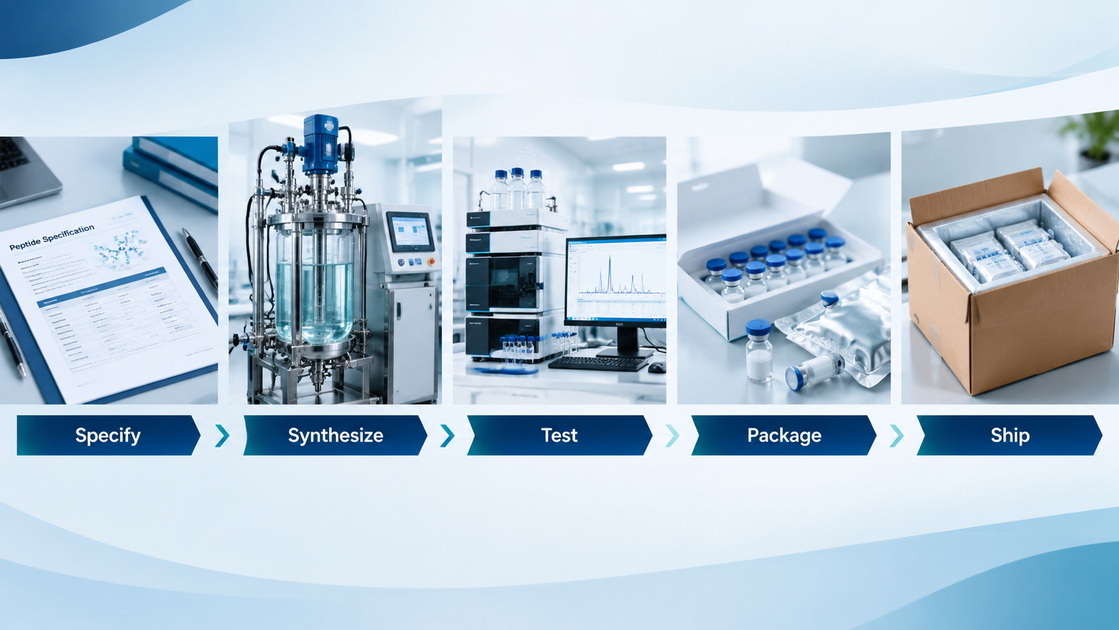
Rchemsell is a China-based peptide development and manufacturing company serving laboratory research and cosmetic industry customers.
According to its company brief, Rchemsell provides peptide synthesis, quality testing, lyophilized packaging, and transportation support. Its stated product purity range is 98%–99%, and it supports OEM, ODM, and custom peptide synthesis projects.
These capabilities may be relevant for buyers who need specification-driven production rather than catalog purchasing alone.
The appropriate next step is not to assume every project receives identical specifications. Confirm the available sequence, scale, analytical methods, documentation, and release criteria for the proposed order.
Custom peptide synthesis generally begins with a defined molecular specification.
OEM projects may involve production or packaging to customer requirements. ODM projects may include development input, but the precise responsibilities vary between suppliers.
Ask Rchemsell to define what is included in the quotation:
- Sequence and modification feasibility.
- Purification target and acceptance criteria.
- Testing and documentation.
- Vial quantity and packaging format.
- Labeling responsibilities.
- Development deliverables and ownership.
- Production schedule and shipping scope.
Confirm whether the project concerns peptide raw material, packaged research material, or a finished cosmetic formulation. These are different deliverables.
A lower purchase price can become expensive if the material causes rework, delayed experiments, or repeated qualification.
Compare quotations using the same specification and quantity basis.
Include analytical services, usable peptide content, packaging, shipping, customs costs, and any necessary incoming testing.
Avoid paying for unnecessary specifications, but do not remove essential tests simply to match a competitor's price.
The strongest purchasing decision connects cost to a defined, usable deliverable.
Customer reviews can reveal patterns in communication, document availability, packaging, and complaint resolution. They cannot independently prove chemical identity or batch purity.
Look for specific, dated accounts that explain what was ordered and how the supplier responded to an issue.
A review about fast delivery supports a logistics observation—not a claim about biological performance.
For larger projects, request relevant references where available and permitted. Avoid treating anonymous praise, unsupported efficacy statements, or supplier-selected testimonials as substitutes for qualification.
A suitable Peptide Sciences alternative should make procurement more predictable, not merely offer a similar catalog.
Prepare a concise inquiry containing your sequence or product name, quantity, purity target, intended application, required documents, packaging preference, and delivery destination.
Prioritize specification matching, batch traceability, relevant analytical evidence, and application suitability. Price and delivery matter, but they should be compared only after confirming that suppliers are quoting equivalent materials and services.
Not automatically. The appropriate threshold depends on the application and impurity profile. Review the analytical method, identity evidence, content information, and experimental requirements rather than deciding from a one-percentage-point difference alone.
No. A COA supports only the attributes actually tested and reported. Chromatographic purity and mass confirmation do not establish sterility or acceptable endotoxin levels.
Research-grade labeling alone does not establish suitability for cosmetic manufacturing. Confirm ingredient specifications, intended use, formulation compatibility, and the safety documentation required for the finished product and target market.
According to the company brief, Rchemsell supports custom synthesis, OEM, and ODM services. Exact sequences, quantities, packaging options, development scope, and documentation should be confirmed for each project.
1. PSPeptides Research Team. "Peptide Sciences Alternative: Best Options 2026." Source article reviewed for topic structure, supplier-selection claims, and content gaps. Its competitor-specific claims, customer figures, closure narrative, and market statistics were not adopted as independently verified facts. [pspeptides]
2. Bachem. "Quality Control of Amino Acids & Peptides: A Guide." Technical source explaining chromatographic purity, analytical methods, and the distinction between purity and net peptide content. [bachem]
3. Bachem. "FAQ—Frequently Asked Questions." Technical guidance covering peptide purity, net content, counterions, solubility, handling, storage, and shipping considerations. [bachem]
4. Bachem. "Custom Peptide Synthesis Services." Industry reference illustrating specification-dependent synthesis and analytical services, including HPLC, mass spectrometry, peptide content, water, counterion, and endotoxin testing. Not evidence of Rchemsell-specific capabilities. [bachem]
5. Bachem. "Handling and Storage Guidelines for Peptides." Technical guidance on moisture sensitivity, sequence-dependent stability, lyophilized storage, solubilization, and aliquoting. [bachem]
6. MilliporeSigma. "Synthetic Peptide Handling & Storage Protocol." Supporting guidance on sequence-dependent solubility and handling of synthetic peptides. [sigmaaldrich]
7. U.S. Food and Drug Administration. "Modernization of Cosmetics Regulation Act of 2022 (MoCRA)." Official source for cosmetic safety-substantiation responsibilities and supporting records. [fda]
8. U.S. Food and Drug Administration. "Cosmetics & U.S. Law." Official explanation of cosmetic responsibilities and how claims can affect classification as a drug. [fda]


