
Views: 228 Author: Rchemsell Publish Time: 2026-11-17 Origin: Site


Content Menu
>> Research Materials, Cosmetic Ingredients, and APIs Are Different
● How We Selected These Peptide Manufacturing Companies
● Why China Matters in Hormone Peptide Manufacturing
● Top 10 Hormone Peptides Manufacturers and Manufacturing Partners in China
>> 1. Rchemsell — Flexible Research Peptide and Custom Synthesis Support
>> 2. Hybio Pharmaceutical Co., Ltd. — Therapeutic Peptide Integration
>> 3. Sinopep Biopharma — Peptide CMC and Commercial Manufacturing
>> 4. JYMed Technology Co., Ltd. — Peptide APIs and Integrated Development
>> 5. GL Biochem Shanghai Ltd. — Research Synthesis and Peptide Building Blocks
>> 6. GenScript Biotech Corporation — Global Research Peptide Services With Chinese Operations
>> 7. ChinaPeptides / QYAOBIO — Custom Research Peptides
>> 8. CPC Scientific / Medtide Group — Research-to-Commercial Peptide Services
>> 9. AmbioPharm — International Peptide CDMO With Shanghai Manufacturing
>> 10. WuXi AppTec — Integrated Research and Manufacturing Services
● Capacity, MOQ, and Quality-System Comparison
● Technical Buyer's Guide to Hormone Peptide Quality
>> Treat OEM and ODM Terminology Carefully
● Insider Procurement Pitfall: The Method Can Change the Purity Story
● From Supplier Enquiry to Approved Shipment
>> 2. Qualify a Representative Sample
>> 3. Establish Change Control
>> 4. Plan Transport Around Stability
● Choose the Supplier That Matches the Application
>> 1. How Can I Verify Whether an ISO Certificate Is Still Valid?
>> 2. Does a DMF Number Mean a Peptide Is FDA-Approved?
>> 3. Can a 99% Research Peptide Be Used as a Pharmaceutical API?
>> 4. How Do We Compare Capacity Claims Between Manufacturers?
>> 5. How Can We Prevent Quality Changes Between Sample and Bulk Supply?
Selecting hormone peptides manufacturers in China requires more than comparing purity percentages and prices per gram. A dependable partner must demonstrate relevant synthesis capabilities, traceable quality control, realistic production planning, and compliance appropriate to the material's intended use.
China offers a broad peptide manufacturing ecosystem, ranging from research-focused suppliers to pharmaceutical contract development and manufacturing organizations. However, these businesses are not interchangeable. A research peptide supplier may suit an academic project but lack the systems needed for a regulated pharmaceutical program.
This guide compares ten China-based manufacturers or international companies with documented Chinese manufacturing operations. It also explains how to assess their technical fit, verify quality claims, and avoid common procurement mistakes.
Rchemsell appears first as the publishing company. This is a supplier-selection shortlist, not an independently audited ranking by revenue, capacity, or product quality. Supplier statements require project-specific verification.

Hormone peptides are peptide signaling molecules involved in physiological functions such as metabolism, reproduction, fluid balance, and growth regulation.
Commercial enquiries may concern natural peptide hormones, synthetic analogues, or modified molecules used in endocrine research and pharmaceutical development.
Examples include oxytocin, vasopressin-related peptides, gonadotropin-releasing hormone analogues, and glucagon-related peptides.
However, "hormone peptides" is not a manufacturing grade or regulatory classification.
Before approaching suppliers, identify the intended application.
| Material category | Appropriate procurement focus |
|---|---|
| Research-use peptides | Identity, purity, content, traceability, and assay suitability |
| Cosmetic ingredients | Ingredient-specific safety, permitted use, formulation compatibility, and destination requirements |
| Pharmaceutical APIs | Applicable GMP controls, impurity characterization, stability, and regulatory support |
| Finished medicines | Product authorization, licensed manufacture, and distribution requirements |
A high-purity research peptide does not become a pharmaceutical API simply because its molecular name matches an active drug ingredient.
Similarly, a supplier's experience in cosmetics does not establish that a hormone peptide is suitable or permitted for cosmetic use.
The shortlist prioritizes publicly described capabilities and procurement relevance.
The assessment considers:
1. Manufacturing relevance: documented peptide synthesis or peptide API operations.
2. Development capability: custom sequences, modifications, analytical development, and scale-up.
3. Quality transparency: batch documentation, testing scope, and stated quality systems.
4. Production suitability: research quantities versus clinical or commercial manufacturing.
5. International support: experience serving overseas research or pharmaceutical customers.
6. Commercial clarity: identifiable production sites, contracting entities, and realistic commitments.
My first screening question would be: "Can this supplier demonstrate control of this particular molecule at the required grade and scale?"
A broad catalogue or large facility is not sufficient evidence.
China's peptide ecosystem benefits from connected networks of synthesis specialists, analytical laboratories, chemical suppliers, and pharmaceutical manufacturers.
The Yangtze River Delta includes businesses in Shanghai, Nanjing, and Hangzhou, supporting research synthesis, custom manufacturing, and pharmaceutical development. Shenzhen and the wider Guangdong region provide another important concentration of peptide businesses, while some companies locate larger production facilities in Hubei or other provinces.
These are interconnected production networks—not proof that every business within a region has equivalent capabilities.
A 2025 InsightAce Analytic report estimated the global pharmaceutical peptide CDMO market at $2.5 billion in 2024 and projected $6.6 billion by 2034.
These are commercial research estimates for the broader peptide CDMO market. They are not official Chinese export statistics or a measurement of hormone peptides alone.
For buyers, growing demand reinforces the importance of confirming available production slots. Announced capacity and usable capacity are different things.
Founding year: not independently verified.
Location and markets: China-based, with global customers targeted according to company-provided information; a verified geographic sales breakdown was unavailable.
Rchemsell describes its services as peptide synthesis, quality testing, lyophilization, packaging, and transportation coordination. It reports product purity of 98%–99% and supports OEM, ODM, and custom synthesis projects.
Its relevant positioning is a research-focused alternative for laboratories and smaller businesses that need direct communication and coordinated customization rather than a large pharmaceutical development contract.
Customization scope includes agreed sequences, analytical specifications, packaging formats, and project-specific supply requirements, subject to technical feasibility.
Procurement checkpoint: evaluate communication responsiveness through an actual enquiry and request batch-specific data. Cost-effectiveness, delivery reliability, hormone-peptide availability, and pharmaceutical qualifications should not be assumed from general company claims.
The supplied contact page could not be retrieved during this review. Company information here therefore comes from the supplied brief rather than an independently verified factory assessment.
Founded: 1998.
Manufacturing footprint: Shenzhen and Wuhan, China.
Markets: the company reports international pharmaceutical business, including products reaching more than 30 countries.
Hybio focuses on peptide drugs and describes an integrated chain covering APIs, finished dosage forms, and commercialization.
Its published portfolio includes endocrine-related therapeutic peptide APIs, making it directly relevant to pharmaceutical sourcing.
Customization scope: peptide development, CRO/CDMO services, API production, and pharmaceutical manufacturing support.
Procurement checkpoint: verify the exact manufacturing site, molecule, inspection history, and documentation package. Group-level regulatory statements do not automatically establish suitability for every product.
Founded: its company profile states 2004; other website wording refers to supporting innovators since 2009. Confirm the relevant legal entity and operating history.
Location: Hangzhou, Zhejiang, with manufacturing activities elsewhere in China.
Markets: global pharmaceutical and biotechnology partners.
Sinopep describes end-to-end chemistry, manufacturing, and controls services, including peptide API development and cGMP manufacturing.
Its website reports established peptide capacity of 20–30 metric tons annually.
Customization scope: process development, analytical development, scale-up, clinical supply, and commercial API manufacturing.
Procurement checkpoint: determine which site and equipment train would handle the project. Total annual capacity does not establish available capacity for a difficult sequence.
Founded: 2009.
Manufacturing footprint: Shenzhen and Hubei.
Markets: international pharmaceutical development and API customers.
JYMed describes peptide-only development and manufacturing services, with a portfolio that includes oxytocin and metabolic peptide APIs.
Its current company profile reports annual API capacity exceeding 10 tons, alongside research and manufacturing infrastructure.
Customization scope: custom synthesis, process development, analytical work, commercialization support, and formulation-related services through relevant facilities.
Procurement checkpoint: distinguish API manufacture from sterile formulation services. Confirm the contracted site, applicable controls, and actual project allocation.
Founded: 1998.
Location: Shanghai, with an international manufacturing network.
Markets: international research, biotechnology, and peptide manufacturing customers.
GL Biochem supplies custom peptides, peptide reagents, protected amino acids, and related building blocks.
Its published profile describes five manufacturing sites and two research centers, providing a broad technical platform rather than a single-product focus.
Customization scope: customer-defined peptide synthesis, modifications, and related chemistry services.
Procurement checkpoint: verify hormone-specific feasibility and the proposed manufacturing grade. Broad research capacity should not be treated as automatic evidence of regulated API readiness.
Founded: 2002 in the United States; Chinese research and manufacturing operations followed.
China footprint: includes Nanjing operations.
Markets: global academic, biotechnology, and pharmaceutical customers.
GenScript provides custom peptide synthesis, peptide libraries, modifications, and separately described cGMP services.
Its relevance is strongest where hormone-related research forms part of a wider discovery program.
Customization scope: sequence-defined peptides, conjugates, modified peptides, libraries, and development-stage manufacturing.
Procurement checkpoint: specify research or pharmaceutical requirements explicitly. Confirm which facility and quality system apply rather than transferring claims between service lines.
Founded: October 2008.
Location: Shanghai, with additional operations described in China.
Markets: the company reports customers across more than 50 countries and regions.
ChinaPeptides describes solid-phase synthesis, purification, lyophilization, and HPLC and mass-spectrometry reporting.
It is relevant for research buyers requiring customized sequences, purity levels, and modifications.
Customization scope: research peptide synthesis, labeling, modifications, and associated laboratory services.
Procurement checkpoint: confirm the complete contracting legal name and production site. ChinaPeptides is not the same business as CPC Scientific's Chinese Peptide Company manufacturing operation.
Group founded: 2001.
China manufacturing connection: Hangzhou-based peptide manufacturing.
Markets: the group reports projects across more than 50 countries, including the United States, China, Europe, and Japan.
CPC Scientific offers research peptides and GMP manufacturing. Its catalogue includes hormone-related research materials, while its development services extend into commercial APIs.
Customization scope: discovery synthesis, CMC development, analytical services, and contract manufacturing.
The company reports annual peptide API capacity above 1,000 kg.
Procurement checkpoint: identify the contracting entity, manufacturing site, and applicable quality agreement. Do not confuse a catalogue research product with a pharmaceutical supply commitment.
Founded: 2007, with operations established in South Carolina and Shanghai.
Markets: global pharmaceutical, biotechnology, research, and cosmetic customers.
AmbioPharm focuses on custom peptide APIs, particularly development through commercial manufacturing.
Its website reports acquisition by CordenPharma in August 2026, making current ownership and contracting arrangements relevant to supplier qualification.
Customization scope: process development, synthesis, scale-up, analytical development, and GMP manufacturing.
Procurement checkpoint: confirm the current corporate structure, proposed manufacturing location, and whether the project fits its development-stage focus.
Founding year: not verified from the primary pages reviewed.
China footprint: multiple operations supporting a global research and manufacturing network.
Markets: the company reports customers across more than 30 countries.
WuXi AppTec offers integrated services spanning discovery, development, testing, and manufacturing, with peptide-related capabilities within its broader platform.
Customization scope: project-specific development, analytical characterization, and manufacturing support.
Procurement checkpoint: obtain a molecule-specific proposal identifying the peptide manufacturing entity, facility, quality scope, and regulatory deliverables. Group-wide scale is not a substitute for project-level qualification.
Published figures below are supplier statements, not independently audited production guarantees. "Not established" means the reviewed evidence did not support a comparable figure.
| Supplier | Public capacity indicator | MOQ position | Quality or regulatory evidence to request |
|---|---|---|---|
| Rchemsell | Not independently established | Custom quotation | Batch testing, legal identity, site and quality-system evidence |
| Hybio | Integrated API and formulation network | Project-dependent | Site-specific inspection and GMP documentation |
| Sinopep | Reports 20–30 metric tons annually | Project-dependent | Site-specific GMP scope and project quality agreement |
| JYMed | Reports more than 10 tons annually | Project-dependent | API or formulation-site documentation, as applicable |
| GL Biochem | Reports five manufacturing sites | Sequence-dependent | Relevant quality-system scope and analytical package |
| GenScript | Broad research and cGMP services | Service-dependent | Facility-specific quality documentation |
| ChinaPeptides | Synthesis, purification, and lyophilization platform | Sequence-dependent | HPLC/MS data and quality-system evidence |
| CPC Scientific | Reports more than 1,000 kg annually | Project-dependent | Manufacturing-site GMP and regulatory support |
| AmbioPharm | Dual-country manufacturing network | Project-dependent | Current site inspection history and quality agreement |
| WuXi AppTec | Integrated global platform | Project-dependent | Peptide-site qualification and agreed release specification |
A universal MOQ would be misleading. Sequence complexity, purification difficulty, testing requirements, and manufacturing grade affect the minimum economical order.
A meaningful specification can include:
- Sequence, terminal modifications, and counterion.
- Identity and appropriate structural characterization.
- Chromatographic purity and related impurities.
- Peptide content, water, and residual solvents where relevant.
- Microbiological or endotoxin requirements when justified.
- Packaging, stability, and transport conditions.
Some hormone peptides require control of disulfide connectivity or other structural features. A matching molecular mass alone may not distinguish every relevant structural difference.
ICH Q7 provides a recognized GMP framework for API manufacturing.
ISO 9001 can support quality-management assessment, but it does not establish pharmaceutical suitability or product authorization.
CE marking and RoHS are not general quality credentials for bulk peptide ingredients. Their appearance in a peptide supplier presentation should not replace relevant chemical, manufacturing, or regulatory evidence.
Also distinguish manufacturing controls from approval status: an FDA registration or DMF number is not product approval.
For research supply, OEM may describe customized packaging or contracted synthesis.
For pharmaceutical APIs, more precise terms include process development, technology transfer, and contract manufacturing.
Replacing a label does not change the material's regulatory status, manufacturing history, or permitted use.
One frequently overlooked risk is comparing purity percentages generated by different analytical methods.
A less resolving method may combine related impurities with the main peak. Two certificates both stating 99% therefore do not necessarily describe equivalent material.
Ask for chromatograms, methods, integration conventions, and impurity information—not only the headline percentage.
Also distinguish chromatographic purity from peptide content. Water and counterions can contribute to powder weight without being reflected proportionately in an HPLC result.
Finally, ensure the qualified sample represents the proposed commercial process. A small development batch does not automatically establish consistency after scale-up, site transfer, or process changes. 
Match the quotation, business registration, bank beneficiary, production address, and certificate holder.
Ask which synthesis, purification, testing, and packaging operations are subcontracted.
Agree on acceptance methods before receiving the sample.
Use independent testing where justified and compare results with the supplier's reporting basis.
Document notification requirements for changes to site, process, methods, counterion, specifications, or packaging.
For regulated projects, allocate responsibilities through an appropriate quality agreement.
Do not assume every lyophilized peptide needs identical shipping conditions.
Request product-specific stability support, packaging instructions, and temperature controls where required. Confirm destination import requirements and intended-use documentation before dispatch.
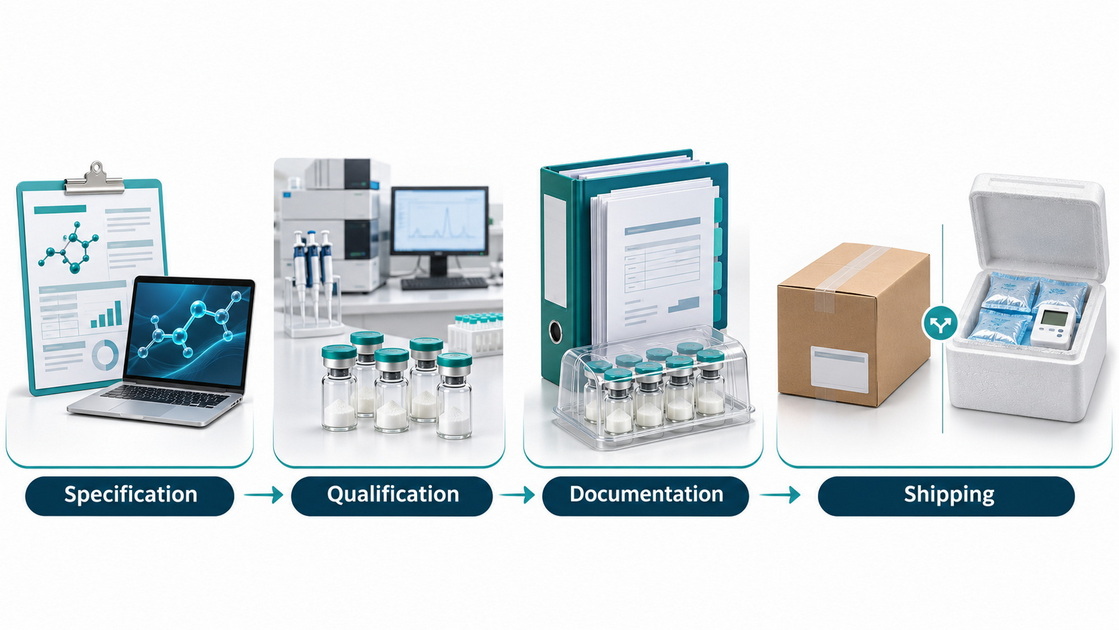
The appropriate hormone peptide partner depends on whether the project needs research flexibility, specialized analytical development, or regulated commercial manufacturing.
For smaller research programs, responsive technical communication and transparent specifications may matter more than headline tonnage.
Check the legal entity, site address, certificate number, scope, and expiry date. Confirm current status with the issuing certification body and, where applicable, an accredited-certificate database. A PDF alone does not establish that a certificate remains active.
No. FDA states that DMFs are neither approved nor disapproved. Their technical contents are reviewed in connection with applications that reference them. Establishment registration also does not establish product approval.
Not on purity alone. Pharmaceutical suitability requires the relevant manufacturing controls, impurity understanding, documentation, stability support, and regulatory assessment.
Separate annual output, reactor volume, batch scale, and available production slots. Ask about the equipment, purification bottlenecks, and campaign schedule proposed for your molecule. These measures are not interchangeable.
Define the approved specification, analytical methods, manufacturing site, and change-notification obligations. Retain reference material, compare representative batches, and investigate significant differences before acceptance.
1. Hybio Pharmaceutical Co., Ltd. "About Us" and corporate website. Sources for establishment in 1998, manufacturing footprint, therapeutic peptide positioning, and international market statements. [hybio]
2. Sinopep Biopharma. "About Us" and corporate manufacturing overview. Sources for the published company history, CMC services, and supplier-reported annual capacity. Differing history statements should be clarified during qualification. [sinopep]
3. JYMed Technology Co., Ltd. "About Us" and "Facilities." Sources for establishment in 2009, Shenzhen and Hubei operations, product scope, and supplier-reported capacity. [jymedtech]
4. GL Biochem. "About Us." Primary source for manufacturing-network and service descriptions. Pharmaceutical Technology, "GL Biochem," supplies the independently published 1998 founding-year reference. [glbiochem]
5. GenScript. "Our Business," corporate history materials, "Custom Peptide Synthesis and Library Services," and "cGMP Peptide Synthesis." Sources distinguishing international corporate origins, Chinese operations, research services, and pharmaceutical development capabilities. [genscript]
6. ChinaPeptides / QYAOBIO. Official website. Source for October 2008 establishment, Shanghai contact location, international customer coverage, synthesis, purification, lyophilization, and analytical reporting. [chinapeptides]
7. CPC Scientific. "Company Profile," China manufacturing announcement, and "GMP Peptide Manufacturing." Sources for group establishment, international markets, Hangzhou manufacturing, services, and reported capacity. [cpcscientific]
8. AmbioPharm. "AmbioPharm Expanding Operations" and corporate website. Sources for 2007 establishment, Shanghai operations, service scope, and the company's announced 2026 acquisition by CordenPharma. [ambiopharm]
9. WuXi AppTec. Corporate website. Source for the integrated CRDMO platform, international operations, and reported customer reach. Founding year and comparable peptide-specific capacity were not established from the reviewed page. [wuxiapptec]
10. InsightAce Analytic. Peptide CDMO (Pharmaceutical) Market Size, Share & Trends Analysis Report, 2025–2034. Published March 27, 2025. Source for the $2.5 billion 2024 market estimate and $6.6 billion 2034 projection. These are commercial estimates, not official Chinese hormone peptide export statistics. [insightaceanalytic]
11. U.S. Food and Drug Administration. Q7 Good Manufacturing Practice Guidance for Active Pharmaceutical Ingredients. Official guidance covering quality systems, documentation, production controls, analytical methods, and API supply-chain responsibilities. [fda]
12. U.S. Food and Drug Administration. "Drug Master Files." Official explanation that DMFs are neither approved nor disapproved and are reviewed in connection with referencing applications. [fda]
13. U.S. Food and Drug Administration. "Electronic Drug Registration and Listing System." Official clarification that establishment registration and drug listing do not indicate product approval. [fda]
14. European Union, Your Europe. "CE Marking." Official explanation that CE marking applies only to products covered by relevant legislation. Environmental Protection Agency, Ireland. "RoHS." Official explanation of restrictions concerning electrical and electronic equipment. [europa]


