
Views: 239 Author: Rchemsell Publish Time: 2026-09-03 Origin: Site


Content Menu
● Why "Best Peptide Manufacturer" Is Not a Universal Ranking
>> Five Factors That Define Supplier Fit
● What Are Catalogue Peptides?
>> Common Applications for Catalogue Peptides
>> Catalogue Peptide vs Custom Peptide Synthesis
● How to Evaluate Catalogue Peptide Manufacturers
>> Review the Certificate of Analysis
>> Understand What HPLC and MS Results Mean
>> Do Not Evaluate Peptides by Purity Alone
● Build a Risk-Based Peptide Supplier Scorecard
>> Recommended Supplier Scorecard
>> Example of a Better Procurement Decision
● Global Catalogue Peptide Supplier Categories
>> Large Life-Science and Research-Reagent Suppliers
>> Specialized Peptide Manufacturers
>> China-Based Custom Peptide Manufacturing Partners
● Custom Peptide Manufacturing for Research and Cosmetic Development
>> When Rchemsell May Be a Better Fit
● From Peptide Request to Purchase Order
>> What to Include in a Peptide RFQ
● Quality, Compliance, and Responsible Claims
>> Responsible Supplier Claims Matter
● How to Select Your Peptide Manufacturing Partner
● Start Your Custom Peptide Project With Rchemsell
>> 1. What are catalogue peptides?
>> 2. How do I choose a catalogue peptide manufacturer?
>> 3. Is 98% or 99% purity enough for peptide research?
>> 4. What testing should be included with a peptide order?
>> 5. What is the difference between catalogue peptides and custom peptides?
Searching for the top catalogue peptide manufacturers can quickly produce long lists of biotechnology companies. However, a list of company names does not tell a laboratory, distributor, cosmetic brand, or procurement team what matters most: whether a supplier can deliver the correct peptide, at the required quality level, with reliable analytical documentation, consistent packaging, and a realistic lead time.
Catalogue peptides are pre-synthesized peptides supplied in standardized formats for research, assay development, screening, immunology, receptor studies, cell-signaling work, formulation research, and related applications. They can help teams move faster than a fully custom project because an established sequence may already be available for purchase.
But availability alone is not a sufficient purchasing criterion.
A peptide that appears comparable on a catalogue page may differ materially in purity definition, peptide content, counterion, analytical method, batch documentation, packaging, storage requirements, and delivery capability. For this reason, experienced buyers evaluate peptide suppliers through a quality-and-fit framework rather than relying only on catalog size, headline purity, or a broad "best manufacturer" ranking.
This guide explains how to assess global catalogue peptide manufacturers, what documentation to request, when to choose catalogue products instead of custom synthesis, and how Rchemsell can support research and cosmetic-industry customers with custom peptide development, quality testing, lyophilized packaging, OEM, ODM, and international logistics.
Scope note: This article is intended for research, analytical-development, and cosmetic R&D procurement. It does not rank suppliers for clinical use, does not endorse specific products, and should not be interpreted as medical, regulatory, or therapeutic advice.

The original competitor article offers a broad list of manufacturers, but it treats "best" as a fixed conclusion. In professional procurement, the better question is:
Which catalogue peptide manufacturer best fits the sequence, purity, scale, documentation, application, timeline, and logistics requirements of this project?
A supplier that is ideal for early-stage milligram research may not be the best partner for a multi-gram custom peptide, a modified peptide library, a cosmetic active-development project, or an OEM program requiring private-label packaging.
| Supplier Evaluation Factor | Why It Matters | Questions to Ask |
|---|---|---|
| Product availability | Determines whether a catalogue peptide can meet the immediate need | Is the exact sequence, salt form, modification, and purity available? |
| Analytical documentation | Supports material identity and quality review | Are HPLC and MS data available for the actual lot? |
| Customization capability | Important when the catalogue does not match the required design | Can the supplier modify sequence, terminal groups, labels, cyclization, or purity? |
| Manufacturing and QC controls | Influences batch consistency and project confidence | What controls are used from raw materials through final release? |
| Packaging and logistics | Protects sensitive materials during shipment and storage | Is lyophilized packaging available, and how are shipping conditions managed? |
The purpose of a supplier comparison should therefore be to help buyers make a defensible decision—not to create an unverified "top 10" list.
Catalogue peptides are pre-designed and pre-synthesized peptide products listed by a supplier for repeat ordering. They often include commonly studied sequences, signaling peptides, receptor ligands, enzyme substrates, epitopes, control peptides, antimicrobial peptides, and peptide fragments used in laboratory research.
For many projects, catalogue products provide a practical starting point because they can reduce design time and avoid the initial setup stage associated with custom synthesis.
- Drug-discovery and target-validation research.
- Receptor-binding and cell-signaling assays.
- Immunology and epitope-mapping studies.
- Enzyme-substrate and inhibitor studies.
- Biomarker-method development.
- Antibody validation and assay controls.
- Cosmetic ingredient screening and formulation research.
- Academic studies requiring established peptide sequences.
Catalogue availability can accelerate a project, but it should never replace material qualification. Researchers should confirm that the catalogue specification matches the scientific requirement before ordering.
| Requirement | Catalogue Peptide | Custom Peptide Synthesis |
|---|---|---|
| Known, standard sequence | Often a strong option | May be unnecessary unless special specifications are needed |
| Unusual sequence or modification | May not be available | Usually the preferred route |
| Fast project start | Often faster if stock is available | Lead time depends on complexity, scale, and testing |
| Control over purity target | Limited to listed specifications | Can be defined in the project brief |
| Private-label or OEM packaging | Often limited | More suitable for OEM and ODM programs |
| Scale-up planning | Depends on supplier inventory | Can be planned from research scale to larger quantities |
| Tailored analytical package | Usually standardized | Can be discussed according to project needs |
Key takeaway: Catalogue peptides are best when the listed product truly matches the research requirement. Custom synthesis is more appropriate when sequence design, modification, purity, packaging, documentation, or commercial presentation requires greater control.
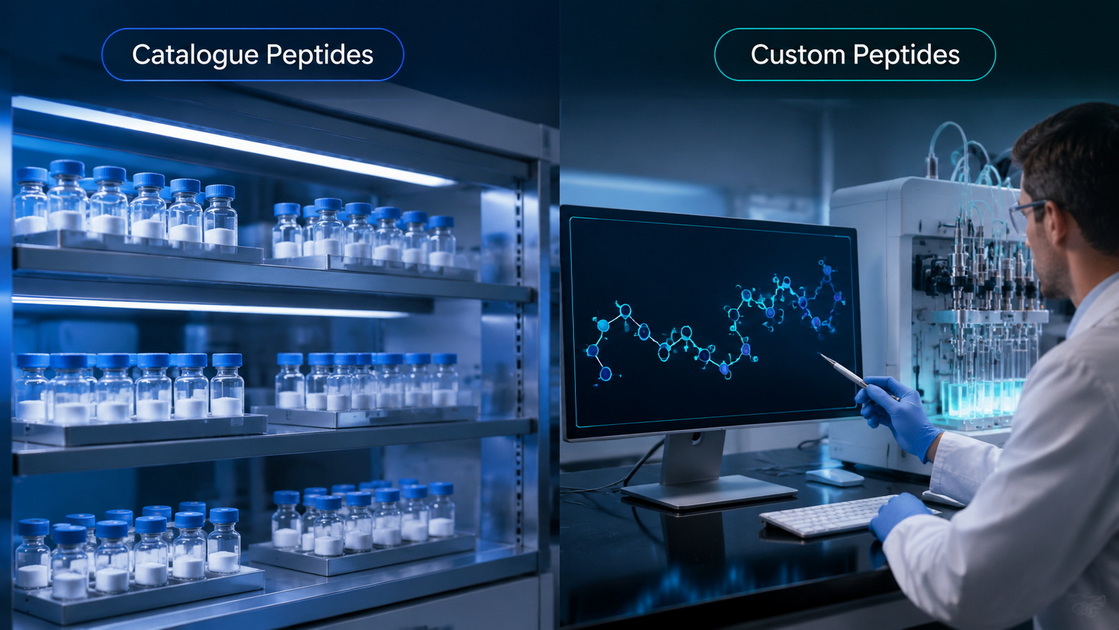
A credible peptide manufacturer should be assessed through evidence. Company scale and branding can be useful signals, but procurement decisions should be based on documentation, technical communication, and the supplier's ability to meet the actual specification.
A lot-specific Certificate of Analysis, commonly called a COA, is one of the most important documents in peptide procurement. It should link directly to the material being purchased through a clear batch or lot number.
A useful COA may include:
- Product name and peptide sequence.
- Molecular weight or calculated mass.
- Lot or batch number.
- Purity result and analytical method.
- Identity confirmation method.
- Net peptide content, where applicable.
- Packaging format and storage guidance.
- Date of manufacture or retest information, if provided.
- Authorized quality-review information.
A COA should not be treated as a marketing brochure. It is a quality document that helps the buyer verify whether the received material matches the purchase specification.

For synthetic peptides, HPLC is commonly used to assess chromatographic purity, while mass spectrometry supports confirmation of molecular mass and identity. These analytical tools answer different questions, so buyers should ask for both whenever the application requires robust documentation.
A scientific review of synthetic peptide therapeutics explains that LC-MS plays an important role in impurity characterization and in the development of control strategies for peptide manufacturing. It also highlights the importance of evaluating structural isomers and stereoisomers, which may not be fully addressed by a single purity percentage alone.
When reviewing supplier data, ask:
- Is the purity result reported from analytical HPLC?
- Is a chromatogram available for the actual batch?
- Does the measured mass align with the expected molecular mass?
- Are relevant impurities discussed or controlled?
- Is the stated purity appropriate for the intended application?
- Does the certificate identify the same lot number printed on the vial and shipping documentation?
A supplier may advertise 98%–99% peptide purity, which can be appropriate for many research and development applications. However, purity is only one part of material quality.
Professional buyers should also consider:
- Identity: Is the intended molecular species confirmed?
- Impurity profile: Are meaningful process-related or degradation-related impurities considered?
- Peptide content: Does the amount of active peptide align with the stated weight?
- Counterion and salt form: Are they suitable for the intended assay or formulation?
- Water content: Could moisture affect weighing, stability, or concentration calculations?
- Residual solvents: Are they controlled according to the product's purpose?
- Stability: Has storage guidance been defined for the supplied format?
- Traceability: Can the supplier connect the finished vial to analytical results and manufacturing records?
Bachem's quality-control guide similarly identifies identity, purity, by-products, and product content as distinct quality questions. It also lists water content, residual solvents, acetic acid content, and residual trifluoroacetic acid as examples of relevant testing considerations depending on the peptide and application.
A long list of manufacturers is less useful than a structured comparison system. To improve procurement consistency, create a supplier scorecard before requesting quotations.
| Evaluation Area | Suggested Weight | What Good Looks Like |
|---|---|---|
| Sequence and modification capability | 20% | The supplier understands the requested sequence, length, modifications, and feasibility risks |
| Analytical documentation | 20% | Lot-specific COA, HPLC data, MS confirmation, and additional testing options |
| Quality-system transparency | 15% | Clear process controls, traceability, specification discussion, and responsive technical review |
| Purity and material specification | 15% | Purity target is appropriate for the application, not simply the highest advertised number |
| Lead time and communication | 10% | Realistic timelines, proactive updates, and technical answers before production begins |
| Packaging and shipping | 10% | Appropriate lyophilized packaging, labeling, storage instructions, and global delivery planning |
| Commercial flexibility | 10% | Support for OEM, ODM, custom labeling, repeat orders, and scalable supply |
This scorecard does not guarantee supplier performance, but it reduces the risk of selecting a company only because it appears at the top of a search result.
A cosmetic R&D company needs a modified peptide for efficacy screening and later product development. A large catalogue supplier may offer a similar unmodified sequence at high purity. However, the project requires a terminal modification, a defined packaging format, analytical records, and the potential for OEM support.
In that case, a smaller but technically responsive custom manufacturer may offer a better fit than a large catalogue-only provider. The decision should be driven by specification alignment, not brand recognition alone.
Instead of presenting an absolute ranking, buyers can group manufacturers according to their operating strengths. Many global peptide suppliers may overlap across these categories.
Global life-science suppliers often provide broad reagent portfolios, established ordering systems, regional distribution, and extensive technical resources. They can be convenient when researchers need peptides alongside antibodies, proteins, assay reagents, cell-culture products, or laboratory consumables.
Potential strengths include:
- Broad catalogues.
- Familiar procurement workflows.
- Multi-country distribution.
- Integrated research-reagent purchasing.
- Established customer-service infrastructure.
Potential considerations include:
- Less flexibility for unusual specifications.
- Standardized documentation packages.
- Higher cost structures for some projects.
- Catalogue availability that may vary by region.
Specialized peptide companies focus more closely on peptide chemistry, synthesis, purification, modification, and analytical support. They may be a stronger choice for peptide libraries, complex sequences, difficult modifications, or projects that require direct communication with technical teams.
Potential strengths include:
- Greater peptide-specific expertise.
- Custom synthesis options.
- Support for challenging sequences and modifications.
- More flexible purity, scale, and packaging discussions.
- Opportunities to progress from prototype to repeat supply.
Potential considerations include:
- Lead times may depend on complexity.
- Production feasibility should be confirmed before order placement.
- Documentation requirements should be agreed upon in writing.
China-based manufacturers can be attractive to international buyers seeking flexible project communication, competitive manufacturing economics, custom synthesis, and integrated packaging services. However, buyers should apply the same documentation and qualification standards they would use with any global supplier.
A reliable manufacturer should be able to explain its production workflow, quality-control methods, lot documentation, packaging options, and shipping process clearly.
The country of origin is not a substitute for quality evaluation. The relevant question is whether the supplier can meet the requested specification consistently and transparently.
Rchemsell is a China-based peptide manufacturer serving laboratory research and cosmetic-industry customers. The company focuses on peptide R&D and production, providing an integrated service pathway from peptide synthesis through quality testing, lyophilized packaging, and global shipping coordination.
For buyers who need more than a standard catalogue listing, Rchemsell can support:
- Custom peptide synthesis for defined sequences and project requirements.
- High-purity peptide production, typically targeted at 98%–99% based on the agreed specification.
- Quality testing to support identity and purity verification.
- Lyophilized peptide packaging designed for storage and transport needs.
- OEM and ODM support for businesses developing branded peptide-related products.
- Custom packaging and labeling discussions for commercial projects.
- Global logistics coordination for international customers.
Rchemsell may be a practical partner when your project involves:
- A sequence not available in a standard peptide catalogue.
- Special terminal modifications, labels, cyclization, or other design requirements.
- A defined purity range rather than a generic catalogue specification.
- Small-scale R&D followed by recurring or expanded orders.
- Cosmetic formulation research requiring tailored packaging or documentation.
- OEM or ODM projects that require a coordinated manufacturing partner.
- International sourcing needs that require clear communication and export-oriented support.
Rchemsell should be evaluated through the same evidence-based procurement process described in this guide: requested specifications, supporting test documents, communication quality, trial orders where appropriate, and defined acceptance criteria.
Many procurement delays happen because the initial request is incomplete. A clear technical brief helps the manufacturer assess feasibility, quote accurately, and recommend appropriate testing or packaging.
Before contacting a catalogue or custom peptide manufacturer, prepare the following information:
1. Peptide sequence: Include amino-acid sequence, terminal groups, and required modifications.
2. Intended application: State whether the material is for research, assay development, cosmetic formulation screening, or another non-clinical use.
3. Purity requirement: Specify the desired purity target and whether it must be confirmed by analytical HPLC.
4. Quantity and scale: Provide the requested quantity per peptide and estimated repeat-order volume.
5. Analytical requirements: Request HPLC, MS, COA, or additional testing as needed.
6. Salt form and counterion preference: Clarify if relevant to the experiment or formulation.
7. Packaging format: State vial size, aliquoting needs, lyophilized form, labeling, and private-label requirements.
8. Storage and shipment needs: Identify temperature expectations, destination country, and required shipping documentation.
9. Timeline: Share the desired delivery date and whether the order is a pilot, validation, or repeat-supply project.
10. Regulatory boundaries: Clearly identify that the material is intended for the permitted research or cosmetic application, not unapproved medical use.
A complete RFQ is one of the easiest ways to improve quote accuracy and reduce late-stage changes.
For pharmaceutical applications, manufacturing quality systems are often assessed against frameworks such as ICH Q7, which addresses Good Manufacturing Practice principles for active pharmaceutical ingredients under an appropriate quality-management system.
However, customers should not assume that all catalogue or research peptides are GMP materials. Research-grade, cosmetic-grade, non-GMP, and GMP-grade materials are not interchangeable terms. Each project should define the quality standard, documentation package, and compliance requirements appropriate to its intended use.
A trustworthy peptide supplier should avoid making unsupported claims about:
- Clinical efficacy.
- Therapeutic outcomes.
- Human self-administration.
- Unapproved medical treatment.
- Guaranteed biological performance in every experimental system.
Instead, credible manufacturers should communicate clearly about what they can document: peptide sequence, purity target, identity testing, lot records, packaging, storage guidance, and manufacturing capabilities.
Before placing an order, use this final checklist:
- Confirm that the sequence and modification exactly match your requirement.
- Review whether the stated purity is relevant to your application.
- Request lot-specific HPLC and MS information.
- Verify COA traceability and lot numbering.
- Ask about peptide content, water content, counterion, and residual-solvent testing when relevant.
- Confirm packaging, labeling, storage, and shipment arrangements.
- Define the acceptable delivery timeline before production begins.
- Request a pilot or small-scale batch for a new supplier relationship when appropriate.
- Keep written records of specifications, quotations, analytical documents, and shipping conditions.
- Avoid suppliers that make unverified therapeutic or medical claims.
The strongest supplier relationship is built on a detailed specification, transparent communication, and a quality system that the buyer can evaluate.

The right catalogue peptide manufacturer is not necessarily the largest company or the one with the longest product list. It is the supplier that can reliably meet your scientific, commercial, and logistical requirements with the correct level of documentation.
Rchemsell provides integrated peptide synthesis, quality testing, lyophilized packaging, OEM, ODM, and global shipping support for laboratory research and cosmetic-industry projects. Whether you need a standard peptide, a modified sequence, a high-purity custom material, or a scalable private-label solution, a detailed project brief is the best place to start.
Catalogue peptides are pre-synthesized peptide products listed by manufacturers for repeat purchase. They are commonly used in research, assay development, immunology, drug-discovery studies, and cosmetic R&D. Buyers should still verify sequence, modification, purity, documentation, and storage conditions before ordering.
Compare suppliers using a structured framework that includes sequence availability, purity target, COA quality, HPLC and MS documentation, customization capability, lead time, packaging, shipping, and technical communication. Do not choose based only on catalogue size or brand visibility.
It may be appropriate for many research projects, but suitability depends on the assay sensitivity, intended application, impurity tolerance, and required reproducibility. Purity should be reviewed together with molecular identity, peptide content, impurity profile, stability, and lot-level analytical documentation.
At minimum, many buyers request a lot-specific COA, HPLC purity result, and mass-spectrometry identity confirmation. Depending on the application, additional testing may include peptide content, water content, residual solvents, counterion analysis, endotoxin testing, or stability studies.
Catalogue peptides are standardized, pre-listed products. Custom peptides are manufactured to a buyer's defined sequence, modifications, purity target, scale, packaging, and documentation requirements. Custom synthesis is usually the better option when a standard catalogue product does not fully match the project specification.
1. Biorunstar. "Best 10 Catalogue Peptides Manufacturers in the World." Original article reviewed as a structural reference and content-gap benchmark. The revised article replaces absolute rankings with an evidence-led supplier-selection framework. [Read the original article]. [biorunstar]
2. Wang F, et al. "Characterization of Synthetic Peptide Therapeutics Using Liquid Chromatography-Mass Spectrometry." "Journal of Pharmaceutical and Biomedical Analysis", 2021. Discusses impurity characterization, LC-MS workflows, critical quality attributes, structural isomers, and risk-based peptide control strategies. [Read the PubMed record]. [pubmed.ncbi.nlm.nih]
3. Bachem. "Quality Control of Amino Acids & Peptides: A Guide." Covers quality considerations including identity, purity, by-products, peptide content, water content, residual solvents, and counterion-related analysis. [Read the quality-control guide]. [bachem]
4. Bachem. "Custom Peptide Synthesis Services." Describes custom peptide manufacturing, HPLC and MALDI-MS release testing, and optional analyses such as peptide content, water content, acid content, counterion content, and endotoxin testing. [Read the custom synthesis page]. [bachem]
5. International Council for Harmonisation. "ICH Q7 Good Manufacturing Practice Guide for Active Pharmaceutical Ingredients." GMP guidance for API manufacturing quality-management systems. [Read the ICH Q7 reference page]. [gmp-compliance]
6. Duan J, et al. "Enantiomeric Purity Analysis of Synthetic Peptide Therapeutics by HPLC-ESI-MS/MS." "Journal of Pharmaceutical and Biomedical Analysis", 2023. Explains why chiral purity and potential D-isomer impurities can be important quality considerations for synthetic peptides. [Read the PubMed record]. [pubmed.ncbi.nlm.nih]


