
Views: 266 Author: Rchemsell Publish Time: 2026-10-16 Origin: Site


Content Menu
● Australia's Position in Semaglutide Sourcing
● Important Australian Regulatory Boundaries
● How the Suppliers Were Evaluated
>> 1. Correct Product and Business Category
>> 3. Manufacturing and Quality-System Evidence
>> 4. Capacity and Delivery Reliability
>> 5. Customization Boundaries
● Five Organizations Relevant to Australian Buyers
● 1. Rchemsell: A Custom Research-Peptide Option
>> Company Background and Main Markets
>> Critical Due-Diligence Point
● 2. Novo Nordisk: The Approved-Medicine Reference Point
>> Company Background and Main Markets
● 3. Sapphire Bioscience: Australian Research Distribution
>> Company Background and Main Markets
● 4. Cayman Chemical: Research Reagents With an Australian Channel
>> Company Background and Main Markets
● 5. Tocris Bioscience: A Defined Research-Catalog Option
>> Company Background and Main Markets
● Technical Buyer's Guide: What "98%–99% Purity" Does Not Prove
>> HPLC Purity Is Not the Same as Peptide Content
>> Build a Fit-for-Purpose Analytical Package
>> Use Relevant Compliance Criteria
● Comparing Price Per Milligram Without Comparing Content
● Sampling, Factory Verification, and Logistics
>> Verify the Manufacturing Entity
>> Agree on Shipping Conditions
● FAQ
>> 1. Does "research use only" make semaglutide importation lawful?
>> 2. Can a 99% HPLC result establish pharmaceutical grade?
>> 3. How should we verify a supplier's ISO or GMP claim?
>> 4. Can an OEM supplier make private-label semaglutide for Australian patient use?
>> 5. What should we do when the catalog identifier and COA disagree?
The right semaglutide supplier depends first on the intended use. Australian procurement teams must distinguish approved prescription medicines, laboratory research reagents, and materials proposed for pharmaceutical development. These categories have different quality expectations, distribution arrangements, and legal requirements.
For approved medicines, the Therapeutic Goods Administration identifies Novo Nordisk as the company behind the approved semaglutide products Ozempic and Wegovy. Research catalogs and overseas peptide manufacturers operate in a different category and should not be presented as interchangeable alternatives for patient treatment.
This guide reviews five sourcing organizations relevant to Australian buyers, beginning with Rchemsell as a China-based research-peptide manufacturer. It also covers an approved-medicine manufacturer, an Australian research distributor, and international research-reagent brands with Australian purchasing channels.
The central selection principle is qualification: verify the intended use, legal supply pathway, manufacturing site, analytical evidence, and commercial commitments before comparing prices.
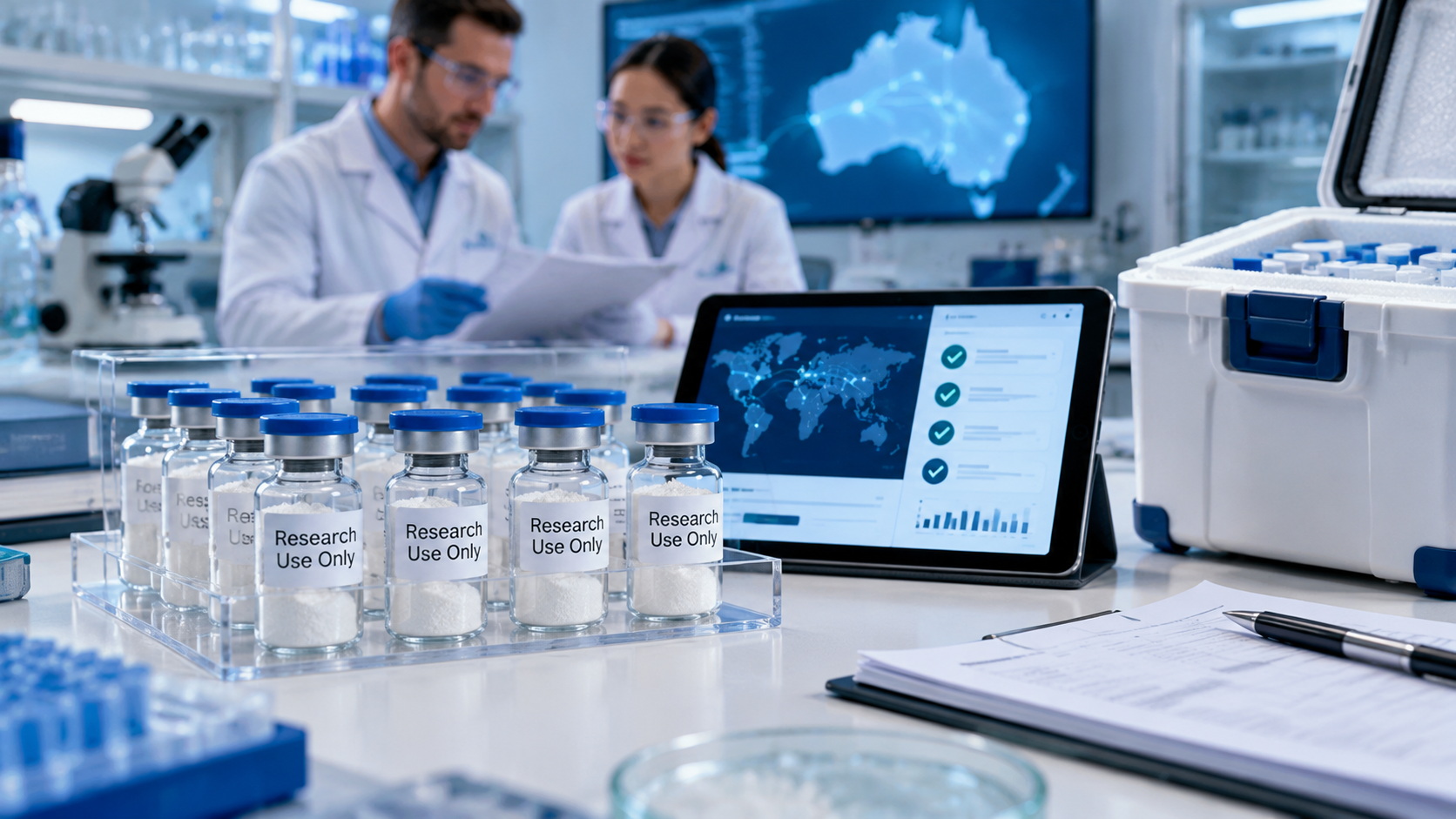
Australia has a substantial biomedical research ecosystem and an established regulatory framework for medicines. However, the sources reviewed for this article do not establish Australia as a major domestic manufacturing cluster for semaglutide active pharmaceutical ingredient.
Its more clearly documented strengths include research institutions, clinical development, pharmaceutical distribution, and specialist laboratory procurement.
Melbourne's Parkville precinct illustrates this environment. The Victorian Government describes it as a biomedical hub bringing together hospitals, universities, research institutes, and biomedical organizations, with close to 73,000 jobs. This is evidence of a broader life-sciences cluster—not semaglutide manufacturing capacity.
For procurement managers, Australian suppliers can offer local account support and distribution services. Overseas manufacturers may offer custom synthesis or larger research quantities. Neither location nor a local website establishes pharmaceutical suitability.
Novo Nordisk's Annual Report 2025 reported total company sales of DKK 309.064 billion and availability of Wegovy in 52 countries. These figures demonstrate the scale of the originator's business and product reach, but they are not an estimate of Australia's semaglutide API market.
No verified public dataset reviewed for this guide isolates Australian semaglutide manufacturing capacity or research-reagent demand. Broad peptide-market forecasts should not be substituted for those missing figures.
Before reviewing suppliers, purchasing teams should establish what they are legally entitled to import, receive, use, or supply.
The TGA's April 2026 advisory states that a "research use only" disclaimer does not, by itself, change a product's regulatory status, permit importation, or remove advertising and supply obligations. State and territory controls may also apply.
Australia also removed the relevant pharmacist-compounding exemption for GLP-1 receptor agonist products from 1 October 2024. A research supplier should therefore not be positioned as a routine source for private-label patient-use semaglutide.
Semaglutide is also not made suitable for cosmetic use merely because a supplier manufactures other cosmetic peptides. Its proposed use requires a separate regulatory assessment.
This article is intended for institutional procurement and supplier evaluation, not personal purchasing, prescribing, or administration.
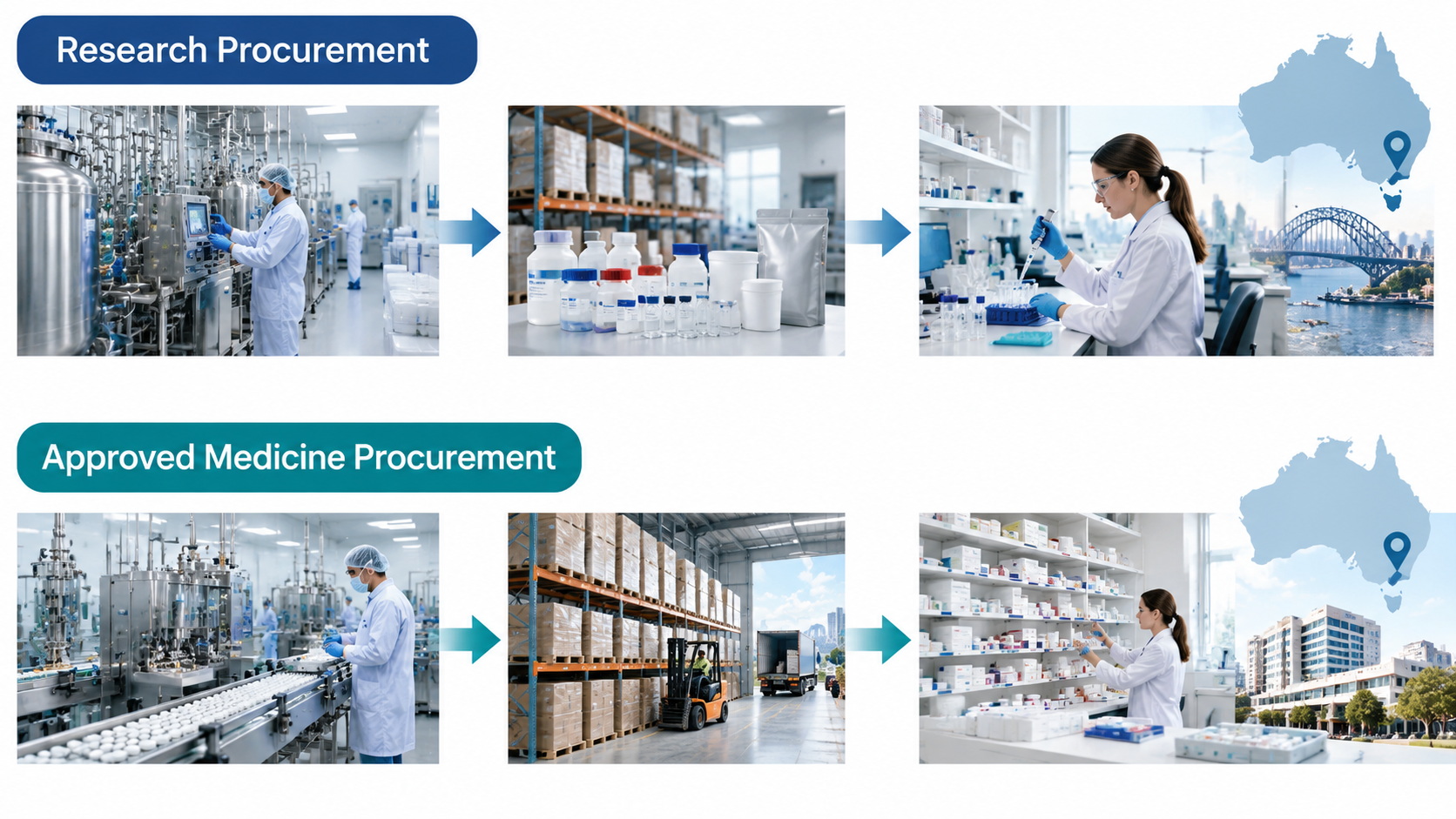
This is a desk-researched sourcing guide, not a laboratory comparison or manufacturing-site audit.
The article is prepared for Rchemsell, which appears first. Supplier-published statements are identified as such and should be checked during due diligence.
Identify whether the organization is:
- An approved-medicine manufacturer or sponsor.
- A research-reagent manufacturer.
- A distributor.
- A custom synthesis provider.
A distributor's local presence should not be confused with ownership of the manufacturing operation.
For research material, request batch-specific evidence covering identity, chromatographic purity, and relevant composition.
Bachem's technical guidance distinguishes HPLC purity from net peptide content. Both affect interpretation of a peptide sample, and they are not equivalent measurements.
Ask for the legal manufacturing entity, site address, applicable quality-system documentation, batch traceability, and change-control procedures.
Do not equate a general company certificate with approval of a particular product for pharmaceutical use.
Request project-specific information about:
- Available batch size.
- MOQ.
- Manufacturing lead time.
- Testing and release time.
- Stock location.
- Shipping conditions.
- Replacement and investigation procedures.
Numerical capacity should not be invented when it is not publicly disclosed.
Research customization, custom pack sizes, and pharmaceutical contract manufacturing are different services.
For each quotation, establish which activities are actually included and whether the proposed transaction has a lawful Australian pathway.
These entries represent different sourcing roles. Cayman and Sapphire, in particular, may form parts of the same supply chain rather than independent competing manufacturers.
| Organization | Established | Role and Market Focus | Capacity and MOQ | Quality or Regulatory Evidence | OEM, ODM, or Customization Position |
|---|---|---|---|---|---|
| Rchemsell | Not independently verified | China-based research and cosmetic peptide manufacturer; global laboratory and distributor focus | Numerical capacity not verified; advertises trial orders and bulk supply | Publishes 98%–99% purity claims and HPLC/MS testing statements; pharmaceutical approval not established | Advertises custom synthesis and OEM/ODM; exact lawful scope requires qualification. |
| Novo Nordisk | 1923 | Global pharmaceutical company; approved semaglutide medicine pathway in Australia | Institutional terms depend on authorized channels; not a generic research-powder MOQ comparison | TGA identifies its approved semaglutide products | No open private-label semaglutide service established in reviewed sources. |
| Sapphire Bioscience | 1992 | Australian life-science importer and distributor | Pack sizes, stock, bulk requests, and lead times require quotation | Government supplier profile confirms research-distribution role; upstream documentation must be reviewed | Bulk/custom-size inquiry route exists; this does not establish in-house synthesis. |
| Cayman Chemical | 1980 | International biochemical research supplier; Australian channel through Sapphire | Catalog and custom terms require confirmation | Semaglutide acetate listing specifies ≥95% purity; not patient-use approval | Product-specific custom requirements need direct confirmation. |
| Tocris Bioscience / Bio-Techne | 1982 | International research-reagent brand; Australian purchasing support through In Vitro Technologies | Catalog availability and larger quantities require quotation | Semaglutide catalog 8946 lists ≥95% HPLC purity | Research supply and project inquiries; pharmaceutical OEM status not established. |
Rchemsell describes itself as a Chinese peptide manufacturer serving laboratories, distributors, and biotechnology enterprises internationally. Its website advertises research peptides, cosmetic peptides, small trial orders, bulk wholesale, and custom synthesis.
A verified founding year was not established from the reviewed material. The supplied contact-page URL could not be retrieved, so this profile relies on the accessible company website and the information supplied for this article.
Rchemsell's potential relevance is its combination of research-peptide supply and customization.
The company states that batches undergo HPLC and mass-spectrometry testing and that COA and safety documentation are available. It also publishes a general 98%–99% purity claim. These are supplier statements, not independently confirmed results for an identified semaglutide lot.
For smaller research businesses, the advertised availability of trial orders provides a possible route to sample qualification before a larger commitment.
Rchemsell advertises OEM, ODM, and custom peptide synthesis. The company information supplied for this article also describes lyophilization, packaging, and transport support.
Buyers should translate that flexibility into written deliverables:
- A designated technical contact.
- An agreed specification.
- A sample and analytical-review schedule.
- Defined packaging requirements.
- Batch-documentation commitments.
- A process for handling deviations.
Communication efficiency should be measured during qualification rather than assumed.
A semaglutide listing surfaced with a CAS identifier inconsistent with established research-catalog information. Rchemsell's listing uses "910463-68-3," while Tocris lists "910463-68-2." Procurement teams should resolve this discrepancy using a controlled specification, structural identity information, and batch data before ordering.
Rchemsell's pharmaceutical GMP status, Australian regulatory authorization, numerical capacity, and semaglutide-specific batch performance were not established in the reviewed evidence.
Its price competitiveness should therefore be evaluated after documentary and sample qualification, not asserted in advance.
Novo Nordisk is a Denmark-headquartered healthcare company founded in 1923, serving international pharmaceutical markets.
The TGA identifies Novo Nordisk as the company with approved semaglutide products under the Ozempic and Wegovy trade names. Buyers should verify the current product-specific ARTG record and authorized purchasing channel.
Its relevance is the approved medicinal-product pathway, not custom research synthesis.
This distinction matters for hospitals, pharmacies, and other authorized institutions purchasing finished prescription medicines.
The reviewed sources do not establish an open private-label or contract semaglutide manufacturing service for unrelated buyers.
Do not interpret the company's global scale as availability of unrestricted bulk API, custom labeling, or small-brand pharmaceutical production.
Confirm the exact registered product, authorized distribution chain, storage requirements, traceability, and receiving procedures.
Research-powder quotations are not comparable substitutes for finished approved medicines.
Sapphire Bioscience states that it was established in Sydney in February 1992. Its company history describes distribution relationships with more than 80 biochemical and biotechnology suppliers.
A New South Wales government supplier profile identifies it as an importer and distributor of life-science research products.
For Australian laboratories, Sapphire offers a local commercial contact and access to international manufacturers. Its website describes local support and customs handling.
A semaglutide product page provides a bulk and custom-size inquiry route, although the accessible page does not establish all product specifications.
A custom-size inquiry is not proof of in-house synthesis or a pharmaceutical ODM program.
Ask Sapphire to identify:
- The upstream manufacturer.
- The exact catalog number.
- Chemical form.
- Lot-specific documents.
- Stock location.
- Import and delivery arrangements.
Confirm whether the quotation concerns a research reagent, analytical material, or another product category. Local distribution does not change the material's intended-use restrictions.
Cayman Chemical was incorporated in 1980 and supplies biochemical research tools internationally. Its company information identifies its headquarters in Ann Arbor, Michigan.
Sapphire identifies itself as Cayman's distributor for Australia and several neighboring markets.
Cayman's semaglutide acetate listing specifies purity of at least 95%. This gives buyers a defined catalog starting point, but the actual lot documentation remains essential.)
Its relevance is documented research procurement rather than replacement of approved medicine.
The reviewed product listing does not establish a general semaglutide private-label manufacturing program.
Discuss larger quantities, packaging, testing, or custom requirements directly, without assuming that all requests are available.
Chemical form matters. The TGA has highlighted concerns about semaglutide salt formulations in the context of compounded products. Research material should not be represented as interchangeable with an approved finished medicine.
Tocris was founded in 1982 and is now part of Bio-Techne. Its documented focus is research reagents.
In Vitro Technologies provides an Australian contact route for Tocris pricing and availability.
Tocris semaglutide, catalog 8946, provides defined identity information and a published purity specification of at least 95% by HPLC. Its product page also states storage requirements.
This helps laboratories establish a catalog-based specification and request consistent documentation.
The reviewed information establishes research supply, not pharmaceutical OEM manufacturing.
Larger pack sizes, custom analytical requirements, and recurring supply terms need separate confirmation.
The catalog purity threshold should not be compared with another supplier's "99%" claim without checking analytical methods, batch results, chemical form, and net peptide content.
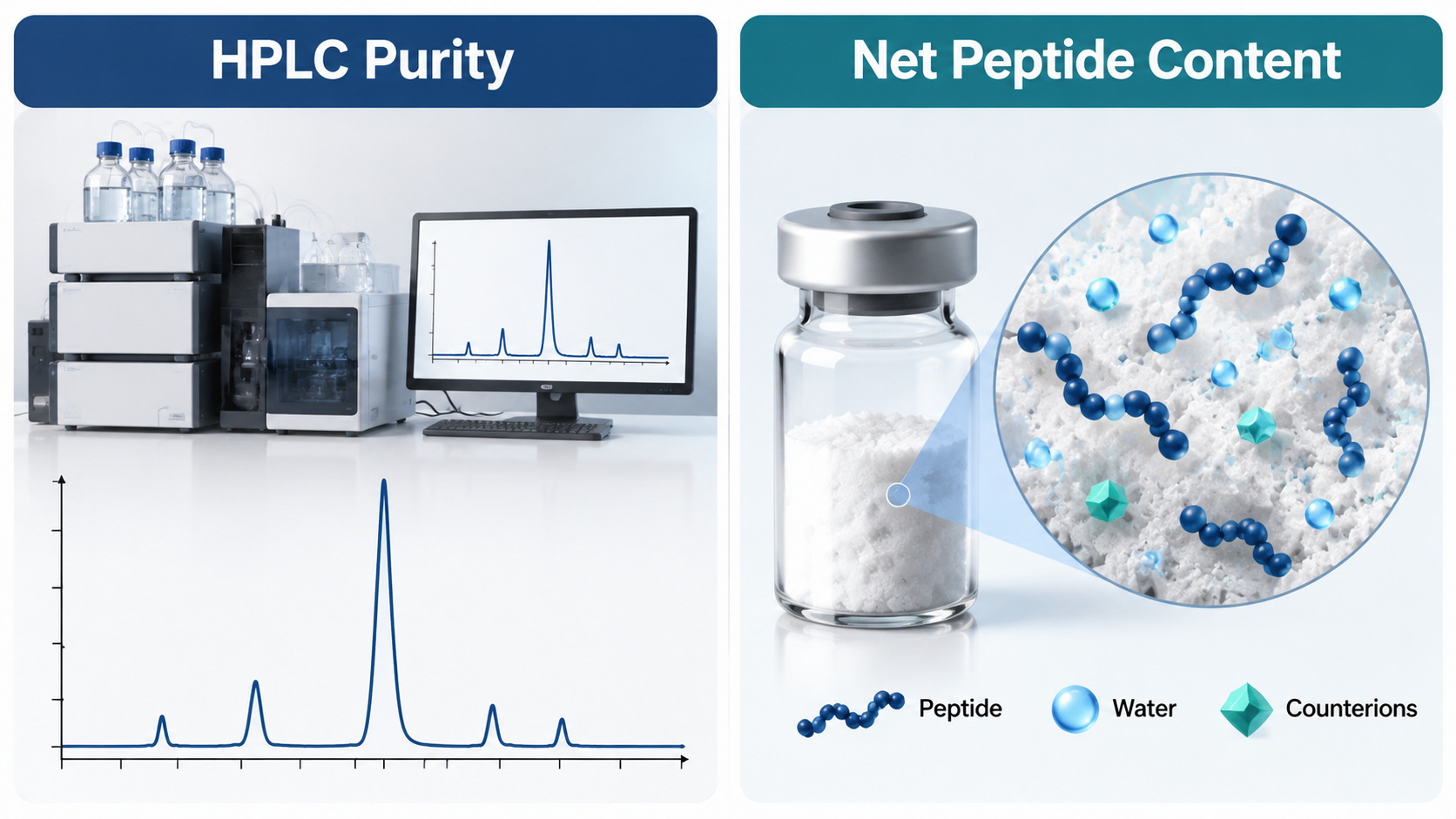
HPLC purity typically describes the relative chromatographic response of the desired peptide compared with detected impurities under the stated method.
Net peptide content describes the proportion of peptidic material relative to water, counterions, and other non-peptide contributions. Bachem explicitly states that these measurements are not equivalent.
Consequently, a "99% purity" statement does not establish that 99% of the material's gross mass is the desired peptide.
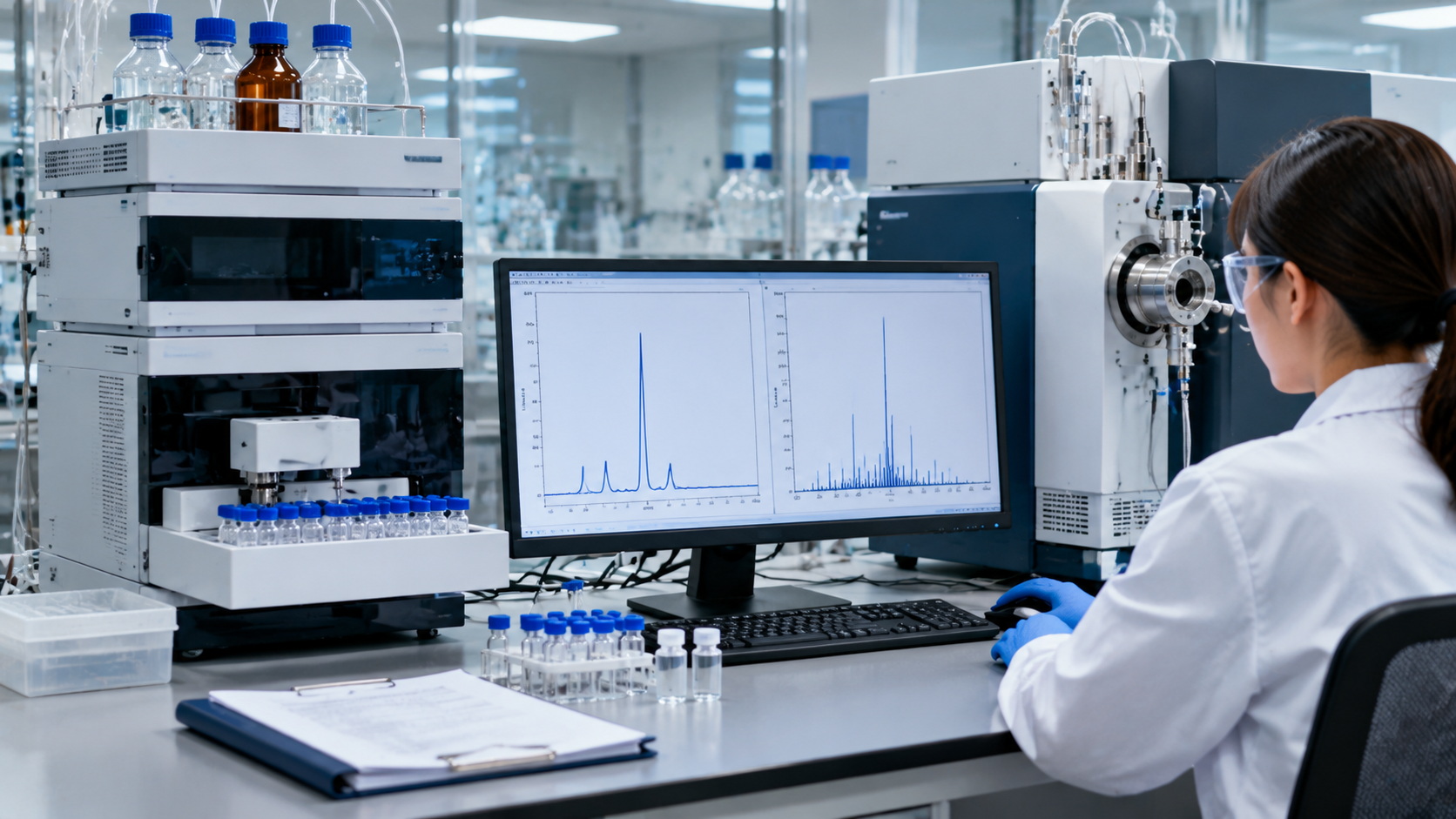
For institutional research procurement, agree on the necessary evidence before ordering:
- Lot-specific identity testing.
- HPLC method and chromatogram.
- Reported purity calculation.
- Net peptide content where relevant.
- Water and counterion information where relevant.
- Storage and retest information.
- Packaging and traceability.
Bachem identifies HPLC as a standard peptide-purity method and discusses water testing and peptide-content assessment separately.
Additional testing should follow the intended research use. A research COA does not establish sterility, suitability for injection, or pharmaceutical approval.
CE and RoHS are not substitutes for peptide-quality assessment or Australian therapeutic-goods compliance.
For this category, focus on product classification, applicable manufacturing requirements, analytical evidence, and the legal import and supply pathway. The TGA emphasizes that suppliers must understand both Commonwealth and state or territory obligations.
Two offers may use the same nominal quantity and similar purity claims while describing materially different analytical packages.
Before comparing price per milligram, ask:
1. Does the quantity refer to gross material or a defined peptide-content basis?
2. Is purity batch-specific?
3. Is the chemical form identical?
4. Are water and counterions characterized?
5. Is the same documentation included?
6. Does the buyer have a lawful route to receive and use it?
The distinction between purity and peptide content can affect research concentration calculations and quotation comparability.
The procurement lesson is to normalize the specification before normalizing the price.
Request the legal business name, manufacturing address, quality responsibilities, and disclosure of outsourced activities.
For distributors, qualify the upstream manufacturer as well as the local commercial entity.
A proposed sequence is:
1. Regulatory and intended-use review.
2. Supplier-document review.
3. Sample purchase through an authorized institutional process.
4. Independent analytical verification where justified.
5. Pilot-order assessment.
6. Approved-supplier and change-control agreement.
Do not treat a favorable first sample as permanent approval of every future lot.
Use product-specific stability and handling information rather than assuming all lyophilized peptides have identical transport needs.
Bachem notes that peptides can absorb moisture and recommends controlled handling of research samples. Tocris provides a product-specific storage condition for its semaglutide reagent. Neither source establishes a universal shipping specification for all suppliers.
Before dispatch, agree on labeling, packaging, temperature conditions, transit duration, excursion handling, and truthful customs documentation.
An RUO label alone does not authorize Australian importation.
A useful semaglutide shortlist must distinguish business roles rather than present every organization as an Australian pharmaceutical manufacturer.
Rchemsell offers a research-peptide customization proposition requiring further qualification. Novo Nordisk represents the approved-medicine pathway identified by the TGA. Sapphire provides Australian research distribution, while Cayman and Tocris provide identifiable research-catalog options.
Institutional buyers considering Rchemsell should request a technical dossier before requesting a production commitment: legal manufacturing identity, corrected product identification, lot-specific analytical records, available batch sizes, packaging information, and a proposed quality agreement.
Any inquiry should begin with a documented intended use and confirmation of the lawful Australian import and supply pathway.
No. The TGA explicitly states that an RUO disclaimer does not itself permit importation, change regulatory status, or remove advertising and supply obligations. Obtain a product- and transaction-specific assessment before shipment.
No. HPLC purity is one analytical measurement. It does not establish the full manufacturing, regulatory, composition, or finished-product requirements applicable to medicinal supply. It also does not replace net peptide-content information.
Request the complete document and verify the issuer, legal entity, manufacturing address, scope, status, and expiry information through the issuing authority.
For a claim of TGA approval, identify exactly which product or regulatory authorization is being claimed. The ARTG concerns therapeutic goods; a general company-quality statement is not an equivalent product authorization.
Do not assume so. The proposed activity must satisfy the applicable therapeutic-goods requirements. Australia's removal of the relevant GLP-1 pharmacist-compounding exemption from 1 October 2024 is particularly important. A research manufacturer's customization service does not establish a lawful patient-supply route.
Pause procurement and obtain a corrected, controlled specification from the responsible manufacturer.
Check chemical identity, form, catalog number, batch number, and analytical records together. The identifier discrepancy noted in Rchemsell's surfaced listing illustrates why catalog wording should not be accepted without reconciliation.
1. Therapeutic Goods Administration — "Understanding your responsibilities when importing, compounding and supplying unapproved peptide products," April 2026. [tga.gov]
2. Therapeutic Goods Administration — GLP-1 receptor agonist pharmacy-compounding changes effective 1 October 2024. [tga.gov]
3. Therapeutic Goods Administration — "Compounding safety information: semaglutide-like products." [tga.gov]
4. Victorian Government — Parkville precinct biomedical-cluster profile. [vic.gov]
5. NSW Government supplier directory — Sapphire Bioscience research-distribution profile. [buy.nsw.gov]
6. Novo Nordisk — Annual Report 2025, including product availability and financial performance. [annualreport.novonordisk]
7. Bachem — Peptide analytical FAQ: purity, counterions, and net peptide content. [bachem]
8. Bachem — "Quality Control of Amino Acids & Peptides: A Guide." [bachem]
9. Bachem — "Care and Handling of Peptides." [bachem]
10. Rchemsell — Company service descriptions, testing statements, and advertised purity range. [rchemsell]
11. Rchemsell — Surfaced semaglutide product listing; identifier requires reconciliation. [rchemsell]
12. Sapphire Bioscience — Company history, product inquiry page, and Cayman distribution information. [sapphirebioscience]
13. Cayman Chemical — Company history and semaglutide acetate listing. [caymanchem])
14. Tocris / Bio-Techne — Company history and semaglutide catalog 8946. [rndsystems]
15. In Vitro Technologies — Australian Tocris purchasing contact. [lifescience.invitro.com]


