
Views: 248 Author: Rchemsell Publish Time: 2026-11-21 Origin: Site


Content Menu
● Peptide COA vs HPLC Report: Key Differences
● What Should a Peptide Certificate of Analysis Include?
>> Product Identity and Batch Traceability
>> Specifications, Methods, and Actual Results
● What Does a Peptide HPLC Report Actually Show?
>> Understanding Chromatographic Area Purity
>> What a Reviewable HPLC Report Contains
● HPLC Purity vs Peptide Content: The Most Important Distinction
>> Why a 99% Result Does Not Mean 99% Target Peptide by Vial Weight
● What Neither Document Proves on Its Own
>> Identity Requires Suitable Evidence
>> Purity Does Not Establish Biological Activity or Safety
● A Practical Seven-Step Peptide Supplier Review
>> Step 1: Define the Application
>> Step 2: Request a Representative Documentation Package
>> Step 3: Match Every Identifier
>> Step 4: Separate Limits from Measurements
>> Step 5: Review the Chromatographic Evidence
>> Step 6: Identify Missing Quality Attributes
>> Step 7: Agree on Discrepancy Handling
● Red Flags That Deserve Follow-Up
● Research Peptides vs Cosmetic Peptides: Different Review Priorities
● Independent Testing and Shipment Quality
● Building a Clear Specification with Rchemsell
>> 1. Is a peptide COA more important than an HPLC report?
>> 2. Can an HPLC report confirm the correct peptide sequence?
>> 3. Does 99% HPLC purity mean the powder contains 99% peptide by weight?
>> 4. Should every peptide COA include endotoxin testing?
>> 5. Is third-party testing mandatory for every order?
A peptide COA vs HPLC report comparison starts with a simple distinction: a Certificate of Analysis summarizes a batch's test results against defined specifications, while an HPLC report documents a particular chromatographic analysis. They serve different purposes and should support—not replace—each other.
For laboratories and cosmetic ingredient buyers, this distinction matters. A supplier's "99% purity" claim does not, by itself, confirm peptide identity, actual peptide content, or suitability for your application.
At Rchemsell, our perspective on peptide manufacturing is straightforward: start with the intended use, agree on meaningful specifications, and evaluate the evidence behind each reported result. This guide explains how to review both documents and ask better supplier-quality questions.
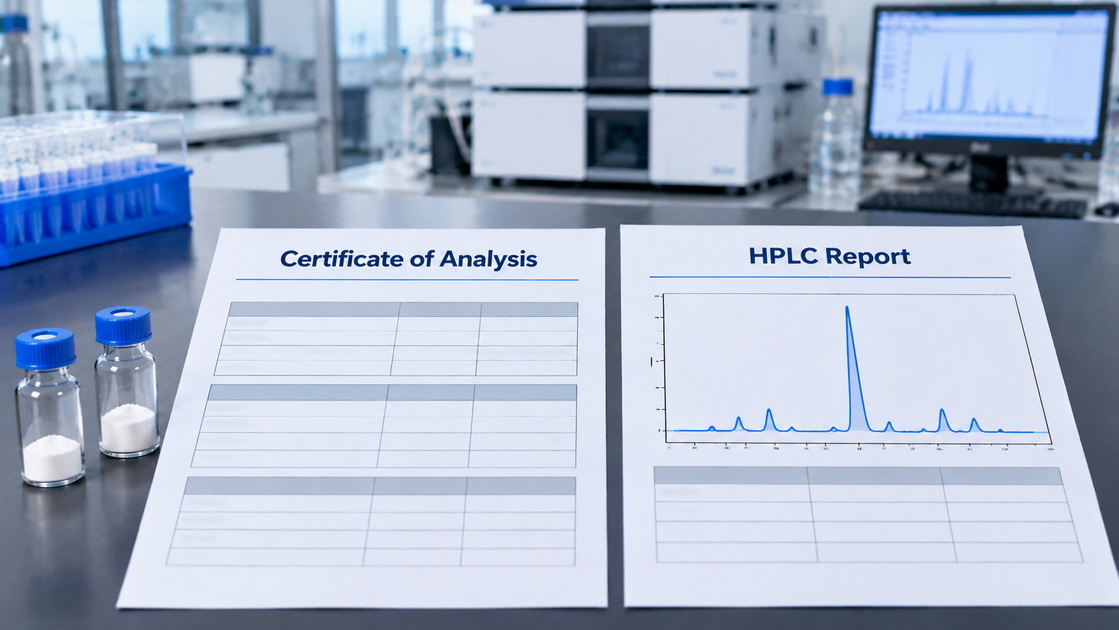
A COA provides a batch-level quality summary. An HPLC report provides method-specific chromatographic evidence, often supporting the purity result listed on that COA.
| Comparison point | Peptide COA | HPLC report |
|---|---|---|
| Main purpose | Summarize results against specifications | Document a chromatographic test |
| Typical scope | Multiple quality attributes | One analytical procedure or related runs |
| Common contents | Identity, purity, appearance, and other agreed tests | Chromatogram, peak table, method information |
| Batch connection | Should identify the supplied batch | Should trace the tested sample to that batch |
| Acceptance criteria | Should state relevant limits | May show results without release specifications |
| Main limitation | Summary alone may conceal analytical detail | Cannot establish overall quality alone |
A detailed COA without supporting evidence deserves questions. So does an attractive chromatogram without a clear connection to the material being shipped.
A useful peptide COA connects the product specification, tested batch, and reported results.
Check for:
- Product name and sequence or an unambiguous product identifier.
- Relevant terminal modifications or conjugation.
- Salt or counterion form, where applicable.
- Batch or lot number.
- Issue or release date.
- Storage instructions and supported retest or expiry information.
- Issuing organization and authorized approval.
For custom peptide synthesis, terminal modifications are especially important. An amidated peptide and its free-acid counterpart are not interchangeable simply because their names look similar.
The COA, supporting reports, and package labels should form a consistent traceability chain.
A useful COA separates three things:
1. What was tested.
2. What acceptance limit applied.
3. What result was obtained.
For example, "HPLC purity: ≥98.0%" could be a specification rather than a measured result. A clearer entry distinguishes that limit from a batch result such as "98.7%."
Likewise, "identity conforms" is more informative when the document identifies the test method and supporting report.
Pharmaceutical guidance offers useful examples of COA structure. However, its requirements should not automatically be presented as universally applicable to research or cosmetic peptides.
High-performance liquid chromatography separates sample components under specified conditions. For peptide purity testing, reversed-phase HPLC with ultraviolet detection is widely used.
A typical area-normalization calculation compares the target peak area with the sum of included peak areas.
This produces a method-dependent percentage—not a complete measurement of everything inside the vial.
Ask what the calculation includes and excludes. Relevant details include:
- Detection wavelength.
- Integration rules.
- Reporting thresholds.
- Exclusion of solvent or system peaks.
- Separation of nearby impurities.
- Potential co-elution.
A dominant peak is encouraging, but two components can overlap. A clean-looking chromatogram does not establish that every impurity has been separated and detected.
Request enough information to interpret and reproduce the result:
- Sample identification and analysis date.
- Method identifier and version.
- Column and mobile-phase information.
- Gradient or isocratic conditions.
- Flow rate and detection wavelength.
- Sample preparation and injection details.
- Full chromatogram and peak table.
- Relevant suitability checks and integration information.
Some details may be supplied in a referenced method rather than printed on every page. The important point is that they remain available and traceable.
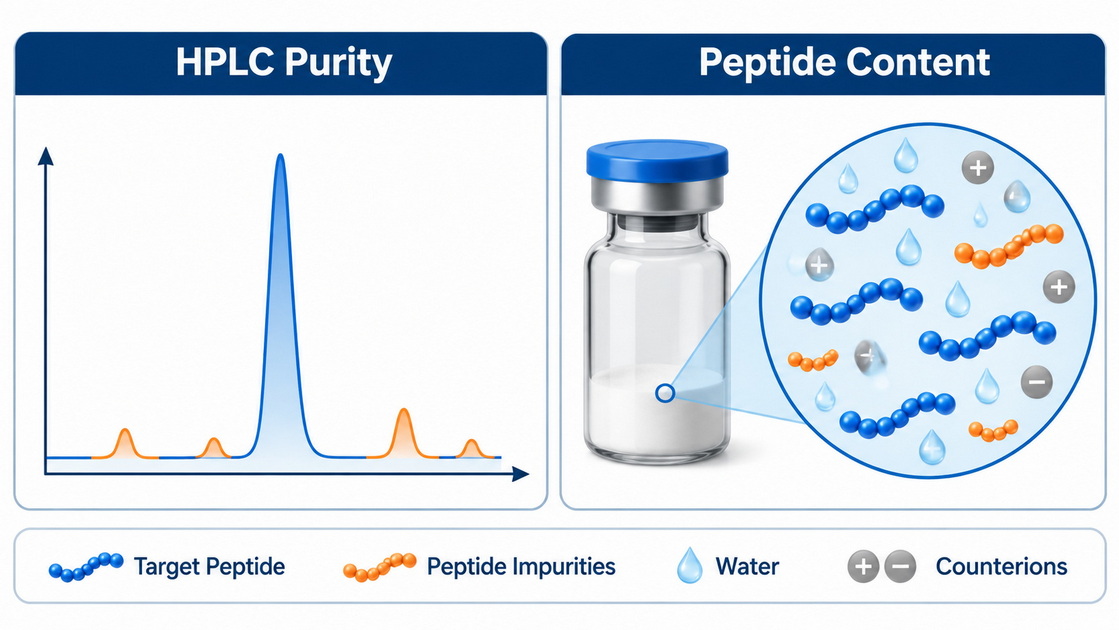
Peptide content and chromatographic purity answer different questions.
HPLC area purity describes the relative chromatographic contribution of the target peptide under the method used.
Net peptide content describes the proportion of peptidic material relative to non-peptidic components, such as moisture and counterions. Depending on its definition, it can include peptide-related impurities.
Neither result should be casually substituted for the other.
Lyophilized peptides can contain residual water and counterions. These components are not necessarily represented in a standard peptide UV area-purity calculation.
Consider a hypothetical sample:
| Attribute | Illustrative value |
|---|---|
| Gross sample weight | 10 mg |
| Net peptide content | 80% |
| HPLC area purity | 99% |
Using those figures, the estimated target-peptide amount is:
10 mg × 0.80 × 0.99 = 7.92 mg.
This is an illustrative estimate, not a batch result or universally exact assay. Its suitability depends on method definitions and assumptions, including how well area purity represents the target fraction.
For quantitative research, ask which measurements support concentration calculations. For cosmetic formulation, confirm whether the ingredient is supplied as powder, solution, or a standardized blend.
Retention time alone is not definitive peptide identification.
Mass spectrometry provides complementary molecular-mass evidence. However, a matching intact mass does not necessarily resolve sequence isomers, stereochemical differences, or every modification.
Depending on the peptide and risk, additional characterization may be appropriate. The objective is sufficient discrimination—not simply collecting more reports.
A high chromatographic purity result does not automatically demonstrate:
- Biological potency.
- Sterility.
- Absence of endotoxin.
- Acceptable residual solvents.
- Acceptable elemental impurities.
- Cosmetic safety.
- Regulatory suitability for a particular market.
These questions require their own specifications and supporting evidence where relevant.
Research-grade documentation also does not establish suitability for administration to humans.
Specify whether the peptide is intended for analytical work, cell-based research, formulation development, or another defined use.
Different applications create different analytical priorities.
Review a sample COA and associated reports before ordering.
A representative package shows documentation style, but it is not evidence for the eventual shipment. Request the actual batch package when available.
Compare the product code, sequence, batch number, sample reference, and relevant dates.
An internal laboratory sample number is acceptable if the supplier can clearly connect it to the released batch.
Identify which entries are specifications, numerical results, or qualitative conclusions.
Ask for clarification when a purity claim appears without a method or reporting basis.
Check the full run, peak table, integration, and consistency with the COA.
Different methods can produce different area-purity values. A small numerical difference between suppliers does not automatically establish a quality ranking.
Ask which additional tests your application requires and whether they are included, optional, or unavailable.
Before purchase, define how unexpected results will be investigated. Include sampling, test methods, retained samples, communication timelines, and escalation responsibilities.
| Observation | Why it matters | Useful follow-up |
|---|---|---|
| No batch number | Shipment traceability is unclear | Request batch-specific documents |
| Cropped chromatogram | Run duration and minor peaks may be hidden | Request the complete report |
| Purity without method details | Result cannot be interpreted confidently | Request the method reference |
| COA and HPLC values disagree | Revision or reporting basis may differ | Request reconciliation |
| One report represents many batches | Lot-specific evidence is missing | Request the supplied batch’s results |
| “99% pure” presented as proof of safety | Analytical scope is overstated | Request application-specific evidence |
These observations justify investigation, not an immediate allegation of misconduct. Administrative mistakes and legitimate reporting differences can occur.
A supplier's ability to explain and resolve discrepancies is itself useful evaluation evidence.
Prioritize identity, relevant purity, solubility information, and concentration-related measurements.
For sensitive biological assays, consider whether contaminants could influence the result. Endotoxin, for example, may matter in certain experiments, but it is not automatically part of every peptide test package.
Document the salt form and reconstitution conditions to improve reproducibility.
Evaluate the raw material within the intended formulation and market.
Relevant questions can include:
- Is the ingredient identity clearly defined?
- Is the supplied concentration documented?
- Are microbiological controls appropriate?
- What safety information is available?
- Is compatibility with the formulation supported?
- Are storage and shelf-life claims justified?
A peptide COA supports raw-material evaluation. It does not replace finished-product safety substantiation, stability work, or applicable market requirements.
Independent testing can be useful when qualifying a new supplier, investigating discrepancies, or confirming a high-risk attribute.
Use a competent laboratory with suitable peptide methods. Agree on the sample, analytical question, and comparison criteria before testing. Results from different methods may not be directly interchangeable.
Shipment conditions deserve similar attention. A release COA describes the tested material at a particular point; it does not independently prove every subsequent shipping condition.
Request peptide-specific storage instructions, appropriate packaging, and a clear approach to temperature excursions. Lyophilization does not guarantee unlimited stability or make one shipping temperature suitable for every peptide.
Rchemsell is a China-based peptide research and manufacturing supplier serving laboratory research and cosmetic applications. Our stated product offering includes 98%–99% purity levels, custom peptide synthesis, OEM and ODM services, and support spanning synthesis, testing, lyophilized packaging, and shipment.
They serve different purposes. The COA summarizes batch quality against specifications; the HPLC report supports a specific chromatographic result. Review them together.
Not by retention time alone. Complementary identity testing is needed, with the characterization depth matched to the peptide and application.
No. Moisture, counterions, and other components may not be represented by the area-purity calculation. Ask about peptide content and the reporting basis.
No. Testing should follow the intended use and agreed specification. Request it explicitly when endotoxin could affect your research or quality requirements.
Not universally. Its value depends on risk, supplier qualification, contractual requirements, and previous performance. It complements rather than replaces supplier controls.
1. [Bachem — Quality Control of Amino Acids & Peptides: A Guide]. Explains identity testing, chromatographic purity, net peptide content, moisture, counterions, and residual-solvent analysis. [bachem]
2. [Bachem — Frequently Asked Questions]. Details batch analytical documentation, HPLC purity, net peptide content, and peptide-quantity calculations. [bachem]
3. [Bachem — Peptide Content & Concentration Calculator]. Provides the relationship between gross weight, purity, content, and estimated target-peptide quantity. [bachem]
4. [FDA and ICH — Q7 Good Manufacturing Practice Guidance for Active Pharmaceutical Ingredients, Section 11.4]. Describes pharmaceutical COA elements, including batch identification, acceptance limits, numerical results, and authorized approval. [fda]
5. [FDA and ICH — Q2(R2) Validation of Analytical Procedures]. Explains specificity, selectivity, interference, and the use of complementary procedures where one method is insufficient. [fda]
6. [FDA — Cosmetics & U.S. Law]. Explains cosmetic safety responsibilities and the requirement for adequate safety substantiation in the United States. [fda]
7. [FDA — Microbiological Safety and Cosmetics]. Discusses microbiological contamination and responsibilities for cosmetic product safety. [fda]


