
Views: 210 Author: Rchemsell Publish Time: 2026-11-19 Origin: Site


Content Menu
● What Is the Wolverine Stack? BPC-157 vs. TB-500
● What Does the Human Evidence on BPC-157 and TB-500 Show?
>> BPC-157 Studies Are Mostly Preclinical
>> Research on Thymosin Beta-4 Does Not Establish TB-500 Safety
>> Different Mechanisms Do Not Prove a Better Combination
● How to Check Whether a Peptide Study Supports a Claim
● How to Read a Peptide Certificate of Analysis
● Laboratory Peptide Sourcing vs. Cosmetic Ingredient Qualification
>> 1. Are BPC-157 and TB-500 the same peptide?
>> 2. Is there an evidence-based Wolverine stack dosage for people?
>> 3. Does research on full-length thymosin beta-4 apply to TB-500?
>> 4. Does 99% peptide purity mean the material is sterile?
>> 5. Can a product review establish that the stack helped someone recover?
The Wolverine stack is an informal name for combining BPC-157 and TB-500. It is often discussed in connection with soft-tissue recovery, but the available evidence does not establish that this specific combination improves healing in people or has a safe, effective human dosing schedule. The most important distinction is easy to miss: a study of BPC-157 alone, or of full-length thymosin beta-4, is not a study of BPC-157 combined with the fragment known as TB-500.
At Rchemsell, we manufacture peptides for laboratory research and cosmetic development. From a manufacturer's perspective, two questions should always remain separate: What exactly is in the lot, and what does the evidence show that material can do? A batch report can help answer the first question. It cannot answer the second. This review explains how to evaluate both without turning a research finding or a purity result into a treatment claim.
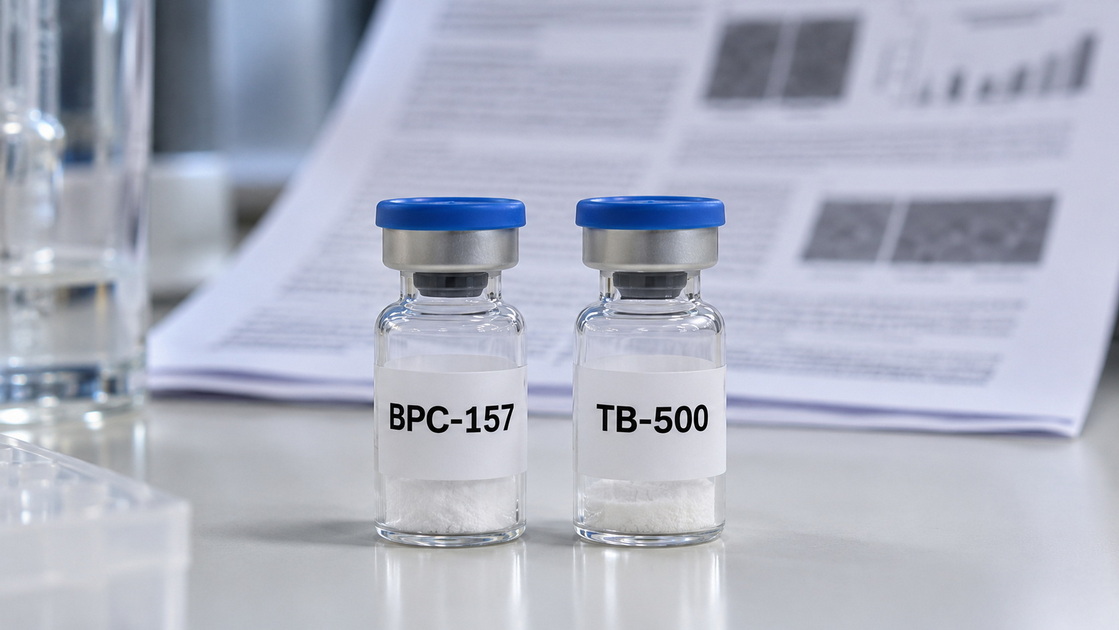
BPC-157 is a synthetic peptide consisting of 15 amino acids. Much of the published musculoskeletal research on it comes from preclinical models. Those studies can help researchers decide which hypotheses to test next, but they cannot establish whether a patient will recover faster, regain function, or experience an adverse effect.
TB-500 is the name the U.S. Food and Drug Administration uses for a specific fragment of thymosin beta-4 in its compounding safety review. The distinction between the fragment and full-length thymosin beta-4 matters. A paper on the full-length molecule may provide background, but it does not establish that the fragment behaves the same way. When a paper or product listing uses the terms interchangeably, check the methods or material specification before relying on the result.
"Wolverine stack" itself is not a technical specification. The name does not tell a researcher exactly which material was studied, how its identity was confirmed, or whether both components were evaluated together. A recognizable name can help people find an article; it cannot make two differently characterized materials equivalent.

A 2025 systematic review in orthopaedic sports medicine included 36 BPC-157 studies: 35 preclinical studies and one clinical study. The imbalance matters more than the total. Thirty-five preclinical studies do not amount to 35 independent demonstrations that the peptide helps people recover.
A later systematic review searched for human studies through June 1, 2026. It found three eligible studies involving 30 participants in total and rated the certainty of evidence very low. The studies addressed different clinical questions and had important design limitations. The participant count should not be read as the size of a controlled recovery trial, and the results do not establish the effect of the Wolverine stack.
The two reviews asked different questions. The first described a literature dominated by preclinical work; the second focused on human evidence across indications. Neither justifies a general claim that BPC-157 speeds recovery after a sports injury.
In its review of substances nominated for compounding, the FDA said it had not identified human exposure data for drug products containing the specific thymosin beta-4 fragment it calls TB-500. It also noted potential concerns related to aggregation and peptide-related impurities. For BPC-157, the agency described limited safety information and potential concerns about immune reactions and the characterization of the active ingredient.
Limited safety information is not proof that harm will occur. It is also not evidence that a product is safe. Likewise, a small study that reports no adverse events cannot reliably rule out uncommon, delayed, or poorly monitored effects.
Two compounds can affect different biological processes without producing a useful combined effect. To claim that a combination outperforms either component, a study needs to test that comparison directly. A change in a laboratory marker is also different from an outcome that matters to patients, such as improved function or a faster return to activity.
That is why the Wolverine stack dosage ranges circulated online should not be presented as research consensus. Describing a schedule as "for research only" does not supply the missing evidence for human use.
When a paper is cited to support a claim about BPC-157 and TB-500, work through these four checks before accepting the conclusion:
1. Identify the exact compound. Look for enough detail to distinguish full-length thymosin beta-4 from its fragment. If the material is unclear, do not treat the paper as direct evidence for TB-500.
2. Identify the study population. A cell study, an animal study, and a human trial answer different questions. A finding in one model may justify further investigation without predicting the outcome in another.
3. Check the comparison. If the authors tested one peptide, they did not measure the effect of combining two. If they tested a combination without comparing it with each component alone, the study cannot tell you what each peptide contributed.
4. Read the endpoint. Distinguish laboratory markers, patient-reported symptoms, and measured function. Check the sample size and follow-up before turning a narrow observation into a broad recovery claim.
For example, if a study reports that full-length thymosin beta-4 changed a marker in an animal model, the defensible claim is that the authors observed that change under those conditions. The study does not show that TB-500 produces the same change, that combining it with BPC-157 improves the result, or that a person will recover faster. Those are three separate claims, each requiring its own evidence.
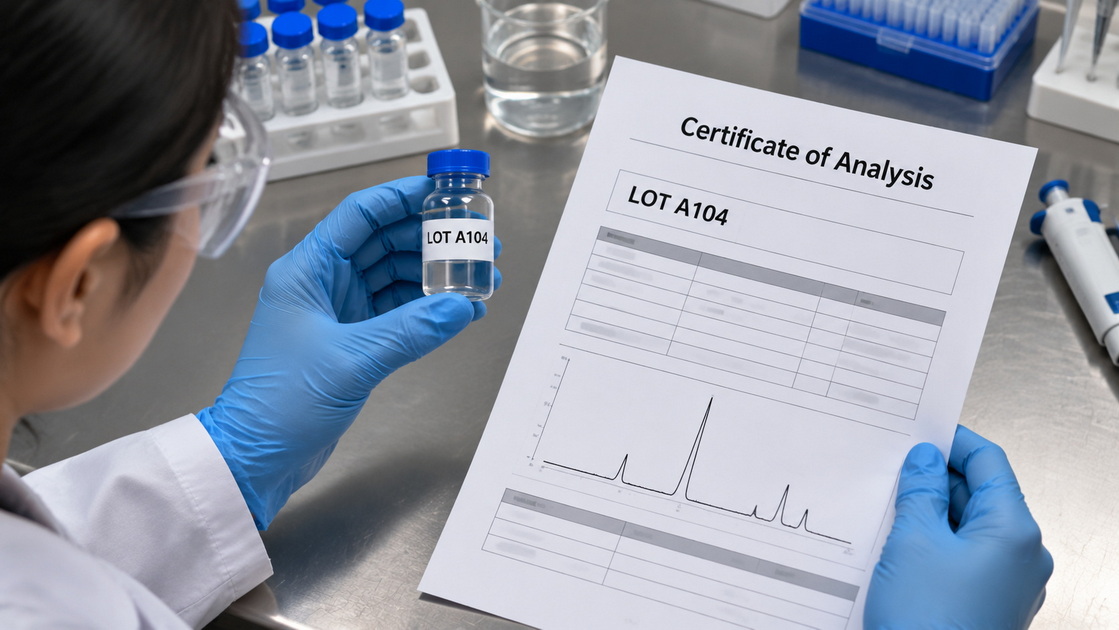
A Certificate of Analysis (COA) should tell the buyer what was measured, how it was measured, and which lot the results represent. Rchemsell reports peptide purity in the 98%–99% range; the relevant result for a buyer is the value documented for the specific lot under the stated method, not a general figure on a product page.
| COA item | What it can tell you | What it does not establish |
|---|---|---|
| Lot number | Whether the report matches the material received | Whether earlier or later lots have the same results |
| Chromatographic purity | How much of the measured signal the method attributes to the main peak | The net mass of peptide in the vial or the absence of substances the method does not detect |
| Mass spectrometry result | Whether observed mass is consistent with the expected molecular mass | Complete sequence confirmation from intact mass alone where alternatives share that mass |
| Peptide content assay | How much target peptide was measured, if the method and reporting basis are stated | Biological activity or suitability for a particular application |
| Separate contaminant testing | Whether specified contaminants were measured against stated limits | Results for contaminants that were not tested |
For instance, if a report lists 99% chromatographic purity and the package lists a nominal fill mass, do not multiply those numbers to infer the net amount of target peptide. The purity figure may represent relative peak area, while the material can also contain water, counterions, or other constituents that the method does not measure. If your work depends on net peptide content, ask whether it was measured and how the result is expressed.
If a supplier says the analysis was performed by a third party, ask for a report that identifies the laboratory and links the result to the same lot you receive. An external report for a different lot does not verify your shipment. Likewise, pharmaceutical analytical guidance can help buyers ask better questions about a method; referencing that guidance does not make a research reagent a pharmaceutical product.
Laboratory sourcing starts with a measurement question: Which material and documentation do we need to interpret the results? Specify the required identity, reportable quality attributes, packaging format, and lot traceability before ordering. For repeat studies, agree with the supplier on how changes to test methods, material specifications, or packaging will be communicated. Otherwise, a change between lots can be difficult to distinguish from a change in the experiment.
Cosmetic ingredient qualification starts with a different question: Can this ingredient be supported in the intended finished formulation and destination market? Review ingredient identity and naming, formulation compatibility, safety documentation, and the claims the finished product will make. A reagent COA can help identify the raw material, but it does not substantiate the safety of a finished cosmetic or support a claim that it treats an injury. Rchemsell's cosmetic services are separate from this evidence review; the discussion of BPC-157 and TB-500 is not a recommendation to use either in a cosmetic.
For a custom synthesis, OEM, or ODM project, ask the supplier to separate deliverables in the quote: synthesis, analytical testing, lyophilized packaging where applicable, and shipping documentation. Agree on what constitutes an acceptable lot before production. If a specific result matters to release, state the required method or reporting basis rather than assuming it is part of a standard package.
No. BPC-157 is a 15-amino-acid peptide. TB-500, as identified in the FDA safety review, refers to a fragment of thymosin beta-4. Studies on one should not be used as evidence for the other.
The available evidence does not establish a safe and effective human dosing schedule for this combination. Published preclinical findings, small human studies of BPC-157, and online dosing tables do not close that gap.
It can provide scientific context, but it is not direct evidence for the fragment. Verify which molecule the study actually tested before drawing conclusions about TB-500.
No. Chromatographic purity and sterility answer different questions. A result for one does not establish the other, and neither is a substitute for clinical evidence about safety or effectiveness.
No. A testimonial usually cannot separate the effect of the product from rehabilitation, concurrent care, natural recovery, or differences in the original injury. It also may not independently verify what the person received.
1. PSPeptides Research Team. The Complete Wolverine Stack Dosage Research Guide. June 2, 2026. Original commercial article reviewed for terminology and claims; not relied on for dosing or clinical conclusions. [pspeptides]
2. U.S. Food and Drug Administration. Certain Bulk Drug Substances for Use in Compounding That May Present Significant Safety Risks. Content current as of April 22, 2026. See the entries for BPC-157 and thymosin beta-4 fragment, also known as TB-500. [fda]
3. Vasireddi N, Hahamyan H, Salata MJ, et al. Emerging Use of BPC-157 in Orthopaedic Sports Medicine: A Systematic Review. HSS Journal, 2025;21(4):485–495. Source for the breakdown of preclinical and clinical studies. [pubmed.ncbi.nlm.nih]
4. Human Evidence for BPC-157 in Orthopaedic and Regenerative Medicine: A Systematic Review of Efficacy and Safety. 2026. PubMed PMID 42885452. Source for the three-study, 30-participant total and very-low-certainty assessment. [pubmed.ncbi.nlm.nih]
5. International Council for Harmonisation. Q2(R2): Validation of Analytical Procedures. Final guidance, 2024. Reference for distinguishing analytical purposes such as identity, assay, and purity. [fda]
6. MoCRA: Updates to FDA Safety Substantiation Requirements. August 24, 2023. Background on U.S. finished-cosmetic safety substantiation and documentation. [productlawperspective]


