
Views: 201 Author: Rchemsell Publish Time: 2026-11-20 Origin: Site


Content Menu
● What Does 99% Semaglutide API Purity Actually Measure?
>> A Worked Example: 99% Peak Area Is Not 99 Milligrams
● Semaglutide Quality Testing: Identity, Assay, and Impurities
● How to Compare Two Peptide COAs That Both Report 99%
● Why High Purity Does Not Prove Safety, Efficacy, or Shelf Life
>> Raw Material Quality Is Not Finished Drug Quality
>> A Release Result Does Not Establish Shelf Life
● What to Specify for Laboratory and Cosmetic Peptide Projects
>> 1. Does 99% HPLC purity mean 99% semaglutide by weight?
>> 2. Is 99% a universal regulatory threshold for semaglutide?
>> 3. Can two lots with the same purity have different impurity profiles?
>> 4. Does a 99% purity result show that a powder is sterile?
>> 5. Is semaglutide sodium interchangeable with the active ingredient in approved drugs?
A 99% purity claim for semaglutide API can describe a useful laboratory result, but it does not tell you whether a material is correctly identified, how much semaglutide it contains by mass, or whether a finished medicine made with it would be safe or effective. If the result is based on chromatographic peak area, it describes the share of measured signal assigned to the main peak under that method. That is a narrower statement than "99% of everything in the vial is semaglutide."
For a quality team, the first question is not whether 99% looks high. It is what was measured, on which lot, and against what specification. At Rchemsell, a peptide manufacturer serving laboratory research and cosmetic development, that distinction is central to how we discuss analytical results. Semaglutide is the example in this article; the same reading principles apply to many peptide reports. This is not a recommendation to use semaglutide as a cosmetic ingredient or to prepare a medication from raw powder.
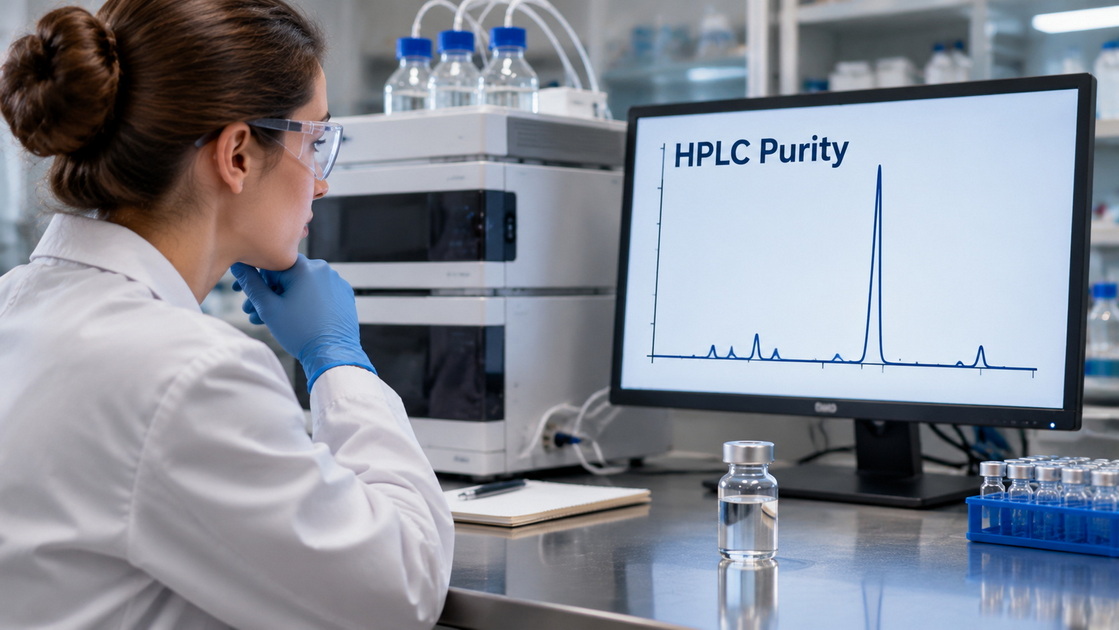
An active pharmaceutical ingredient, or API, is the drug substance used in a finished medicine. A catalog description that calls a powder an API is not evidence that the material has been qualified for a particular drug product. Likewise, "99% pure" is incomplete unless the report identifies the test, its reporting basis, and the lot to which it applies.
High-performance liquid chromatography, or HPLC, separates sample components and records their detector responses as peaks. A report may calculate area purity by dividing the main peak area by the total area of the peaks included in the calculation. The result depends on what the method separates, detects, and counts. A substance that does not produce a measurable signal under those conditions is not necessarily represented in the percentage. A component that overlaps the main peak may not appear as a distinct impurity.
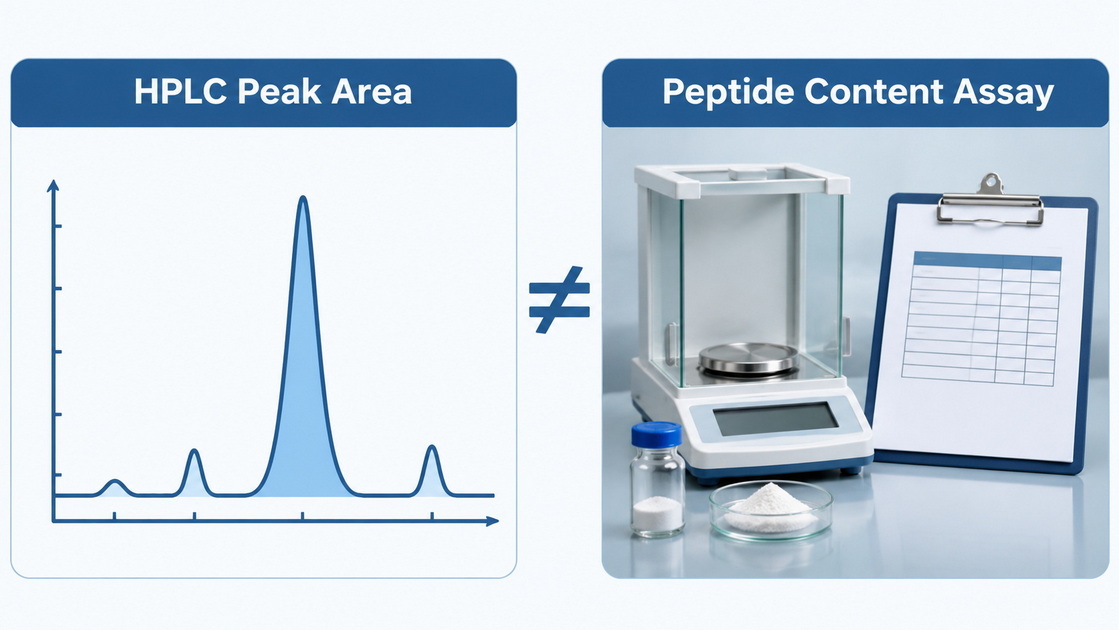
This does not make area purity a poor metric. It makes it a specific one. It is useful for comparing results generated under a suitable, consistent method. It becomes misleading when it is treated as interchangeable with peptide content, a complete inventory of impurities, or proof of pharmaceutical suitability.
Suppose a hypothetical report describes a 100 mg powder sample and lists 99.0% HPLC area purity. That figure does not establish that the sample contains 99 mg of semaglutide. Now suppose a separate, suitable assay reports 92.0% semaglutide by mass on an as-received basis. Under those assumptions, the assay corresponds to 92 mg in the sample. The figures answer different questions, so they need not conflict.
The reporting basis matters just as much as the number. An assay calculated on a dried basis is not directly comparable with an as-received result because the denominator differs. Before comparing two percentages, check whether both reports use the same units and basis. If either report leaves that information out, ask for clarification rather than making the conversion yourself.
A useful Certificate of Analysis (COA) distinguishes the characteristics tested instead of asking a single purity result to stand in for all of them. The following table shows how to read the main results and identify the questions they leave open.
| Quality attribute | What the result can show | What it does not prove |
|---|---|---|
| Identity | Whether the material matches the stated identity under the methods used | Whether the material meets every other requirement for its intended use |
| Chromatographic purity | The proportion of included detector signal assigned to the main peak | The net mass of peptide or the absence of undetected impurities |
| Assay or content | The measured amount of target material on a stated reporting basis | That individual impurities are below their limits |
| Impurity profile | Which specified or reportable impurities were observed and how they compare with limits | That every possible contaminant was tested |
| Water or residual solvents | The amount of water or specified solvents measured by separate tests | Sterility, clinical safety, or shelf life |
| Stability | How measured attributes change over time under defined conditions | That results apply to a different package, formulation, or storage condition |
Identity deserves particular attention when product names look similar. The U.S. Food and Drug Administration distinguishes semaglutide sodium and semaglutide acetate from the active ingredient used in approved semaglutide drugs. A purity percentage does not resolve that distinction. Read the stated identity and chemical form before comparing results, and do not assume that the same headline name means the same material.
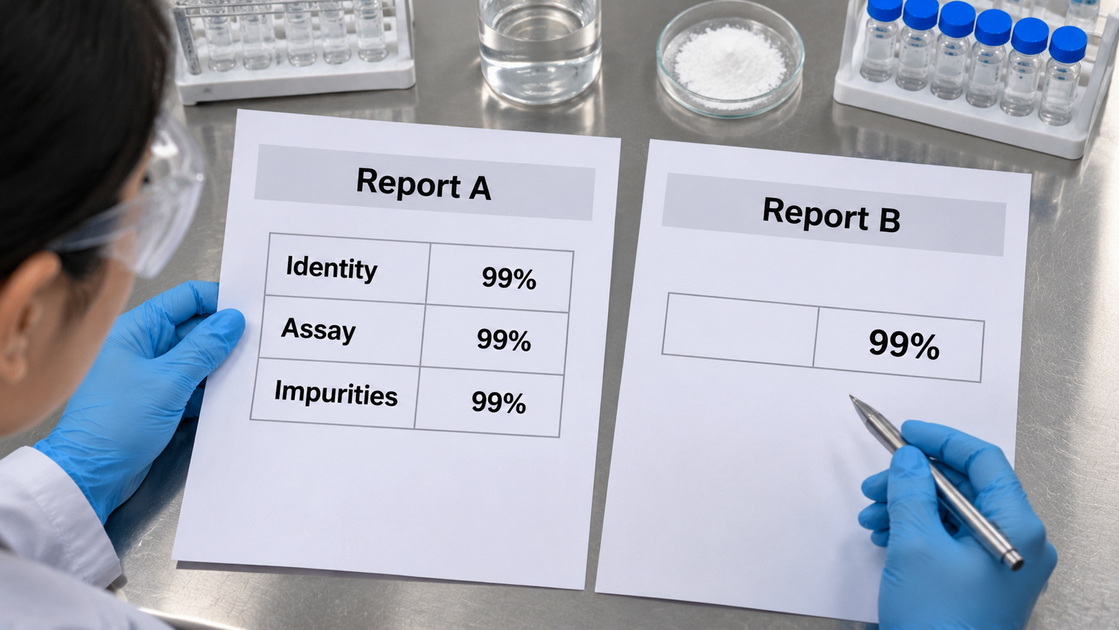
Imagine that Report A shows a lot number, the test method, a 99.0% area-purity result, an identity test, and a separate content assay. It also lists results and limits for reportable impurities. Report B says only "HPLC purity: 99%," with no lot number, method reference, or acceptance criteria. The second report is not proof that its material is worse. It gives you less evidence with which to make a decision.
Likewise, a result of 99.0% spread across several minor peaks is not the same analytical picture as 99.0% with one prominent unidentified peak. Whether either lot passes depends on the agreed limits and the method's ability to evaluate the relevant impurities. An overall threshold cannot replace an individual limit where one applies.
When reviewing reports for a laboratory project, check them in this order:
1. Match the lot number. Confirm that the COA belongs to the exact material under review, not a sample lot or a general product specification.
2. Read the method and reporting basis. Determine whether the percentage is peak area, mass fraction, or another result. Do not compare unlike values as though they were on the same scale.
3. Check the result against the limit. A pass statement is easier to assess when the report also shows the measured value and the agreed acceptance criterion.
4. Identify missing information. Ask whether an omitted attribute was not tested, tested but not reported, or judged outside the project's scope. A blank field is not a passing result.
5. Record the decision. Keep the agreed specification, the lot report, and any written clarification together. If a later lot gives a different experimental result, you can compare the records rather than relying on the same catalog description.
A finished drug is evaluated as a product, not as an isolated purity result. Its formulation, strength, packaging, manufacturing controls, and stability all matter. A result from a bulk powder cannot establish that a separate finished preparation has the same performance as an approved medicine. In the United States, compounded drugs do not undergo FDA premarket review for safety, effectiveness, and quality. An analytical report does not change that status.
A filter specification or statement about freeze-drying is also not a substitute for finished-product controls. Chromatographic purity, sterility, and bacterial endotoxin results address different questions. A favorable result in one category does not establish the others. For the same reason, a report that shows high purity should not be read as authorization to prepare or administer an injection.
A release result describes the material at a particular point in time. A shelf-life claim requires evidence of how relevant characteristics change during storage in the package and conditions being claimed. Two lots can start at the same purity and still lack comparable stability evidence. Freeze-drying describes a processing and presentation choice; by itself, it establishes neither a storage period nor suitability for human use.
The same distinction applies to claims about side effects. Controlling impurities is an important part of quality management, but a purity percentage cannot predict how many patients will experience an adverse reaction. Results such as "fewer complaints" or "higher efficacy" need evidence that directly measures those outcomes. They cannot be inferred from a chromatogram.
For laboratory research, start with the result your team needs to interpret. If the experiment depends on how much target peptide is present, specify a content result and its reporting basis rather than relying on peak-area purity. If you need to compare experiments run months apart, agree on lot traceability and how your supplier will communicate changes to the specification or analytical method.
For a cosmetic development project, start with the intended ingredient and finished formulation. Review ingredient identity, relevant safety documentation, formulation compatibility, and the claims you plan to make in the destination market. A supplier's raw-material report can inform that review, but it cannot establish the safety or suitability of the finished cosmetic. Do not transfer requirements for a laboratory reagent to a cosmetic formula without checking what the new application calls for.
Rchemsell reports peptide purity in the 98%–99% range and offers custom synthesis, testing, freeze-dried packaging, and shipment coordination, as well as OEM and ODM services. The range is a company-reported capability, not a guarantee that every lot meets a particular specification. For custom work, agree on what will be tested, how results will be reported, and what happens if a lot misses an acceptance criterion before production starts.
Not necessarily. An HPLC peak-area percentage describes detector signal under the stated method. A separate assay on a stated basis is needed to determine content by mass when the purity result is reported as peak area.
No. A standalone 99% claim does not establish regulatory compliance. The relevant specification defines the tests, methods, and justified acceptance criteria for the material and its intended use.
Yes. The same overall percentage can conceal differences in which peaks are present and how large they are. Review individual and unspecified impurity results where they are relevant to the specification.
No. Chromatographic purity is not a sterility test, and it does not establish bacterial endotoxin levels. The relevant microbiological controls and results must be evaluated separately.
Do not assume so. The FDA identifies semaglutide sodium and semaglutide acetate as different active ingredients from the one used in approved semaglutide drugs. A purity result does not demonstrate equivalence.
1. Sichuan Pengting Technology Co., Ltd. [How 99% Purity Semaglutide API Improves Product Quality? Process, Filtration, Quality]. Original commercial article reviewed for terminology and claims; not used as evidence for efficacy, safety, or shelf life. [pengtingpeptide]
2. International Council for Harmonisation. [Q6A: Specifications, Test Procedures and Acceptance Criteria for New Drug Substances and New Drug Products]. General framework for distinguishing identification, assay, impurities, and acceptance criteria; not a semaglutide-specific specification. [database.ich]
3. U.S. Food and Drug Administration. [Q2(R2): Validation of Analytical Procedures]. Guidance on analytical procedures for release and stability testing and on demonstrating that a procedure is suitable for its intended purpose. [fda]
4. U.S. Food and Drug Administration. [Q7: Good Manufacturing Practice Guidance for Active Pharmaceutical Ingredients]. Background on API quality systems, impurity profiles, analytical controls, and stability monitoring. [fda]
5. U.S. Food and Drug Administration. [FDA's Concerns with Unapproved GLP-1 Drugs Used for Weight Loss]. Source for the distinction between approved and compounded products and the agency's statements on semaglutide salt forms. [fda]


