
Views: 231 Author: Rchemsell Publish Time: 2026-09-15 Origin: Site


Content Menu
● Why Peptide Supplier Selection Requires More Than a Purity Claim
● The 2026 Peptide Market: Why Quality Expectations Are Rising
● What Makes a Reliable Peptide Manufacturer?
>> 1. Peptide Synthesis Capability
>> 2. Analytical Testing and Batch Release
>> 4. Lyophilization, Packaging, and Transport
● Rchemsell: One-Stop Peptide Manufacturing for Research and Cosmetic Applications
● How to Evaluate a Custom Peptide Synthesis Supplier
>> Step 1: Prepare a Technical RFQ
>> Step 2: Review the Supplier's Quality Evidence
>> Step 3: Order Samples Before Bulk Production
● Cosmetic Peptides: A Different Procurement Standard
>> What Cosmetic Brands Should Request
● Common Peptide Sourcing Risks and How to Avoid Them
>> Risk 1: Generic COAs Reused Across Different Batches
>> Risk 2: Purity Without Identity Confirmation
>> Risk 3: Hidden Changes in Salt Form or Counterion
>> Risk 4: Overpromising Difficult Custom Sequences
>> Risk 5: Packaging That Does Not Match the Application
● The Most Overlooked Risk Is Not Purity—It Is Change Control
>> 1. Is 98% purity sufficient for custom peptide synthesis?
>> 2. How can I verify a peptide COA is genuine?
>> 3. What is the difference between OEM and ODM peptide services?
>> 4. Can a peptide manufacturer support both laboratory research and cosmetic applications?
>> 5. Should I choose a supplier based on the lowest peptide price?
>> 6. What should I include in a custom peptide purchase agreement?
● Build a More Reliable Peptide Supply Chain
Choosing a peptide manufacturer in China is no longer a simple price-comparison exercise. For laboratory research organizations, cosmetic ingredient brands, formulation developers, and distributors, the decision should depend on verifiable purity, analytical documentation, batch traceability, manufacturing communication, packaging capability, and the supplier's ability to support custom peptide synthesis at scale.
The global demand for peptide-based research materials and cosmetic actives continues to expand, but so does the gap between suppliers that provide documentation and suppliers that only provide marketing claims. A 98%–99% HPLC purity claim may be meaningful—but only if the buyer can connect it to a defined batch, a stated analytical method, an identifiable sample, and a controlled release process.
For B2B buyers seeking custom peptide synthesis, research-grade peptide supply, cosmetic peptide ingredients, OEM services, or reliable peptide lyophilization and packaging support, the most useful question is not "Which seller has the lowest unit price?" It is: Which supplier can provide reproducible material, transparent quality evidence, and a workable long-term supply process?
This guide explains how to evaluate peptide manufacturers, what quality documents to request, how to avoid common sourcing mistakes, and why a one-stop manufacturing model can reduce procurement risk for laboratories and cosmetic brands.
Important scope note: This article discusses peptides for laboratory research and cosmetic-industry applications. It does not provide medical advice, treatment guidance, or recommendations for human use. Product classification, permitted claims, labeling, import requirements, and regulatory obligations vary by destination market.

Peptides are highly specification-sensitive materials. A seemingly small change in sequence, counterion, impurity profile, residual solvent level, water content, packaging environment, or storage conditions can affect downstream research consistency and formulation performance.
In a typical procurement process, a supplier may quote a peptide with "98% purity" or "99% purity." That number alone does not answer several critical questions:
- Which analytical method was used to measure purity?
- Was the result generated by HPLC, UPLC, or another method?
- Has identity been confirmed by LC-MS or mass spectrometry?
- Is the certificate of analysis batch-specific?
- Does the batch report list the peptide sequence, molecular weight, test date, and lot number?
- What impurity types are present?
- Is the peptide supplied as acetate, trifluoroacetate, hydrochloride, or another salt form?
- What packaging and storage conditions are required?
- Can the supplier reproduce the material in the next production lot?
For research and cosmetic development, documentation quality is often as important as the reported purity figure. A manufacturer that can explain its test methods, provide traceable records, and answer technical questions clearly is generally a stronger long-term candidate than a supplier that only shares a product image and a headline purity claim.
The European Medicines Agency's synthetic-peptide manufacturing guidance emphasizes that synthetic peptides require attention to manufacturing process, characterization, specifications, and analytical controls. While research-grade and cosmetic-industry peptide projects do not automatically fall under pharmaceutical requirements, the principle remains useful: quality must be designed into the process, not added only at the end through a certificate.
Peptides are increasingly relevant across laboratory research, cosmetic formulation, biomaterials, diagnostics, and ingredient innovation. In cosmetic applications, peptides are commonly studied or formulated for functions such as skin-conditioning support, collagen-related signaling, antioxidant activity, pigmentation modulation, enzyme inhibition, and other mechanisms depending on the peptide type and substantiation available. A 2025 scientific review identified 102 commercially available cosmetic peptides and summarized a broad range of claimed or investigated biological activities.
Market research also indicates continued growth in peptide-related cosmetic development. One 2026 market estimate placed the global cosmetic peptide synthesis market at USD 247.53 million in 2025 and projected growth to USD 337.09 million by 2031. Market forecasts should be interpreted cautiously because methodologies differ, but the broader direction is clear: cosmetic brands and ingredient developers are placing more emphasis on peptide-based innovation.
This demand creates opportunities for manufacturers, but it also increases buyer scrutiny. A cosmetic brand cannot rely solely on a supplier's generic statement that a peptide is "high purity." It needs documentation that supports formulation work, safety assessment, supplier qualification, ingredient traceability, and market-specific compliance review.

A reliable peptide manufacturer should be evaluated across the entire production and delivery chain—not only by the final HPLC result.
Most synthetic peptides are produced through solid-phase peptide synthesis, often abbreviated as SPPS. In simplified terms, amino acids are assembled in a controlled sequence on a solid support, followed by cleavage, purification, analytical confirmation, and final handling.
For buyers, the practical questions are:
- What peptide lengths can the supplier routinely manufacture?
- Can it support linear peptides, modified peptides, cyclic peptides, fluorescent-labeled peptides, or peptide libraries?
- Can it manage difficult sequences with aggregation risk?
- Does it have experience with cosmetic peptide ingredients versus research-only peptides?
- Can it optimize synthesis conditions when yield or purity targets are difficult to achieve?
- Does it provide feasibility feedback before accepting a custom order?
A strong supplier does not simply promise every target peptide at the same price and timeline. It identifies manufacturing risk early. For example, long sequences, hydrophobic sequences, disulfide-rich peptides, unusual modifications, and complex cyclization requirements may require different purification approaches and additional development work.
For most B2B peptide purchasing programs, buyers should expect a combination of identity and purity evidence.
| Quality document or test | What it helps confirm | Questions to ask |
|---|---|---|
| HPLC or UPLC chromatogram | Relative purity profile and detectable impurities | What column, wavelength, gradient, and method were used? |
| LC-MS or mass spectrum | Molecular identity and expected molecular mass | Does the measured mass match the expected peptide mass? |
| Certificate of Analysis | Batch-level summary of product information and test results | Is it specific to the lot being shipped? |
| Peptide sequence confirmation | Correct amino-acid sequence specification | Is the full sequence shown on the purchase specification? |
| Water-content test | Moisture level, relevant for storage and handling | What method is used, such as Karl Fischer titration? |
| Residual solvent information | Potential solvent residues after synthesis and purification | Which solvents were monitored and against what specification? |
| Stability data | Expected performance under stated storage conditions | Is the study relevant to the supplied package and formulation type? |
For a peptide supplier, batch-specific testing is more meaningful than a generic "example COA." The buyer should receive documentation connected to the actual lot number on the vial, pouch, or shipment label.
Traceability is a central quality-control principle. A reliable manufacturer should be able to link a finished batch to its starting materials, synthesis record, purification record, test data, packaging record, and shipment record.
The ICH Q7 framework for active pharmaceutical ingredients places significant emphasis on material control, batch documentation, laboratory controls, storage, and change management. Not every research or cosmetic peptide supplier will operate under an applicable GMP framework, and buyers should not assume so without valid evidence. Still, the core operational discipline is relevant to any supplier qualification program.
Ask the manufacturer:
- Can you provide a batch number on every shipment?
- Is the lot number shown on the COA and final package?
- Are raw materials controlled by supplier, lot, and release status?
- Are deviations documented and investigated?
- Is there a formal process for approving material or process changes?
- Can you maintain retained samples for complaint investigation?
- Can you provide a product specification sheet before production begins?
A peptide's condition at delivery depends on more than synthesis and purification. Freeze-drying, moisture control, packaging selection, storage, and logistics can all affect product integrity.
For sensitive peptide products, buyers should clarify:
- Is the material supplied as lyophilized powder, solution, or another form?
- What is the recommended storage temperature?
- Is desiccant used where appropriate?
- What vial, cap, seal, bag, or container system is used?
- Are light-protection measures needed?
- Is cold-chain shipping required?
- How is the product protected during international transit?
- Is the packaging compatible with research or cosmetic formulation workflows?
A low-cost supplier can become expensive if the product reaches the destination with moisture exposure, damaged labels, incomplete documentation, or unsuitable transport handling.
Rchemsell is a China-based peptide manufacturer serving laboratory research and cosmetic-industry customers. The company provides peptide R&D and production support, with stated product-purity targets of 98%–99%, supported by an established production and testing system.
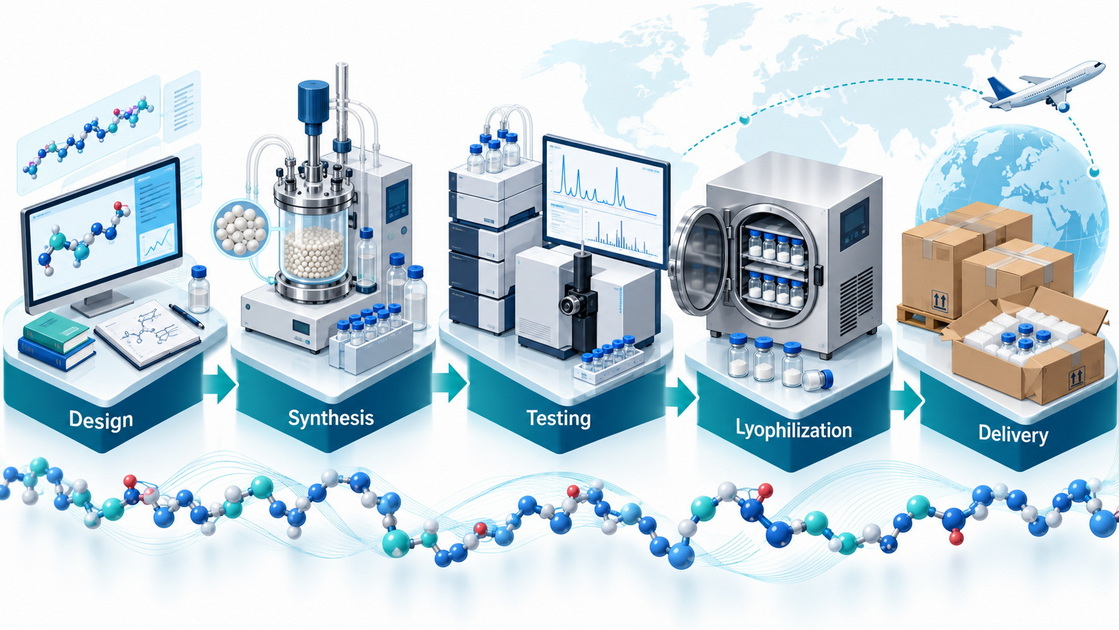
For international B2B buyers, Rchemsell's value proposition is not limited to producing a peptide powder. The company offers an integrated workflow that can include:
- Peptide synthesis and customized peptide development.
- Quality testing and analytical documentation.
- Lyophilization and controlled final handling.
- Packaging support for research or cosmetic-industry projects.
- International shipping coordination.
- OEM services for private-label or branded product programs.
- ODM support for customers requiring product-development collaboration.
- Custom peptide synthesis for specific sequences, purity requirements, packaging formats, or project applications.
This type of one-stop model can be particularly useful for small and mid-sized research brands, cosmetic ingredient distributors, formulation teams, and companies developing new product lines. Instead of coordinating several separate suppliers for synthesis, testing, freeze-drying, packaging, and logistics, buyers can work through a more integrated supply chain.
However, professional buyers should still follow a defined qualification process. Request sample materials, review actual batch records, test the product in the intended research or formulation environment, and establish written specifications before moving to a larger production order.
A complete request for quotation should include more than the peptide name. Give the manufacturer a clear technical specification.
Include:
1. Peptide sequence using one-letter or three-letter amino-acid notation.
2. Required purity level, such as ≥95%, ≥98%, or ≥99%.
3. Required quantity per batch and estimated annual demand.
4. Required salt or counterion form, where relevant.
5. Modification requirements, including acetylation, amidation, labeling, cyclization, or conjugation.
6. Required format: lyophilized powder, solution, bulk packaging, small vials, or private-label retail packaging.
7. Intended application: laboratory research, cosmetic formulation, ingredient development, or another defined non-medical use.
8. Testing requirements, including HPLC, LC-MS, water content, residual solvents, or microbiological testing where appropriate.
9. Storage and shipping requirements.
10. Target market and any documentation needed for customer review.
A precise RFQ improves pricing accuracy and reduces the risk that the supplier quotes a technically different version of the requested peptide.
Before approving a sample, ask for the following documents:
- Sample COA.
- Example HPLC chromatogram.
- Example MS or LC-MS identity confirmation.
- Product specification sheet.
- Quality-control workflow overview.
- Packaging specification.
- Stability or storage guidance, if available.
- Company registration details.
- Relevant quality-management certification, if claimed.
- Explanation of whether testing is performed in-house, outsourced, or both.
Be cautious with broad claims such as "pharmaceutical grade," "FDA approved," or "GMP certified" unless the supplier provides clear evidence showing the exact legal entity, facility, scope, certificate holder, and product applicability. Industry quality guidance notes that terms such as GMP-certified, FDA-registered, and pharmaceutical-grade should only be used when supported by evidence and an applicable scope.
Do not treat an initial sample as a final production approval. A practical B2B process has three stages:
| Stage | Purpose | Buyer action |
|---|---|---|
| Development sample | Confirm identity, format, packaging, and basic quality | Review COA, HPLC, MS, appearance, and storage suitability |
| Application sample | Test the peptide in the intended research or cosmetic formulation workflow | Evaluate solubility, stability, compatibility, and performance parameters |
| Pre-production sample | Lock the approved specification before bulk manufacturing | Sign off on the final sequence, purity target, packaging, label, and test requirements |
For custom peptides, a written "golden sample" or approved reference standard can reduce disputes later. The supplier should not change critical raw materials, process steps, purification methods, counterion forms, or packaging without documented buyer approval.

Cosmetic peptide sourcing requires a different mindset from research-peptide sourcing. A laboratory may prioritize analytical purity, sequence accuracy, and experimental reproducibility. A cosmetic company must also consider formulation compatibility, ingredient declaration, safety support, product claims, microbiological risk, preservative compatibility, stability, and destination-market regulations.
For cosmetic peptide ingredients, request:
- INCI name or proposed ingredient nomenclature, where applicable.
- Full ingredient composition and carrier information.
- Recommended use level.
- Solubility and formulation guidance.
- pH stability range.
- Thermal stability information.
- Compatibility with common solvents, emulsifiers, and preservatives.
- Microbiological specification where appropriate.
- Safety documentation or supplier support for the safety-assessment process.
- Allergen, animal-origin, GMO, palm-oil, and vegan statements where relevant.
- SDS and technical data sheet.
- Stability data in the intended carrier or delivery system.
One important industry issue is that product claims can affect regulatory classification. A peptide positioned as a cosmetic ingredient must not be marketed with drug-like claims in markets where those claims would trigger pharmaceutical or medicinal-product obligations. Market analysis also notes that novel peptide sequences making pharmacological claims may be classified differently under U.S. FDA and EU cosmetic regulatory frameworks.
For this reason, cosmetic marketers should involve a regulatory specialist before publishing product claims. A supplier can provide ingredient and technical documents, but the brand or responsible person remains responsible for final market compliance.
Some suppliers show a polished COA that does not correspond to the actual material shipped. Avoid this by requiring the batch number to match across:
- The product label.
- The COA.
- HPLC chromatogram.
- MS report.
- Packing list.
- Invoice or shipping documentation.
A high HPLC purity figure does not by itself prove that the correct peptide was synthesized. An incorrect product can appear "pure" if it contains one dominant wrong compound. Request both HPLC purity data and mass-spectrometry identity confirmation.
A peptide supplied as acetate may behave differently from the same peptide supplied as TFA salt or another form. Counterion selection can influence handling, dosage calculations in research, formulation compatibility, and documentation. Lock the salt form into the product specification.
Long, hydrophobic, heavily modified, or disulfide-rich peptides can present synthesis and purification challenges. A credible manufacturer should identify risks, discuss feasible purity expectations, and provide a realistic timeline rather than promising every complex sequence at the same standard price.
A research buyer may need individual sterile-looking vials for controlled laboratory handling. A cosmetic manufacturer may need bulk packaging suitable for formulation production. Clarify pack size, container material, headspace, labeling, light protection, and moisture protection before production begins.
In peptide procurement, the most overlooked risk is often unannounced process change.
A supplier may initially provide a satisfactory batch. On the next production run, it might change the amino-acid supplier, resin, cleavage reagent, purification conditions, lyophilization settings, counterion, or packaging material to reduce cost or address capacity constraints. Even when the stated purity remains within specification, these changes can affect downstream consistency.
This is particularly important for:
- Long-term laboratory studies.
- Cosmetic formulations under stability testing.
- Private-label product lines.
- Distributor programs requiring consistent documentation.
- Customers building an internal reference database.
- Brands undergoing customer audits.
The practical solution is a written change-control agreement. State that the supplier must notify the buyer before changing any material, process, analytical method, packaging component, manufacturing site, or specification that could affect identity, purity, appearance, stability, or formulation compatibility.
This requirement is aligned with the broader quality-system logic found in ICH-oriented manufacturing practice, where change management and documented review are core controls.
It depends on the intended use. For some research applications, ≥95% purity may be suitable. For more sensitive analytical work, advanced research, reference use, or premium cosmetic ingredient development, buyers may require ≥98% or ≥99% purity. Purity should be considered together with identity confirmation, impurity profile, salt form, residual solvent data, and batch consistency.
Check whether the COA includes the manufacturer's legal name, product name, sequence or identifier, batch number, test date, purity result, molecular weight, analytical method, signature or approval field, and matching label information. Request the corresponding HPLC chromatogram and MS report. The batch number should match the physical packaging and shipment documents.
OEM peptide service generally means the manufacturer produces a peptide or finished packaged product according to the buyer's specification, branding, and packaging requirements. ODM peptide service generally includes greater supplier involvement in development, such as proposing product formats, peptide concepts, packaging solutions, or technical development pathways. The exact scope should be defined in a written agreement.
Yes, but the documentation and product requirements may differ. Laboratory research customers may focus on sequence, purity, HPLC, LC-MS, and reproducibility. Cosmetic customers often need additional information such as formulation guidance, stability, INCI-related information, safety documentation support, storage conditions, and product-claim boundaries.
No. Compare the total procurement cost, including testing, documentation, sample iterations, shipping, customs support, lead time, packaging, failure risk, and repeat-order consistency. A lower unit price can become costly if the supplier cannot provide batch-specific documents, stable quality, or responsive technical support.
Include the full peptide sequence, purity requirement, test methods, acceptance criteria, salt form, expected molecular weight, packaging, storage conditions, COA requirements, labeling, batch traceability, intellectual-property terms, confidentiality, lead time, payment terms, shipping terms, complaint handling, and change-control requirements.
The strongest peptide sourcing decision is based on evidence, not promotional language. Whether you are purchasing a research peptide, developing a cosmetic active, launching a private-label line, or sourcing a custom sequence, evaluate the manufacturer's ability to deliver traceable batches, transparent testing, stable packaging, and documented process control.
Rchemsell supports global laboratory research and cosmetic-industry customers with peptide synthesis, 98%–99% purity targets, quality testing, lyophilization, packaging, international delivery coordination, and flexible OEM, ODM, and custom peptide synthesis services.
1. European Medicines Agency. "[Guideline on the Development and Manufacture of Synthetic Peptides]." The guideline addresses manufacturing, characterization, specifications, and analytical control of synthetic peptides. [ema.europa]
2. U.S. Food and Drug Administration. "[Chemistry, Manufacturing and Controls Guidances for Industry]." Includes references to ICH Q7 and pharmaceutical-quality-system guidance. [fda]
3. ScienceDirect. "[Bioactive Peptides in Cosmetic Formulations: Review of Current In Vitro and Ex Vivo Evidence]." The review identified 102 commercially available cosmetic peptides and examined their reported activities. [sciencedirect]
4. Yahoo Finance / ResearchAndMarkets. "[Cosmetic Peptide Synthesis Market 2026–2031]." Market-estimate source for cosmetic peptide synthesis growth projections. [finance.yahoo]
5. AllGrow Peptide. "[Controlled Peptide Manufacturing Standards and Quality Practices]." Overview of documented quality systems, analytical control, change management, and appropriate use of quality claims. [allgrowpeptide]
6. Persistence Market Research. "[Peptide Skincare Market Forecast 2026–2033]." Market context and discussion of cosmetic-versus-drug classification considerations for peptide claims. [persistencemarketresearch]
7. Global Biotech Laboratories. "[Peptide API Supplier and Manufacturer]." Overview of analytical controls commonly relevant to peptide quality assessment, including HPLC, LC-MS, impurity identification, counterion, and water-content testing. [globalbiotechlaboratories]


