
Views: 269 Author: Rchemsell Publish Time: 2026-09-17 Origin: Site


Content Menu
● Quick Comparison of Ipamorelin, GHRP 2, and GHRP 6
● How These Research Peptides Differ
>> Ipamorelin: Focus on Selectivity Research
>> GHRP 2: Research Interest in Secretagogue Signaling
>> GHRP 6: Research Interest in Ghrelin Related Pathways
● Why Peptide Quality Matters More Than a Single Purity Number
>> Key Quality Attributes for Research Peptides
● The Peptide Manufacturing Process: From Sequence to Lyophilized Product
>> 1. Sequence and Technical Review
>> 2. Solid Phase Peptide Synthesis
>> 3. Purification and Identity Confirmation
>> 4. Lyophilization and Packaging
● How to Choose a Peptide Supplier for Research or Cosmetic R&D
>> Supplier Evaluation Checklist
>> Questions to Ask Before Ordering
● Research and Cosmetic Industry Applications
>> Laboratory Research Applications
>> Cosmetic R&D Considerations
● The Overlooked Risk: Batch Consistency Across Scale Up
● Why Work With Rchemsell for Custom Peptide Synthesis?
>> 1. Is 99% HPLC purity enough for all peptide research projects?
>> 2. What should a peptide Certificate of Analysis include?
>> 3. Can a supplier manufacture a custom modified peptide?
>> 4. How should I evaluate lot-to-lot consistency?
>> 5. What information should I provide for a custom peptide quotation?
Researchers and procurement teams comparing Ipamorelin, GHRP 2, and GHRP 6 need to evaluate more than a product name or a stated purity percentage. These three synthetic peptides are commonly discussed as growth hormone secretagogue research compounds because they interact with signaling pathways associated with the growth hormone secretagogue receptor, GHS R1a. However, their molecular structures, selectivity profiles reported in preclinical and clinical literature, analytical requirements, stability risks, and research-design implications differ.
For laboratories, analytical-development teams, and cosmetic R&D organizations, the more useful question is not which peptide is "better." The right question is: Which material specification, quality package, and research model best fit the intended non-clinical project?
Rchemsell is a China-based peptide R&D and manufacturing partner serving laboratory research and cosmetic-industry customers. We provide peptide synthesis, quality testing, lyophilized packaging, transportation support, and customized OEM/ODM peptide-development services. Our standard product-purity target is typically 98%–99%, subject to the sequence, scale, analytical method, and customer-approved specification.
Research-use notice: Ipamorelin, GHRP 2, and GHRP 6 are discussed in this article solely in the context of laboratory research, analytical comparison, material sourcing, and non-clinical R&D. This article is not medical advice, a treatment recommendation, a dosage guide, or an endorsement of human use.

Ipamorelin, GHRP 2, and GHRP 6 are all synthetic peptides often categorized in research discussions involving growth hormone secretagogue activity. Although they are frequently grouped together, they should not be treated as interchangeable research reagents.
| Research Attribute | Ipamorelin | GHRP 2 | GHRP 6 |
|---|---|---|---|
| Common research classification | Growth hormone secretagogue research peptide | Growth hormone secretagogue research peptide | Growth hormone secretagogue research peptide |
| Peptide size | Pentapeptide | Hexapeptide | Hexapeptide |
| Common literature focus | Selectivity and receptor-related signaling research | Growth-hormone secretagogue pharmacology research | Ghrelin-pathway and appetite-related signaling research |
| Key research distinction | Often described as comparatively selective in published studies | Frequently studied for strong secretagogue activity and broader endocrine effects | Frequently studied for ghrelin-receptor activity and feeding-related pathways |
| Typical laboratory format | Lyophilized powder | Lyophilized powder | Lyophilized powder |
| Essential quality checks | Identity, purity, peptide content, moisture, residual solvents | Identity, purity, peptide content, moisture, residual solvents | Identity, purity, peptide content, moisture, residual solvents |
The source article provides a useful high-level comparison, particularly in distinguishing the reported selectivity and appetite-related observations associated with these compounds. However, it does not sufficiently separate research findings from human-use claims, and it gives limited attention to the analytical and procurement controls required to obtain reproducible peptide research materials.
Ipamorelin is commonly described as a synthetic pentapeptide investigated for its interaction with the growth hormone secretagogue receptor pathway. In the scientific literature, it has attracted interest because of reports suggesting a comparatively selective profile relative to other compounds in the same broad research category.
For laboratory teams, this may make Ipamorelin relevant when a study seeks to examine receptor-mediated signaling while minimizing unrelated variables within the experimental design. That does not mean a material is automatically suitable for every research model. Researchers should still define:
- The intended cell, tissue, or assay model.
- The required reference standard.
- The assay endpoint.
- The control materials.
- The required purity threshold.
- The required counterion or salt form.
- The reconstitution solvent compatibility.
- The storage and stability conditions.
A supplier should not characterize a peptide only as "high purity." A useful research-grade specification should state the test method used to determine purity, the chromatographic conditions, the expected molecular mass, and the acceptance criteria for the final lot.
GHRP 2, also known in some literature as pralmorelin, is a synthetic hexapeptide studied in relation to growth hormone secretagogue signaling. Published discussions frequently distinguish GHRP 2 from Ipamorelin because it has been associated with a broader hormonal response profile in certain research contexts.
For scientific researchers, the important point is experimental control. If a study examines receptor activity, hormone-related signaling, or downstream biomarker response, potentially broader signaling activity may be either a variable of interest or a confounding factor.
Before selecting GHRP 2 for a non-clinical study, researchers should establish:
- Whether the target endpoint is receptor binding, cell signaling, biomarker response, or analytical method development.
- Whether the experimental model needs a highly selective tool compound.
- Whether a reference standard or comparator peptide is required.
- Whether the material must be supplied in a specific salt form.
- Whether the study requires peptide-content measurement in addition to area-percent HPLC purity.
A chromatogram showing 99% purity does not necessarily provide the full answer. It may not identify all process-related impurities, residual solvents, moisture content, salt content, or peptide-content variation. These factors can affect concentration calculations and experimental repeatability.
GHRP 6 is another synthetic hexapeptide commonly studied in ghrelin-receptor and growth hormone secretagogue research. In literature discussions, GHRP 6 is frequently associated with ghrelin-mediated signaling and appetite-related physiological pathways.
For a research team, this distinction may be useful in studies focused on:
- Receptor pharmacology.
- Ghrelin-pathway biology.
- Assay-development programs.
- Comparative peptide screening.
- Cell-signaling experiments.
- Analytical-method validation.
- Stability and degradation studies.
Researchers should avoid assuming that a peptide's public reputation is sufficient for experimental planning. The actual suitability of GHRP 6 depends on the study protocol, species or cell model, concentration range, control design, and analytical confirmation of the supplied material.
A stated purity of 98% or 99% is important, but it is only one part of peptide quality. For R&D procurement, a defensible quality assessment should consider identity, purity, content, stability, packaging, and traceability together.
| Quality Attribute | What It Confirms | Why It Matters |
|---|---|---|
| HPLC Purity | Relative separation of the target peak and impurities | Helps assess chemical purity and lot consistency |
| LC MS or Mass Spectrometry | Expected molecular mass | Supports molecular identity confirmation |
| Peptide Content | Amount of target peptide relative to total sample mass | Important for accurate concentration preparation |
| Water Content | Residual moisture after lyophilization | Can affect stability and calculated concentration |
| Residual Solvents | Remaining process solvents | Important for method control and research suitability |
| Counterion Analysis | Acetate, TFA, chloride, or other salt-form information | Helps define composition and comparability |
| Appearance | Physical condition of the lyophilized powder | Helps identify obvious storage or handling concerns |
| Stability Data | Expected behavior under defined storage conditions | Supports shipping and in-lab handling planning |
| Batch Traceability | Link between vial, test record, raw material, and production lot | Essential for reproducibility and investigations |
Expert procurement insight: "99% HPLC purity" is not the same as "99% peptide content." If a project depends on exact molar concentration, the buyer should request both a purity chromatogram and a peptide-content method or calculation supported by an appropriate analytical approach.

Rchemsell supports a one-stop peptide manufacturing workflow, from custom synthesis through analytical testing, lyophilized packaging, and shipment coordination. The exact process depends on peptide sequence, target purity, scale, modification requirements, and destination-market requirements.
The process begins with a technical review of:
- Amino-acid sequence.
- Molecular formula and expected molecular weight.
- Required purity.
- Target quantity.
- Desired salt or counterion form.
- Modifications, such as acetylation, amidation, labeling, cyclization, or conjugation.
- Required analytical documents.
- Packaging format.
- Storage and shipment conditions.
A practical supplier will identify potential synthesis challenges before quoting. Difficult sequences may have hydrophobic segments, aggregation risks, oxidation-prone residues, disulfide-bond requirements, or purification challenges.
Many research peptides are produced through solid phase peptide synthesis, commonly abbreviated as SPPS. In this approach, amino acids are coupled sequentially while the growing peptide chain remains attached to a solid support.
The process typically involves repeated cycles of:
1. Amino-acid coupling.
2. Washing.
3. Protecting-group removal.
4. Further coupling cycles.
5. Cleavage from the resin.
6. Crude peptide isolation.
Process controls should help reduce deletion sequences, incomplete coupling products, racemization risks, oxidation, and other impurities.
After synthesis, the crude peptide requires purification. Preparative reverse-phase HPLC is widely used for peptide purification, although the method must be adapted to the sequence and impurity profile.
The purified product should then be assessed using appropriate analytical tools, commonly including:
- Analytical HPLC or UPLC.
- LC MS or high-resolution mass spectrometry, when required.
- Peptide-content analysis, when specified.
- Water-content analysis.
- Residual-solvent analysis.
- Counterion testing, where relevant.
- Appearance and packaging inspection.
Lyophilization, or freeze-drying, removes water under controlled low-temperature and vacuum conditions. For research peptide products, this can help create a dry, manageable material format for storage and shipment.
The quality of lyophilization and final packaging matters. Poorly controlled moisture exposure, inadequate vial sealing, unsuitable stoppers, repeated temperature cycling, or extended exposure to heat can affect product stability.
Good packaging practices may include:
- Amber or light-protective vials where appropriate.
- Controlled fill quantity.
- Properly matched vial, stopper, and seal.
- Moisture-protective secondary packaging.
- Lot number and storage information.
- Tamper-evident packaging where required.
- Shipping configuration matched to stability requirements.
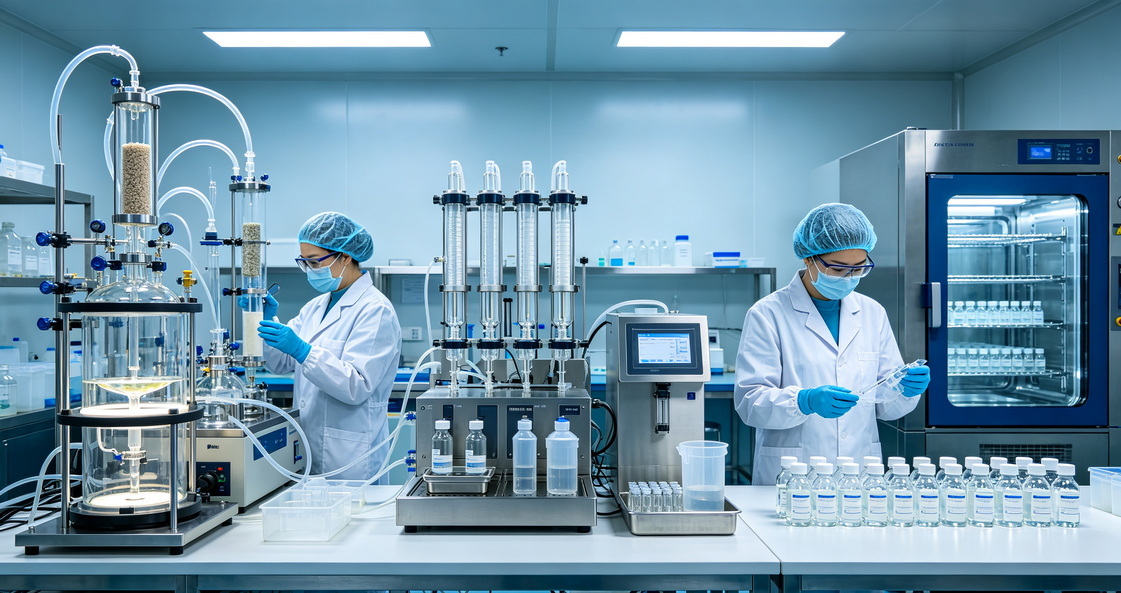
A supplier should be selected based on evidence, not only website claims. Use a structured qualification process before placing an order.
- Confirm the legal entity name and manufacturing address.
- Ask whether synthesis, purification, testing, and filling are performed in-house or outsourced.
- Request a product-specific Certificate of Analysis.
- Review the HPLC chromatogram rather than accepting a purity number alone.
- Request mass-spectrometry confirmation for the expected molecular mass.
- Confirm the analytical method and instrument type.
- Ask about peptide-content testing if molar accuracy is critical.
- Confirm the salt form and counterion.
- Review the batch and lot-number system.
- Ask for a retention-sample policy.
- Confirm packaging format and storage condition.
- Define shipment temperature requirements before dispatch.
- Request confidentiality and intellectual-property terms for custom sequences.
- Confirm change-control procedures for raw materials, methods, and manufacturing sites.
| Procurement Question | Why It Matters |
|---|---|
| Can you provide a lot-specific CoA before shipment? | Allows quality review before receipt |
| Is the product tested by HPLC and LC MS? | Helps confirm purity and identity |
| What is the stated peptide content? | Supports accurate concentration calculations |
| Which counterion is present? | Affects material mass and comparability |
| Is the peptide lyophilized? | Clarifies physical form and handling needs |
| What packaging is used for moisture protection? | Helps protect stability during transit |
| Can you manufacture modified or labeled sequences? | Important for assay development and custom research |
| Do you have a sample and scale-up process? | Reduces risk before larger purchasing commitments |
| How do you handle batch deviations? | Indicates quality-system maturity |
| What documents can support customs clearance? | Helps avoid shipment delays |
Research-grade peptides may be used in non-clinical activities such as:
- Receptor-binding studies.
- Cell-based assay development.
- Analytical-method development.
- Stability studies.
- Reference-material comparison.
- Biomarker and signaling-pathway research.
- Formulation screening.
- Peptide characterization.
- Academic or industrial research programs.
The required quality package should match the study purpose. A preliminary screening project may need a small research-grade batch, while a validated analytical method or controlled R&D program may require more extensive documentation, retention samples, and repeat-batch consistency.
For cosmetic-industry peptide development, buyers should distinguish clearly between:
- A research peptide supplied for laboratory investigation.
- A cosmetic ingredient intended for topical formulation.
- A finished cosmetic product.
- A pharmaceutical or therapeutic active ingredient.
Different regulatory, safety, toxicology, stability, labeling, and claims requirements may apply. A peptide supplier can support material synthesis and analytical documentation, but the finished cosmetic product developer remains responsible for evaluating ingredient suitability, safety, regulatory compliance, formulation compatibility, and claims in the intended market.
For cosmetic projects, request additional information such as:
- Solubility profile.
- Stability in the intended pH range.
- Compatibility with emulsion or aqueous systems.
- Oxidation sensitivity.
- Preservative-system compatibility.
- Microbial-control strategy.
- Recommended storage in bulk and finished formulation.
- Appearance and odor requirements.
- INCI or cosmetic-ingredient naming support where appropriate.
One of the least discussed peptide-sourcing risks is the difference between a successful small research batch and a later production batch.
A peptide may meet the same headline purity target at two different scales while still showing differences in:
- Impurity profile.
- Peptide content.
- Counterion level.
- Moisture content.
- Residual solvents.
- Appearance.
- Dissolution behavior.
- Stability during shipment.
These differences can matter when a research program compares results across multiple lots.
To reduce this risk, establish a product specification and change-control agreement before scale-up. The agreement should define:
- Target sequence and modification.
- Acceptance purity limit.
- Identity-testing method.
- Peptide-content requirement.
- Allowed counterion.
- Moisture specification.
- Residual-solvent limit.
- Packaging configuration.
- Storage condition.
- Lot-release documentation.
- Retention-sample period.
- Notification requirement before manufacturing-process changes.
Internal sourcing tip: Ask for the chromatogram of the approved pilot lot and use it as a comparison reference for future batches. A future batch can meet the same purity percentage while showing a materially different impurity pattern.

Rchemsell supports laboratory and cosmetic-industry customers with peptide synthesis, analytical testing, lyophilized packaging, and transportation coordination. Our service model is built around technical communication, custom requirements, and quality documentation appropriate to the agreed research or R&D purpose.
We can support:
- Custom peptide synthesis.
- Research-grade peptide production.
- Modified-peptide development.
- Peptide purity targets typically in the 98%–99% range, subject to sequence feasibility and agreed specifications.
- HPLC purity testing.
- Mass-spectrometry identity confirmation.
- Lyophilized peptide packaging.
- Custom vial filling and labeling.
- OEM and ODM project support.
- Sample-to-scale manufacturing planning.
- International shipment coordination.
For custom projects, a clear technical brief produces better results. Share the amino-acid sequence, target quantity, purity requirement, salt form, modification requirement, intended research use, packaging preference, and destination country.
Not always. HPLC purity is important, but projects requiring accurate molar concentration, lot-to-lot comparability, or controlled analytical work may also need identity confirmation, peptide-content information, moisture testing, residual-solvent testing, and counterion data.
A useful CoA should include the product name or sequence identifier, batch number, molecular mass result, HPLC purity result, analytical method reference, appearance, quantity, storage condition, testing date, release decision, and authorized quality signature. Depending on the project, it may also include peptide content, water content, residual solvents, and counterion information.
Yes, many custom peptide projects involve modifications such as N-terminal acetylation, C-terminal amidation, fluorescent labeling, biotinylation, cyclization, phosphorylation, PEGylation, or other customer-defined requirements. Feasibility, purity, yield, timing, and cost depend on the sequence and modification.
Compare the CoA, HPLC chromatograms, mass results, peptide content, moisture level, counterion information, packaging configuration, and stability data across lots. Use an approved pilot batch as a reference and require written notification before material, process, analytical-method, or manufacturing-site changes.
Provide the amino-acid sequence, desired purity, quantity, salt form, modifications, expected molecular weight if known, preferred packaging, required test package, intended research or cosmetic R&D use, target delivery date, and destination country.
1. [PSPeptides — Ipamorelin vs GHRP 2 vs GHRP 6]
Source article reviewed for general research-category context, reported distinctions between the peptides, and discussion of GHS R1a-related signaling. [pspeptides]
2. [U.S. Food and Drug Administration — Compounding and Human Drug Quality]
Regulatory context for the distinction between research materials, compounded drugs, and approved human drug products.
3. [European Medicines Agency — Good Manufacturing Practice]
Background information on quality systems and GMP concepts for medicinal-product manufacturing; applicable requirements depend on the product category and intended use.
Reference for GMP principles, quality systems, materials, documentation, and change control relevant to active-substance manufacturing.
5. [International Council for Harmonisation — Q2 Validation of Analytical Procedures]
Reference for analytical-procedure validation concepts relevant to identity, purity, and quantitative analysis.


