
Views: 241 Author: Rchemsell Publish Time: 2026-09-16 Origin: Site


Content Menu
● Why the United Kingdom Matters for Peptide Sourcing
● Semaglutide Technical Requirements Buyers Should Understand
>> Research Grade, Cosmetic Research Grade, and GMP Material Are Not Equivalent
>> Critical Technical Questions for Semaglutide Projects
● Top Semaglutide Manufacturers and Suppliers Serving the United Kingdom
>> 1. Rchemsell — Flexible Custom Peptide Synthesis Partner for Research and Cosmetics
>> 2. Almac Sciences — UK Peptide API and CDMO Capability
>> 3. Biosynth and Pepceuticals — Multi-Kilogram GMP Peptide Supply
>> 4. Sterling Pharma Solutions — Integrated CDMO With Peptide Development Expertise
>> 5. Charles River Laboratories — UK-Based Discovery and Development Support
>> 6. Pharmaron Biologics — Global CDMO With UK Presence
● Buyer's Guide: How to Qualify a Semaglutide Supplier
>> 1. Verify the Supplier's Legal Scope First
>> 2. Request a Complete Sample Documentation Package
>> 4. Confirm Real Production Capacity
>> 5. Validate Logistics and Cold-Chain Risk
● Internal Avoidance Guide: The "Same Chromatogram" Red Flag
● Common Procurement Risks and How to Avoid Them
● Why Rchemsell Can Fit Early and Flexible Projects
● FAQ
>> 1. How can I verify whether a supplier's ISO or GMP certificate has expired?
>> 2. Does 99% HPLC purity mean semaglutide is pharmaceutical grade?
>> 3. Can a UK company sell semaglutide for laboratory research?
>> 4. How should I compare quotations from a UK CDMO and a Chinese peptide manufacturer?
>> 5. What should be included in a semaglutide sample evaluation?
Selecting a semaglutide supplier for laboratory research, formulation development, or regulated pharmaceutical programs requires more than comparing a quoted purity percentage. Procurement teams need to verify the supplier's legal supply scope, quality system, peptide-development capability, batch traceability, analytical evidence, scale-up plan, and ability to communicate accurately through every stage of the project.
The United Kingdom has a capable life-sciences ecosystem, with established pharmaceutical development clusters in Northern Ireland, Scotland, the North East of England, Oxford–Cambridge, and the wider "Golden Triangle." However, buyers should distinguish carefully between a UK-based CDMO, a UK commercial office representing overseas manufacturing, a research-use supplier, and a company authorized to manufacture an API or investigational medicinal product.
Important scope note: Semaglutide is a prescription-only medicine in the UK. This article is intended for legitimate B2B buyers sourcing materials and development/manufacturing services for lawful research, analytical, cosmetic-research, clinical-development, or appropriately authorized pharmaceutical purposes. It is not medical advice, nor a guide to buying, compounding, or using semaglutide for personal use. UK promotion and supply of medicinal products are subject to MHRA and Human Medicines Regulations requirements.

For this guide, "top" does not mean that each company manufactures commercial semaglutide API in the UK, nor does it imply that every company listed is an interchangeable source for a finished medicinal product. Semaglutide projects are confidential, customer-specific, and highly regulated. Manufacturers may not publicly identify individual API programs.
Instead, we evaluated organizations based on transparent procurement criteria relevant to peptide sourcing:
- Peptide manufacturing competence: Evidence of custom peptide synthesis, purification, analysis, scale-up, or GMP peptide production.
- Quality-system visibility: Public evidence of GMP, ISO, MHRA, MIA(IMP), API-manufacturing registration, or appropriate quality documentation.
- Development-to-scale support: Capability spanning early research, process development, analytical-method development, clinical supply, and commercial scale.
- Traceability: Ability to provide a batch-specific CoA, chromatographic evidence, identity data, impurity information, residual-solvent data, and change-control procedures.
- Regulatory awareness: Familiarity with GMP expectations, CMC documentation, quality agreements, audits, and regional regulatory needs.
- Supply reliability: Manufacturing footprint, capacity-expansion investment, project-management discipline, and contingency planning.
- Customization: Ability to support research, OEM/ODM, private-label, custom synthesis, packaging, and technical-documentation requests within the supplier's lawful operating scope.
- Commercial fit: Whether the supplier is structured for discovery-scale work, small-to-mid-scale programs, clinical development, or larger commercial supply.
For pharmaceutical-grade semaglutide or an investigational medicinal product, buyers should independently verify every claimed authorization directly with the relevant regulator. A supplier's website statement, old certificate, or distributor claim is not enough.
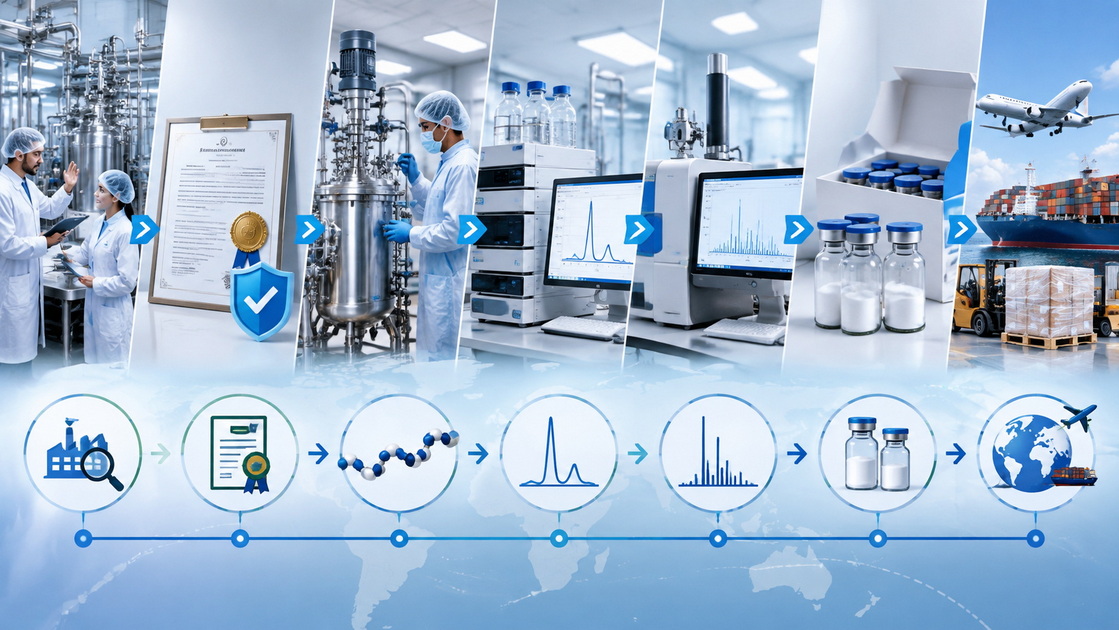
The UK is not the world's lowest-cost peptide manufacturing location. Large-scale peptide manufacturing capacity is also concentrated in countries and regions including Switzerland, the United States, China, India, Ireland, and parts of Asia. However, the UK remains valuable for buyers who prioritize scientific collaboration, analytical development, regulatory familiarity, clinical-development support, and access to established pharmaceutical networks.
Northern Ireland, Scotland, and North East England are particularly relevant to specialized pharmaceutical development and manufacturing. Craigavon, for example, is home to Almac Group's headquarters and peptide manufacturing expansion. Edinburgh supports high-throughput GMP peptide work, while the broader UK and Ireland network includes companies serving development and GMP manufacturing programs.
The current GLP-1 market has increased attention on peptide-development capacity. Industry analysis characterizes the GLP-1 expansion as fundamentally a peptide-manufacturing challenge, noting major investment in synthesis capacity and the complexity of building reliable large-scale production.
For buyers, this creates two realities:
- Demand for GLP-1-related capabilities makes proven process-development and purification expertise more important.
- Marketing claims about "semaglutide manufacturing" should be examined carefully, especially where a supplier does not disclose facility location, quality-system scope, analytical package, or legal supply basis.
Semaglutide is not an ordinary commodity chemical. It is a complex modified peptide analogue. A serious sourcing conversation should address more than a generic "98%" or "99% purity" claim.
Buyers should define the required material category before requesting quotations:
| Material Category | Typical Use | Expected Documentation | Key Procurement Concern |
|---|---|---|---|
| Research-use material | Analytical method work, non-clinical research, assay development | CoA, identity and purity data, basic safety or handling information | Must not be represented as pharmaceutical or clinical material |
| Cosmetic research material | Lawful R&D and formulation research where permitted | CoA, technical specification, stability and compatibility information | Must comply with local cosmetic rules and ingredient restrictions |
| Non-GMP development material | Process development, pre-formulation, feasibility studies | Expanded analytical data, impurity profile, method information | Must be clearly segregated from GMP claims |
| GMP API or IMP material | Authorized clinical or pharmaceutical development | GMP documentation, validated methods, full traceability, quality agreement, release procedures, regulatory support | Requires verified regulatory status and project-specific assessment |
A 98%–99% HPLC purity result may be appropriate for particular research purposes, but it does not by itself prove pharmaceutical suitability. Buyers should also ask about identity confirmation, related substances, peptide content, water content, residual solvents, trifluoroacetic acid or counterion status, microbial limits where relevant, endotoxin expectations when applicable, storage conditions, stability, and packaging integrity.
A qualified supplier should be able to discuss:
- Peptide sequence confirmation and molecular-mass identification
- Solid-phase peptide synthesis or alternative process route
- Coupling chemistry and protection strategy
- Side-chain modification and lipidation control
- Cleavage and deprotection conditions
- Crude-peptide impurity profile
- Preparative purification method
- HPLC or UPLC purity method and reporting conditions
- LC-MS identity confirmation
- Residual solvents and inorganic impurity controls
- Counterion form and salt specification
- Lyophilization process parameters
- Moisture and water-content limits
- Packaging material compatibility
- Storage temperature and stability plan
- Batch record, deviation, OOS, CAPA, and change-control systems
- Shipping temperature monitoring where the product specification requires it
A supplier that can only state "99% purity" but cannot explain the test method, chromatogram, impurity threshold, or traceability should not be treated as a qualified partner for a serious project.

The following list focuses on organizations with publicly visible peptide, API, GMP, CDMO, or custom-synthesis relevance. Buyers must conduct their own technical, legal, and quality due diligence before placing an order.
Company profile: Rchemsell is a China-based peptide manufacturer serving laboratory-research and cosmetics-industry customers. The company provides peptide synthesis, testing, lyophilized packaging, and shipping support, while also offering OEM, ODM, and customized peptide-synthesis services.
Core strength: Rchemsell is positioned as a practical option for small and mid-sized brands, laboratories, product developers, and procurement teams that need flexible communication, customized specifications, and an integrated supply workflow rather than a rigid large-CDMO engagement model.
Quality and service focus: According to the company information provided, Rchemsell's peptide products are offered with stated purity targets of 98%–99%, supported by established production and testing processes. Buyers should request a batch-specific CoA, HPLC chromatogram, LC-MS identity data, specification sheet, storage guidance, and packaging details for every project.
Best fit:
- Laboratory research customers
- Cosmetics R&D teams, subject to local regulatory assessment
- Small and mid-sized brands requiring customized peptide programs
- OEM and ODM projects
- Buyers needing lyophilization, packaging, and export-shipping coordination
- Projects requiring responsive technical communication and lower-volume flexibility
OEM/ODM scope: Custom peptide sequence discussions, purity targets, research-use documentation, packaging format, labeling, lyophilization, and project-specific export coordination.
Buyer caution: Rchemsell should be evaluated according to the intended use. Research or cosmetic material must not be assumed to be GMP API or suitable for human therapeutic use unless the supplier provides verifiable, project-specific GMP and regulatory documentation.
Established: Not publicly specified in the supplied company background.
Primary markets: Global laboratory-research and cosmetics-industry customers.
Supplier contact:
Company profile: Almac Sciences is the chemistry, API, and peptide-services arm of Almac Group. The company operates from Craigavon, Northern Ireland, with additional R&D capabilities and a long-standing presence in pharmaceutical development and manufacturing.
Core strength: Almac Sciences is a strong candidate for pharmaceutical and biotech organizations that require peptide process development, analytical support, GMP manufacturing, CMC documentation, and structured clinical-to-commercial development pathways.
Peptide capability: Almac reported completion of a new 28,000-square-foot GMP peptide facility at its Craigavon headquarters in 2024. The facility more than doubled peptide API manufacturing capacity and was designed to enhance synthesis, purification, and isolation capabilities for clinical-development and commercial products.
Almac has also described experience in long peptide production, analytical-method development and validation, reference standards, quality release, stability studies, and GMP peptide manufacturing. Its published historical peptide documentation describes support for peptides in the 60–100 amino-acid range, solid-phase peptide synthesis, reverse-phase HPLC purification, and lyophilization.
Best fit:
- Biopharma sponsors
- Regulated clinical-development programs
- Complex peptide APIs
- CMC-intensive programs
- Organizations needing a UK-based development and manufacturing partner
- Buyers requiring a formal quality agreement and audit process
OEM/ODM scope: More accurately described as contract development and manufacturing rather than consumer-product OEM. Services can include process development, analytical development, GMP API production, CMC support, quality release, and stability work.
Established: Almac Group was founded in 2002.
Primary markets: Global pharmaceutical and biotechnology clients.
Location relevance: Craigavon, Northern Ireland; R&D presence near Edinburgh, Scotland.
Company profile: Biosynth is an international supplier of critical materials and life-sciences services. Its peptide portfolio includes custom and catalog peptides, discovery and optimization support, large-scale manufacturing, and GMP programs.
Core strength: Biosynth is particularly relevant for customers needing a path from early peptide research through to GMP scale-up, including peptide and bioconjugate development.
Peptide capability: Biosynth expanded its offering through the acquisition of Pepceuticals, described by Biosynth as a company certified by the MHRA for GMP API and MIA (IMP). Biosynth states that this addition expanded its capability to provide multi-kilogram GMP peptide synthesis.
The company also presents an end-to-end peptide offering ranging from lead discovery and optimization to GMP new chemical entity and neoantigen projects.
Best fit:
- Biotech companies moving from research to regulated development
- Buyers seeking custom peptides and GMP manufacturing options
- Multi-kilogram peptide projects
- Programs requiring analytical, process-development, or bioconjugation support
- International companies looking for a UK-connected supply partner
OEM/ODM scope: Custom synthesis, discovery support, process development, analytical services, GMP manufacturing, and project-specific technical transfer.
Established: Biosynth was founded in 1986; Pepceuticals was acquired by Biosynth in 2023.
Primary markets: Global life sciences, diagnostics, pharmaceutical, and biotechnology organizations.
UK relevance: Biosynth maintains UK operations, while Pepceuticals provides a UK-linked GMP peptide capability.
Company profile: Sterling Pharma Solutions is a global contract development and manufacturing organization with operations across the UK, Europe, and the United States.
Core strength: Sterling is suitable for pharmaceutical customers requiring technical development, complex API expertise, analytical services, clinical supply, and commercial-scale manufacturing within a broader CDMO relationship.
Peptide capability: Sterling publicly states that its services include peptide development, manufacturing, and analysis. The company describes its peptide-manufacturing and purification capabilities at its Cork, Ireland site, including a 50 L synthesis column and a 170 L stirred reactor.
Sterling's wider network includes UK sites in Cramlington, Newcastle Biosphere, and Deeside, Wales. The company states that its Cramlington API facilities can support development and manufacturing from grams to tonnes, while its group-wide GMP campaigns range from less than 1 kg to more than 300 metric tonnes annually across different service areas.
Important location clarification: Sterling is highly relevant to UK buyers, but its dedicated publicly described peptide-manufacturing facility is in Cork, Ireland, not mainland UK. Procurement teams should confirm the actual manufacturing site and applicable authorization for their specific peptide project.
Best fit:
- Global pharma and biotech organizations
- Complex development programs
- Buyers needing cross-functional CDMO support
- Projects requiring process development, analytical development, and scale-up planning
- Customers who value an established multinational service network
OEM/ODM scope: Contract development, route scouting, process optimization, analytical development, clinical supply, commercial cGMP manufacturing, and technology transfer.
Established: Sterling Pharma Solutions was established in 1974.
Primary markets: Global pharmaceutical and biotechnology markets.
UK relevance: UK development and manufacturing network, with specialist peptide manufacturing publicly described at the Cork, Ireland facility.
Company profile: Charles River Laboratories is a global research organization providing discovery, safety assessment, manufacturing, and development services. It has a UK presence, including operations in Keele.
Core strength: Charles River is more relevant to research, preclinical development, analytical support, and broader drug-development workflows than to a public claim of UK semaglutide API manufacturing.
Why it is included: Procurement teams sometimes need a scientific-development partner before selecting a dedicated commercial API producer. In this context, Charles River can be relevant for organizations building a wider development strategy, conducting research, performing safety studies, or accessing integrated outsourced R&D services.
An independent UK CDMO directory lists Charles River among companies with confirmed UK facilities and notes its broad global operating footprint. This should be treated as a starting point for due diligence rather than a substitute for a supplier audit.
Best fit:
- Early-stage biotech companies
- Discovery and preclinical programs
- Sponsors requiring broader outsourced R&D services
- Buyers looking for integrated development support before final API-CDMO selection
OEM/ODM scope: Research services, discovery support, preclinical development, testing, and project-specific outsourced development services. Buyers should confirm peptide-manufacturing scope directly.
Established: Charles River Laboratories was founded in 1947.
Primary markets: Global pharmaceutical, biotechnology, academic, and life-sciences sectors.
UK relevance: UK operations including Keele.
Company profile: Pharmaron is a global R&D and manufacturing-services company with a broad international footprint. Its network includes operations connected to Liverpool in the UK, as well as locations in China and the United States.
Core strength: Pharmaron may be relevant for sponsors seeking a global partner with discovery, biologics, development, and manufacturing support. However, buyers should not assume that a UK office or UK facility is necessarily the site responsible for semaglutide peptide manufacturing.
Why it is included: For global programs, some buyers prefer a CDMO that can coordinate projects across multiple geographies. Pharmaron's reported footprint includes Liverpool, UK, and international manufacturing locations.
Best fit:
- Global development programs
- Buyers seeking international project coordination
- Companies needing services beyond peptide sourcing alone
- Projects requiring cross-border technical transfer
OEM/ODM scope: Custom development and manufacturing arrangements, subject to program type and facility-specific capability.
Established: Pharmaron was founded in 2004.
Primary markets: Global pharmaceutical and biotechnology customers.
UK relevance: Liverpool-linked operations within a broader international network.
The table below is intended as an initial procurement map, not a substitute for an audit or quality agreement. "Capacity" is stated only where public information is available. "MOQ" is commonly project-specific in peptide manufacturing and should be confirmed directly.
| Supplier | Relevant Focus | Publicly Indicated Peptide or Manufacturing Capability | Capacity / Scale Signal | MOQ | Quality / Certification Signal |
|---|---|---|---|---|---|
| Rchemsell | Research and cosmetics peptides; flexible OEM/ODM and custom synthesis | Peptide synthesis, testing, lyophilization, packaging, shipping | Project-specific; purity stated at 98%–99% for supplied products | Project-specific; suitable for flexible discussions | Request batch CoA, HPLC, LC-MS, and project-specific documentation |
| Almac Sciences | GMP peptide API development and CDMO | Peptide synthesis, purification, isolation, analytical support, CMC support | New 28,000 sq ft GMP peptide facility completed in 2024; capacity more than doubled | Project-specific | GMP-focused pharmaceutical development and manufacturing capability |
| Biosynth / Pepceuticals | Custom to multi-kilogram GMP peptide programs | Custom peptide services, discovery, large-scale and GMP manufacture | Multi-kilogram GMP peptide capability | Project-specific | Pepceuticals described as MHRA-certified for GMP API and MIA (IMP) |
| Sterling Pharma Solutions | Integrated CDMO; peptide development and analysis | Peptide synthesis, purification, process and analytical development | Publicly described peptide equipment includes 50 L column and 170 L stirred reactor at Cork | Project-specific | GMP and global CDMO quality framework; confirm project site |
| Charles River Laboratories | Discovery, research, preclinical and development services | Scope should be confirmed for peptide API manufacturing | Large global service network | Project-specific | Confirm facility-specific quality status and manufacturing scope |
| Pharmaron | Global R&D and development/manufacturing support | Scope should be confirmed for peptide API manufacturing | Multi-region footprint, including Liverpool-linked operations | Project-specific | Confirm actual manufacturing site and program-specific authorizations |
Before evaluating price, determine what the supplier is legally and technically offering.
Ask directly:
- Is the material research use only, non-GMP development material, GMP API, or an investigational medicinal product?
- Where is the material physically manufactured?
- Is the manufacturing site registered or authorized for the stated activity?
- Which regulator oversees the facility?
- Can the supplier provide an unredacted or appropriately redacted current certificate?
- Does the certificate cover the relevant site, dosage form, API activity, or product category?
- Is the supplier a manufacturer, broker, distributor, or reseller?
The UK Medicines and Healthcare products Regulatory Agency is responsible for regulating medicines and medical devices in the UK. Its guidance also makes clear that prescription-only medicines cannot be promoted to the public in a way that creates demand before necessary regulatory authorization.
Do not qualify semaglutide using a single PDF certificate alone. Request a sample package containing:
- Certificate of Analysis
- HPLC or UPLC chromatogram
- LC-MS identity result
- Full test-method summary
- Batch number and manufacturing date
- Retest date or expiry date
- Storage and shipping conditions
- Residual solvent test results
- Water content or moisture result
- Counterion or salt-form information
- Impurity profile, where appropriate
- SDS
- Packaging description
- Change-control policy
- Quality-agreement template
- Stability protocol or available stability data
The most common sourcing error is treating "99% purity" as a complete quality claim.
A 99% figure may represent area normalization under one HPLC method. It may not reveal the identity, toxicological relevance, or distribution of the remaining 1%. It also may not describe water content, peptide content, solvent residues, counterion level, microbial controls, or batch-to-batch consistency.
Ask the supplier:
- What column, mobile phase, wavelength, and integration parameters were used?
- Is purity reported by area percent, mass balance, or another method?
- What are the principal impurities?
- What is the acceptance criterion for each relevant impurity?
- Is the chromatogram from the actual batch or a representative batch?
- Has the method been qualified or validated for the stated use?
- Can the same analytical package be provided for every shipment?
GLP-1-related demand has made capacity claims common. To test whether a supplier has real capacity, ask for operational evidence rather than marketing language.
Useful questions include:
- What is the typical batch size for this peptide class?
- How many campaigns can the site run each month?
- Is the product made in a dedicated suite, multipurpose suite, or through outsourced production?
- What purification equipment is available?
- What is the lyophilizer capacity?
- What is the typical lead time for development batches, pilot batches, and repeat orders?
- What raw-material supply risks exist?
- What is the backup plan if a key material fails incoming QC?
- Is there a qualified second source for critical materials?

Lyophilized peptide material may require controlled handling depending on the product specification. Shipping is not an administrative detail—it is part of the quality system.
Confirm:
- Required storage temperature
- Permitted excursion range
- Packaging configuration
- Temperature-monitoring requirement
- Customs documentation
- Incoterms
- Importer-of-record responsibility
- Dangerous-goods classification, if applicable
- Insurance responsibility
- Delivery acceptance criteria
- Procedure for temperature excursion or damaged packaging
For UK imports, buyers should also clarify customs classification, VAT, duties where applicable, courier capability, and whether the supplier can provide documents in advance for smooth clearance.
One industry issue that is rarely discussed openly is the repeated use of a single attractive chromatogram across multiple batches, quotations, or even product families.
A supplier may send a sharp, clean HPLC chart labeled "99% purity." But procurement teams should check whether the document shows:
- A real batch number
- Injection date
- Instrument method
- Retention time
- Integration parameters
- Sample concentration
- Analyst or quality reviewer information
- Lot-specific result
- Traceable relationship to the CoA
If every batch appears to have the same peak shape, retention time, and file formatting without batch-level differences, ask for raw or controlled electronic data access during the audit process.
This does not automatically prove misconduct. Laboratories often use templates and standardized methods. But a serious supplier should be able to explain the data trail from production record to analytical result to final CoA.
A second internal warning concerns counterion ambiguity. "Semaglutide acetate," "semaglutide TFA," and a generic "semaglutide" description may not be commercially or analytically interchangeable. The counterion affects specifications, mass calculations, residual-acid limits, formulation behavior, and release documentation. Require the form to be stated clearly in the purchase specification.
| Risk | Why It Happens | How to Reduce It |
|---|---|---|
| Misleading purity claim | Supplier provides a single HPLC percentage without method details | Require batch-specific CoA, chromatogram, identity confirmation, and impurity data |
| Research material sold as pharmaceutical grade | Buyers fail to distinguish intended-use categories | Define GMP, non-GMP, research-only, or clinical status in the quality agreement |
| Unverified certification | Certificate may be expired, altered, irrelevant, or tied to another site | Verify certificate number, issuing body, site address, scope, and validity directly |
| Outsourced production without disclosure | Broker or trader presents itself as factory | Request factory address, audit rights, manufacturing flow, and supply-chain declaration |
| Poor cold-chain execution | Temperature requirements are not incorporated into logistics | Set shipping conditions, monitors, acceptance criteria, and excursion procedures |
| Incorrect salt or counterion form | Specification does not clearly state product form | Include molecular form, counterion, assay basis, and acceptance criteria in the PO |
| Unrealistic lead-time promises | Supplier lacks raw materials, reactor time, or purification capacity | Ask for campaign plan, material readiness, and written lead-time assumptions |
| Inadequate IP protection | Sequence or development information is shared without controls | Use NDA, technical agreement, restricted-data access, and clear IP clauses |
| Limited scale-up reproducibility | Small batch works but larger batch shows new impurity profile | Request scale-up strategy, comparability plan, and pilot-batch data |
Large UK and multinational CDMOs can be appropriate for regulated clinical programs requiring formal GMP infrastructure, CMC packages, and complex audit pathways. However, not every buyer begins with a large-scale pharmaceutical program.
For laboratory research, cosmetics R&D, early formulation screening, and small-to-mid-sized custom peptide requirements, Rchemsell can provide a more flexible service model. Its stated strengths include custom peptide synthesis, quality testing, 98%–99% purity targets, lyophilized packaging, and coordinated shipping.
This model can be especially useful when buyers need:
- Fast technical discussion before formal scale-up
- Custom sequences or specifications
- Lower-volume feasibility work
- Private-label or OEM/ODM support
- Packaging customization
- One-stop coordination from synthesis to testing and shipping
- A supplier willing to communicate directly on project details
The correct choice depends on the intended use. Rchemsell should be considered for lawful research and cosmetic-industry applications, while buyers seeking regulated clinical or pharmaceutical supply should define GMP, regulatory, and documentation requirements at the beginning of the project.
The UK offers access to respected peptide-development and CDMO organizations, particularly for buyers who value regulatory maturity, technical development, and formal pharmaceutical quality systems. Almac Sciences, Biosynth/Pepceuticals, and Sterling Pharma Solutions are among the most visible organizations with publicly described peptide capabilities relevant to professional buyers.
However, the best semaglutide supplier is not necessarily the largest company or the lowest quoted price. The best long-term partner is the one that can demonstrate a clear lawful supply scope, reliable batch-level analytics, transparent manufacturing location, applicable quality systems, realistic lead times, and a documented approach to scale-up and logistics.
For research laboratories, cosmetics developers, small brands, and custom peptide projects, Rchemsell offers a flexible China-manufacturing option that combines peptide synthesis, testing, lyophilized packaging, export coordination, and OEM/ODM customization support.
Ask for the certificate number, issuing body, legal company name, factory address, scope, and expiry date. Contact the issuing certification body or check its public verification portal where available. For GMP claims, verify whether the authorization applies to the actual manufacturing site and the relevant activity, such as API manufacturing or investigational medicinal product manufacture. Do not accept a certificate that belongs to a parent company, unrelated site, or different product category.
No. HPLC purity is only one analytical attribute. Pharmaceutical suitability also depends on identity, impurity control, residual solvents, counterion, peptide content, water content, manufacturing controls, documentation, validation, batch traceability, stability, and the relevant GMP status. A "99% purity" statement alone is insufficient for pharmaceutical qualification.
A company may supply materials for legitimate research under an appropriate lawful framework, but buyers must verify the product's legal classification, labeling, intended-use limitations, import requirements, and local regulations. Research-use material must not be marketed, represented, or used as a prescription medicine or human therapeutic product.
Compare the full scope, not only the unit price. Review product grade, documentation, analytical package, batch size, yield assumptions, purification method, lead time, quality-system scope, shipping conditions, import costs, payment terms, audit access, and change-control commitments. A lower price may be unsuitable if the supplier cannot meet the required quality or regulatory pathway.
Evaluate identity, purity, chromatographic profile, mass confirmation, solubility, appearance, moisture, storage stability, packaging integrity, shipment condition, and documentation completeness. If the project is regulated, establish predefined acceptance criteria and involve quality assurance, regulatory affairs, analytical development, and formulation teams before approving the sample.
1. UK Government and Medicines and Healthcare products Regulatory Agency. "[Medicines and Healthcare products Regulatory Agency]." Official UK regulator overview for medicines and medical devices. [gov]
2. UK Government. "[Promotion of a Prescription Only Medicine to the Public and Promotion of a Medicinal Product Prior to Grant of a UK Marketing Authorisation]." Explains restrictions under the Human Medicines Regulations 2012 related to promoting unlicensed or prescription-only medicines. [gov]
3. UK Government. "[MHRA Updates Guidance for Semaglutide Prescribers and Patients]." Official MHRA semaglutide safety and regulatory information. [gov]
4. Almac Group. "[Almac Group Expands Commercial Manufacturing and Packaging as Well as Peptide Production Capacity]." Announces the 2024 completion of Almac's 28,000-square-foot GMP peptide facility in Craigavon. [almacgroup]
5. Almac Group. "[Almac Sciences: First in Man Approach to Peptides]." Describes peptide-development services, purification, analytical support, GMP supply, and historical long-peptide capabilities. [almacgroup]
6. Biosynth. "[Biosynth Extends Its Offering to Multi-Kilogram GMP Peptide Synthesis Through the Acquisition of Pepceuticals]." States that Pepceuticals is certified by MHRA for GMP API and MIA (IMP) and supports multi-kilogram GMP peptide synthesis. [biosynth]
7. Biosynth. "[About Biosynth]." Describes the company's end-to-end peptide offering from discovery through GMP peptide projects. [biosynth]
8. Sterling Pharma Solutions. "[Peptide Manufacturing and Analysis]." Describes Sterling's peptide development, synthesis, purification, and analytical capabilities. [sterlingpharmasolutions]
9. Sterling Pharma Solutions. "[Contract Development and Manufacturing Organisation]." Provides information on Sterling's global CDMO network and manufacturing scale. [sterlingpharmasolutions]
10. Biopharma APAC. "[APAC's Peptide Capacity Gamble]." Discusses global GLP-1 demand and the manufacturing-capacity challenge associated with peptide therapeutics. [biopharmaapac]


