
Views: 0 Author: Rchemsell Publish Time: 2026-09-18 Origin: Site


Content Menu
● What Is Peptide Stability Testing?
● Why ICH Guidelines Matter for Peptide Stability
>> ICH Q1A(R2): The Core Stability Framework
>> ICH Q5C: Why Polypeptides Need Product-Specific Testing
>> Practical Difference Between Q1A and Q5C
● The Main Peptide Degradation Pathways
>> Sequence-Specific Risk Assessment
● How to Design an ICH-Informed Stability Study
>> Step 1: Define the Product and Intended Use
>> Step 2: Perform Risk-Based Stress Testing
>> Step 3: Select Stability-Indicating Analytical Methods
>> Step 4: Choose Appropriate Storage Conditions
>> Step 5: Test the Final Packaging System
● Stability Testing for Cosmetic Peptides
>> Cosmetic Stability Development Checklist
● A Practical Rchemsell Workflow
>> From Custom Synthesis to Delivery
● Common Stability Testing Mistakes
>> Relying Only on a Single HPLC Purity Result
>> Assigning a Shelf Life From Accelerated Data Alone
>> Testing Bulk Material but Not Final Packaging
>> Ignoring Reconstitution and In-Use Conditions
>> Treating Cosmetic Formula Stability as Ingredient Stability
● Request a Custom Peptide Stability Plan
● FAQ
>> 1. What is peptide stability testing?
>> 2. Does a 98% or 99% purity peptide automatically have a long shelf life?
>> 3. Which ICH guideline is most relevant to peptide stability?
>> 4. Should lyophilized peptides be tested differently from peptide solutions?
>> 5. What analytical methods are commonly used for peptide stability testing?
Peptide stability testing is the process of demonstrating how a peptide's identity, purity, potency-related performance, and physical characteristics change over time under defined storage, transport, and use conditions. For peptide manufacturers and buyers, an ICH-informed stability program is essential because a peptide can appear acceptable by a single purity result while still developing degradation products, aggregation, moisture-related changes, or loss of functional performance.
At Rchemsell, we support laboratory-research and cosmetic-industry customers with peptide synthesis, analytical testing, lyophilization, packaging, and international shipping. Our peptide materials are typically supplied at 98%–99% purity, with OEM, ODM, and custom peptide synthesis options designed around each customer's sequence, application, packaging, and documentation needs. Stability testing should be built into that workflow—not treated as a final check after manufacturing.
Important scope note: This article provides technical and commercial guidance for research-use and cosmetic peptide supply chains. It is not a substitute for a product-specific regulatory strategy, GMP release program, clinical-development package, or marketing-authorization submission.

Peptide stability testing evaluates whether a peptide remains within predefined quality specifications throughout its proposed shelf life, shipping window, storage period, or in-use period.
Under ICH Q1A(R2), stability testing is intended to show how the quality of a drug substance or drug product changes over time when exposed to environmental factors such as temperature, humidity, and light. The resulting data are used to support storage recommendations, retest periods, and shelf-life assignments.
For peptides, the risk profile is often more complex than a simple "pass/fail purity" decision. A short synthetic peptide may be sensitive to:
- Oxidation, especially when residues such as methionine, cysteine, tryptophan, histidine, or tyrosine are present.
- Deamidation, often associated with asparagine or glutamine residues.
- Hydrolysis, particularly in aqueous formulations or under unfavorable pH conditions.
- Aggregation or self-association, which may affect solubility, appearance, analytical behavior, or bioactivity-related properties.
- Disulfide scrambling, a critical concern for cysteine-containing peptides.
- Adsorption to containers, filters, tubing, or delivery surfaces.
- Moisture uptake, which can be especially relevant for hygroscopic powders.
- Light exposure, including photodegradation during handling, filling, storage, or transportation.
- Freeze–thaw stress, a common issue for reconstituted or solution-based peptide products.
For a research peptide, the practical question may be: "Will the material remain suitable for an assay after shipment and storage?" For a cosmetic peptide, the question may become: "Will the ingredient retain its specified purity and formulation compatibility throughout the finished product's intended shelf life?" For a regulated peptide drug program, the question is broader: "Can we demonstrate consistent quality, safety, and performance through the full lifecycle of the drug substance and drug product?"
The International Council for Harmonisation (ICH) provides a widely used framework for designing scientifically defensible stability studies. Although the exact regulatory path depends on the product category and market, ICH principles give manufacturers and customers a common language for discussing storage, degradation, packaging, and data expectations.
ICH Q1A(R2) is the foundational guideline for stability testing of new drug substances and drug products. It explains that stability data should establish the impact of environmental conditions—including temperature, humidity, and light—on product quality over time.
For peptide projects, Q1A(R2) is especially useful when designing:
- Long-term storage studies.
- Accelerated stability studies.
- Stress testing protocols.
- Photostability studies.
- Packaging evaluations.
- Retest-period or shelf-life justifications.
- Ongoing stability commitments.
The guideline also states that formal stability studies should normally include data from at least three primary batches. These batches should represent the proposed manufacturing process and be packaged in the intended—or representative—container closure system.
ICH Q5C addresses stability testing for well-characterized biotechnological and biological products, including proteins and polypeptides and their derivatives. It recognizes that these materials can undergo complex physical, chemical, and functional changes that may not be adequately captured by one analytical method.
This matters because peptide quality is multidimensional. A good stability strategy should not rely solely on HPLC purity. Instead, it should use a stability-indicating analytical panel capable of detecting meaningful changes in identity, purity, degradation profile, and—where relevant—functional or potency-related attributes.
ICH Q5C also emphasizes that stability studies should use suitable specifications, meaningful test intervals, and methods that can detect product changes over the proposed expiration period.
| Topic | ICH Q1A(R2) | ICH Q5C | Practical implication for peptides |
|---|---|---|---|
| Primary purpose | Stability of new drug substances and products | Stability of biological and biotechnology-derived products | Use Q1A as the core framework; use Q5C concepts when product complexity warrants it |
| Main stress factors | Temperature, humidity, light, oxidation, hydrolysis | Product-specific physical, chemical, and functional degradation | Build risk-based studies around sequence, dosage form, and intended use |
| Analytical expectations | Stability-indicating methods and specification-based evaluation | Assessment of purity, identity, potency, and structural integrity | HPLC alone may be insufficient for complex peptide products |
| Batch expectations | Normally three primary batches | Representative production lots and appropriate protocol design | Use representative lots, processes, and final packaging |
| Storage claims | Supported by real-time stability data | Supported by product-specific stability evidence | Do not make shelf-life claims based only on accelerated results |
A peptide stability program should start with the peptide's molecular risk profile. The sequence, molecular weight, terminal modifications, disulfide bonds, salt form, formulation, packaging, and expected use conditions all influence degradation behavior.
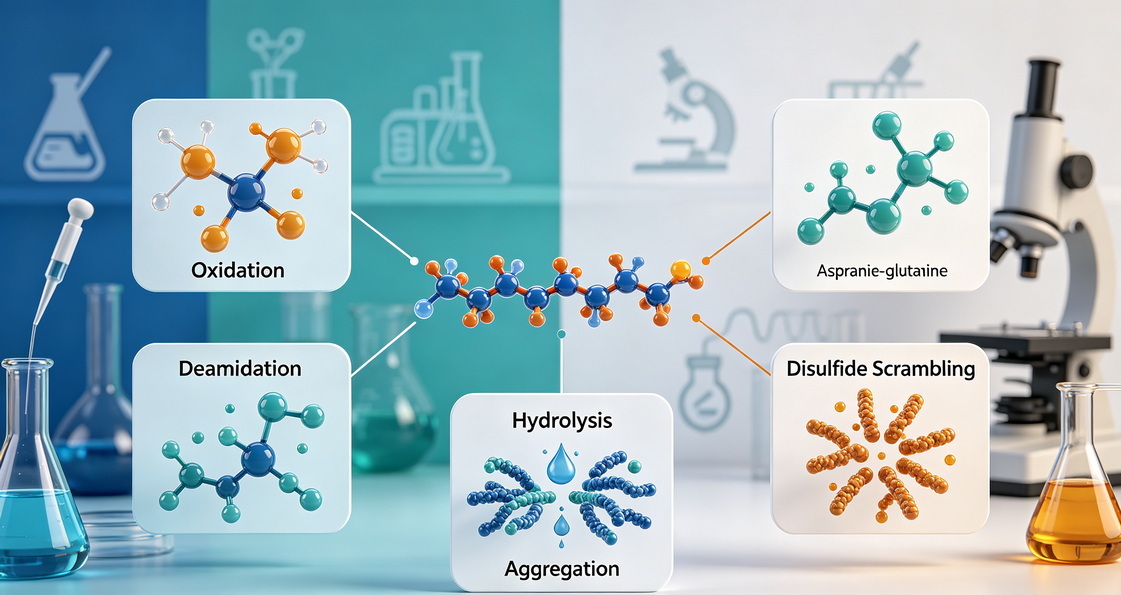
Chemical degradation changes the peptide's molecular structure. Common mechanisms include oxidation, deamidation, hydrolysis, and racemization.
Oxidation is a frequent concern for peptides containing oxidation-prone residues. Oxygen exposure, trace metals, peroxides, light, and elevated temperature can accelerate the process. For a susceptible sequence, a stability plan may include peroxide screening, headspace/oxygen considerations, light protection, and antioxidant compatibility assessments where formulation rules allow.
Deamidation can produce acidic variants and may be influenced by pH, temperature, buffer composition, and moisture. This is particularly relevant for peptides containing asparagine or glutamine residues.
Hydrolysis is often more significant in solution than in a well-controlled lyophilized solid. A peptide that remains stable as a dry powder may degrade rapidly after reconstitution or incorporation into an aqueous cosmetic base.
Physical instability does not always change the primary amino-acid sequence, but it can still change product quality and performance.
Examples include:
- Aggregation.
- Precipitation.
- Reduced solubility.
- Changes in particle characteristics.
- Adsorption to glass, plastic, or process-contact surfaces.
- Cake collapse or poor reconstitution in lyophilized products.
- Moisture uptake and physical appearance changes.
For lyophilized peptides, the quality of the final cake is not merely cosmetic. A collapsed, discolored, cracked, or highly hygroscopic cake can signal processing, packaging, moisture-control, or stability problems that warrant investigation.
Before finalizing a protocol, an experienced peptide supplier should review the sequence and project conditions.
| Peptide feature | Potential stability concern | Useful development question |
|---|---|---|
| Cysteine residues | Oxidation, disulfide scrambling, dimer formation | Is the intended disulfide pattern confirmed and controlled? |
| Methionine or tryptophan | Oxidation and light sensitivity | Does the product require light-protective handling or packaging? |
| Asparagine or glutamine | Deamidation | Which pH and temperature ranges minimize degradant formation? |
| Asp-Gly or similar motifs | Potential hydrolysis or rearrangement risks | Are forced-degradation studies needed to map likely degradation routes? |
| Long or hydrophobic sequence | Aggregation or poor solubility | Which solvent, buffer, concentration, and container are suitable? |
| Lyophilized format | Moisture uptake, cake collapse, reconstitution issues | Is the vial, stopper, desiccant, and seal system fit for shipping conditions? |
A useful peptide stability protocol is not a generic checklist. It should be a written, risk-based plan that connects the peptide's properties with analytical methods, storage conditions, sampling time points, acceptance criteria, and decision rules.
Start by documenting exactly what is being tested:
- Peptide name, sequence, molecular weight, and modification status.
- Salt form, counterion, purity target, and impurity profile.
- Physical form: lyophilized powder, solution, cosmetic raw material, or formulated product.
- Intended use: laboratory research, cosmetic formulation, process development, or regulated development.
- Proposed storage temperature and shipping conditions.
- Packaging configuration, including vial, bag, bottle, stopper, cap, liner, and outer carton.
- Reconstitution instructions or in-use conditions, if applicable.
This definition prevents a common mistake: testing a peptide under one set of conditions and making claims about a different packaging format, concentration, or use scenario.
Stress testing is designed to reveal likely degradation pathways and to demonstrate whether the analytical methods are stability-indicating. ICH Q1A(R2) identifies temperature, humidity where appropriate, oxidation, photolysis, and hydrolysis across a broad pH range for solutions or suspensions as relevant areas for stress evaluation.
For peptide materials, stress studies may include:
1. Elevated-temperature exposure to accelerate thermally driven degradation.
2. High-humidity exposure for moisture-sensitive solid materials.
3. Light exposure to evaluate photostability.
4. Oxidative challenge for oxidation-prone sequences.
5. pH stress for solution products or formulation-development work.
6. Freeze–thaw cycling for materials that may be frozen after reconstitution.
7. Agitation or shipping simulation when transport vibration may be relevant.
8. Container-contact studies to identify adsorption, leachables, or compatibility risks.
Stress results should guide the method-development strategy. If a degradation product forms under oxidative stress but the method cannot separate it from the main peak, the method may not be appropriate for stability monitoring.
For most peptide projects, HPLC purity is important—but it should be interpreted as one part of the quality picture.
A practical analytical package may include:
- RP-HPLC or UPLC: Purity, related substances, and degradation-profile monitoring.
- LC-MS: Molecular identity confirmation and degradant characterization.
- Mass balance evaluation: Comparison of parent peptide loss and observed degradant formation.
- Water content testing: Especially valuable for lyophilized and hygroscopic peptides.
- Appearance and reconstitution checks: Color, cake integrity, clarity, dissolution time, and visible particles.
- pH measurement: For solution or reconstituted products.
- Peptide content or assay: Quantitative confirmation where appropriate.
- Microbiological controls: Relevant for certain aqueous cosmetic or formulated systems.
- Functional or potency-related assays: Important when a validated biological activity measure is relevant to the product claim.
ICH Q5C notes that there is no single stability-indicating assay suitable for all biological products. The analytical approach should be product-specific and capable of detecting relevant changes in purity, identity, and potency.
Storage conditions must match the proposed label claim and distribution reality. The correct condition for a research peptide may differ substantially from that of a peptide cosmetic ingredient or a finished peptide-containing serum.
Examples may include:
| Product type | Typical stability question | Example monitoring approach |
|---|---|---|
| Lyophilized research peptide | Can purity and identity remain within specification during refrigerated or frozen storage? | Real-time storage study, moisture monitoring, HPLC/LC-MS checks |
| Reconstituted peptide solution | How long can the solution remain suitable after preparation? | Short-term in-use study, pH, appearance, purity, microbial risk assessment where relevant |
| Cosmetic peptide raw material | Is the ingredient stable in a cosmetic-compatible solvent system? | Temperature, light, pH, preservative, and compatibility testing |
| Finished cosmetic formula | Does the peptide remain stable in the final emulsion, serum, or gel? | Formula-specific stability, packaging compatibility, appearance, viscosity, pH, peptide assay where feasible |
| Custom peptide for global shipping | Can the material tolerate the planned transport route? | Shipping simulation, temperature-excursion assessment, packaging qualification |
For products with a proposed shelf life of at least 12 months, ICH Q1A(R2) generally describes long-term testing at three-month intervals during the first year, six-month intervals in the second year, and annually thereafter through the proposed shelf life.

A strong stability program tests the peptide in the same container closure system proposed for storage and distribution, or a system that appropriately simulates it. This is specifically reflected in ICH Q1A(R2) expectations.
For a lyophilized peptide, packaging decisions may include:
- Amber versus clear glass vials.
- Nitrogen flushing where scientifically justified.
- Stopper and cap compatibility.
- Moisture-barrier properties.
- Tamper-evident and secondary protective packaging.
- Cold-chain or insulated shipping configuration.
- Desiccant use, where appropriate.
- Small-quantity versus bulk-packaging exposure risks.
A peptide that passes stability testing in a sealed amber vial cannot automatically be assumed stable in a clear bottle, a bulk bag, or a consumer-facing cosmetic package.
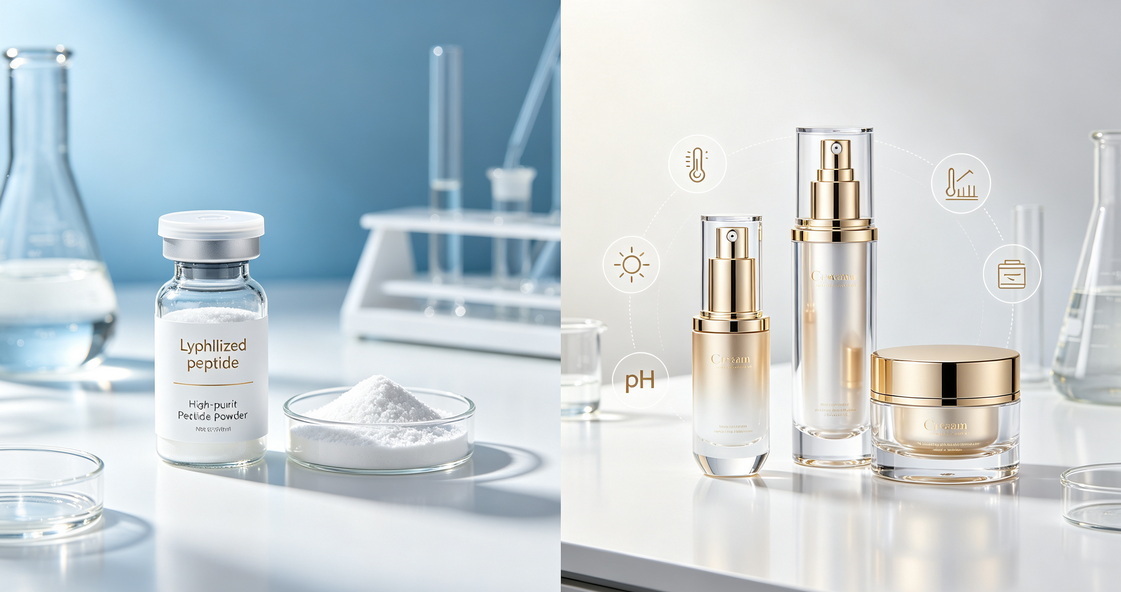
Cosmetic peptide stability deserves separate attention because the active peptide may be stable as a dry raw material but less stable after incorporation into a finished formula.
The finished formula can introduce new stressors:
- Water activity.
- Emulsifiers and surfactants.
- Preservatives.
- Fragrance ingredients.
- Metal-ion contamination.
- pH adjustment agents.
- Oxygen exposure.
- Airless pump, dropper, jar, or tube packaging.
- Repeated consumer opening and closing.
- Exposure to heat during filling or transport.
For cosmetic applications, the best approach is to test both the peptide ingredient and the final formulation. Ingredient-level data cannot fully replace finished-product data because interactions with the formula matrix may change the degradation profile.
- Confirm peptide identity and starting purity before formulation.
- Select a formulation pH range based on the peptide's stability risk assessment.
- Screen compatibility with solvents, humectants, emulsifiers, preservatives, and chelators.
- Evaluate light sensitivity in the intended primary packaging.
- Include accelerated and real-time storage conditions suitable for the target market.
- Monitor visible appearance, odor, color, pH, viscosity, and phase separation.
- Where technically feasible, measure peptide content or use a validated marker method.
- Evaluate freeze–thaw resilience if the product may encounter cold-weather distribution.
- Verify microbiological quality and preservative-system performance for applicable cosmetic products.
For global buyers, peptide stability should be considered from the initial inquiry through delivery—not after the order has shipped. Rchemsell can structure a one-stop workflow around synthesis, testing, lyophilization, packaging, and logistics so that the project is aligned with the customer's actual application.
1. Project review: Confirm sequence, modifications, purity requirement, quantity, intended use, storage expectation, and requested documentation.
2. Peptide synthesis: Manufacture the peptide according to the agreed technical specification and project requirements.
3. Quality testing: Conduct appropriate identity and purity testing, commonly including HPLC and mass-spectrometry-based confirmation where applicable.
4. Lyophilization and packaging: Select packaging suited to the product format, expected storage conditions, and shipping pathway.
5. Stability-support planning: Recommend suitable storage guidance and, where needed, design project-specific stability, compatibility, or transport-excursion testing.
6. International shipment support: Coordinate packaging and shipping considerations to reduce avoidable temperature, moisture, light, and handling risks.
For customers requiring OEM, ODM, or custom peptide synthesis, the most valuable early-stage information is not only the amino-acid sequence. It is also the intended formulation, target market, packaging concept, batch size, documentation expectations, and real-world storage conditions.
A high initial purity result does not prove long-term stability. The method must be capable of detecting relevant degradation products, and the sample must be tested across time under meaningful conditions.
Accelerated studies are useful for risk assessment, comparison, formulation screening, and method development. However, real-time data are the primary basis for defensible shelf-life and retest claims.
Packaging can materially affect light exposure, moisture ingress, oxidation, adsorption, and contamination risk. Final-package testing is essential for realistic stability conclusions.
A lyophilized peptide may be stable for months or years in its unopened vial yet have a much shorter usable period after reconstitution. In-use conditions deserve their own protocol.
A peptide's behavior in a finished serum or cream can differ from its behavior as a dry powder. Evaluate the final product, not only the raw peptide.
A peptide's stability profile is determined by more than its sequence or starting purity. It depends on the complete system: synthesis quality, impurity profile, dosage form, moisture level, packaging, shipping route, storage temperature, formulation, and intended use.
If you need a 98%–99% purity peptide, custom sequence synthesis, lyophilized packaging, analytical testing, OEM or ODM support, or a stability-focused supply strategy for laboratory research or cosmetic development, contact Rchemsell with your peptide sequence, target quantity, purity requirement, application, formulation details, storage target, and destination market.
A well-defined request allows the technical team to recommend a more appropriate synthesis, testing, packaging, and delivery approach from the beginning.
Peptide stability testing is a planned analytical study that evaluates whether a peptide maintains its specified quality attributes—such as identity, purity, content, appearance, and relevant functional characteristics—during storage, transport, and intended use.
No. Initial purity describes the material at the time of testing. Shelf life depends on how the peptide changes over time under defined conditions, including temperature, moisture, oxygen, light, packaging, and formulation environment.
ICH Q1A(R2) is the primary stability framework for new drug substances and products. ICH Q5C adds important concepts for well-characterized proteins and polypeptides, including the need for product-specific tests that can assess purity, identity, and potency-related changes.
Yes. Lyophilized peptides often require special attention to moisture content, cake appearance, reconstitution, and packaging integrity. Peptide solutions usually need additional evaluation of pH, hydrolysis, aggregation, microbial controls where applicable, and freeze–thaw stability.
Common methods include RP-HPLC or UPLC for purity and related substances, LC-MS for identity and degradant characterization, water-content testing for dry powders, pH and appearance checks for solutions, and functional assays when the peptide's biological or cosmetic performance requires them.
1. International Council for Harmonisation. [ICH Q1A(R2): Stability Testing of New Drug Substances and Products]. The guideline defines stability testing as evidence of how product quality changes over time under environmental factors including temperature, humidity, and light. [database.ich]%20Guideline.pdf)
2. European Medicines Agency. [ICH Q1A(R2) Stability Testing of New Drug Substances and Drug Products]. Provides the ICH scientific-guideline context for registration stability data. [ema.europa]
3. International Council for Harmonisation. [ICH Q5C: Stability Testing of Biotechnological/Biological Products]. Covers well-characterized proteins and polypeptides and describes protocol, specification, and interval considerations for stability programs. [database.ich]
4. European Medicines Agency. [ICH Q5C Stability Testing of Biotechnological/Biological Products]. Summarizes the guideline's scope for proteins, polypeptides, derivatives, and related products. [ema.europa]
5. U.S. Food and Drug Administration. [Q1A(R2) Stability Testing of New Drug Substances and Products]. Includes expectations concerning stress testing, three primary batches, packaging configuration, and long-term testing frequency. [fda]
6. U.S. Food and Drug Administration. [Clinical Pharmacology Considerations for Peptide Drug Products]. Provides FDA recommendations for peptide-drug-product development programs; it is referenced here for the broader regulatory context of peptide product development. [fda]


