
Views: 265 Author: Rchemsell Publish Time: 2026-09-14 Origin: Site


Content Menu
● Important Research and Regulatory Disclaimer
● TB-500 vs BPC-157 at a Glance
● TB-500 vs BPC-157: The Most Important Scientific Differences
>> Peptide Length and Sequence Complexity
>> Research Background and Literature Scope
>> Evidence Strength and Translation Limits
● How to Select Between TB-500 and BPC-157 for Laboratory Research
>> Select TB-500 When Your Research Focus Involves
>> Select BPC-157 When Your Research Focus Involves
>> Use Both Peptides When Designing a Comparative Study
● Quality Attributes That Matter More Than Marketing Claims
>> Essential Quality Documents for Research Peptides
● A Practical Procurement Workflow for Research Buyers
>> Step 1: Define the Intended Research Use
>> Step 2: Confirm the Required Specifications
>> Step 3: Review Batch-Specific Analytical Data
>> Step 4: Establish Internal Handling Controls
>> Step 5: Document Research Limitations
● Cosmetic R&D: Where Does the Comparison Fit?
● Why Custom Peptide Manufacturing Matters
● Final Perspective: Choose Based on Research Design
>> 1. Is TB-500 the same as thymosin beta-4?
>> 2. What is the main difference between TB-500 and BPC-157?
>> 3. Are TB-500 and BPC-157 FDA approved?
>> 4. Can TB-500 and BPC-157 be used for human consumption or injection?
>> 5. What purity level should I request for research peptides?
TB-500 and BPC-157 are investigational peptides with distinct chemical identities, research histories, analytical requirements, and regulatory considerations. For laboratories and cosmetic R&D teams, the responsible question is not which peptide is "better" for human outcomes, but which material best fits a clearly defined non-clinical research objective, quality specification, assay workflow, and documentation requirement.
At Rchemsell, we support global laboratories and cosmetic-industry research organizations with peptide synthesis, analytical testing, lyophilized packaging, custom peptide development, OEM/ODM support, and research-focused supply services. Our quality approach centers on product identity, purity, batch consistency, storage suitability, and traceable documentation. Products discussed in this article are intended for research and analytical use only, not for human or veterinary use, injection, diagnosis, treatment, prevention, or consumption.
This guide compares TB-500 vs BPC-157 from a laboratory procurement and formulation-research perspective. It explains their scientific background, structural differences, evidence limitations, analytical selection criteria, documentation expectations, cosmetic R&D relevance, and responsible supplier-evaluation process.

TB-500 and BPC-157 are frequently discussed online in the context of injury recovery, tissue repair, performance, and wellness. Those claims should not be treated as established clinical conclusions.
The U.S. Food and Drug Administration states that compounded products containing BPC-157 may raise concerns regarding immunogenicity, peptide-related impurities, and API characterization. The agency also states that it has limited safety-related information for proposed human administration routes. For TB-500, identified as the thymosin beta-4 fragment LKKTETQ, FDA notes potential concerns involving immunogenicity, aggregation, peptide-related impurities, and lack of human exposure data for drug products containing this fragment.
Neither peptide should be represented as an FDA-approved medicine, a dietary supplement ingredient, or a proven treatment. This article does not provide medical advice, dosage guidance, administration instructions, or therapeutic recommendations.
For research buyers, this limitation is not a weakness in the comparison. It is the central reason to focus on research design, analytical quality, chemical characterization, and intended-use controls.
| Comparison Factor | TB-500 | BPC-157 |
|---|---|---|
| Common research name | TB-500 | BPC-157 |
| Chemical relationship | Synthetic peptide associated with a thymosin beta-4 fragment | Synthetic pentadecapeptide often described in research literature as BPC-157 |
| Commonly cited sequence | Ac-LKKTETQ | GEPPPGKPADDAGLV |
| Approximate peptide length | 7 amino acids | 15 amino acids |
| Research focus in literature | Cell migration, actin-related biology, angiogenesis-related pathways, tissue-model research | Gastrointestinal, inflammatory, vascular, tendon, ligament, and tissue-model research |
| Human clinical evidence | Very limited; no established controlled clinical evidence for TB-500 as a finished therapeutic product | Limited and insufficient to establish safety or effectiveness for medical use |
| FDA approval status | Not FDA approved | Not FDA approved |
| Primary laboratory procurement priorities | Identity confirmation, purity, aggregation control, lyophilization and stability review | Identity confirmation, purity, impurity profile, solvent compatibility and stability review |
| Appropriate commercial positioning | Research use only | Research use only |
BPC-157 is listed in PubChem as a peptide with the formula C62H98N16O22 and a molecular weight of approximately 1,419.5 g/mol. PubChem also notes historical clinical-trial registration information related to an oral formulation, but registry entries and early investigation should not be interpreted as proof of clinical efficacy or regulatory approval.
TB-500 is commonly described as Ac-LKKTETQ, a synthetic seven-amino-acid fragment related to thymosin beta-4. Thymosin beta-4 is a naturally occurring 43-amino-acid peptide associated with actin binding and cell-migration biology, but a biological relationship does not establish that a synthetic fragment has the same activity, safety profile, pharmacokinetics, or clinical performance in humans.
TB-500 is commonly used to describe a synthetic peptide corresponding to the amino-acid sequence Ac-LKKTETQ. It is often discussed as a thymosin beta-4-related fragment because the sequence corresponds to amino acids 17–23 of the longer thymosin beta-4 protein.
From a laboratory perspective, TB-500 is relevant to research programs studying:
- Cell migration and cytoskeletal behavior
- Actin-binding-related pathways
- In vitro wound-model systems
- Angiogenesis-related experimental models
- Tissue-engineering research
- Cell-culture assay development
- Peptide stability and degradation analysis
- Analytical-method development
The shorter peptide length may make TB-500 attractive for laboratories exploring peptide synthesis efficiency, purity profiling, and certain screening workflows. However, short sequence length does not automatically mean that the peptide is easier to use in every application. Purity, identity, salt form, residual solvent profile, aggregation behavior, storage conditions, and method compatibility remain important.
FDA has stated that it has not identified human exposure data for drug products containing thymosin beta-4 fragment LKKTETQ and lacks important information about potential safety issues for human use.
Therefore, responsible laboratory communication should describe TB-500 as an investigational research material, rather than presenting it as a treatment product or wellness solution.
BPC-157 is a synthetic pentadecapeptide, meaning it contains 15 amino acids. Its commonly cited sequence is GEPPPGKPADDAGLV. It is frequently discussed in preclinical research contexts involving gastrointestinal models, inflammation-related pathways, vascular biology, connective-tissue models, and experimental repair mechanisms.
Laboratories may evaluate BPC-157 in areas such as:
- Peptide characterization and identity testing
- Cell-based screening workflows
- In vitro gastrointestinal research models
- Biomaterial interaction studies
- Inflammation-related experimental pathways
- Stability testing under different temperature or solvent conditions
- HPLC method development
- LC-MS confirmation studies
- Cosmetic ingredient research at an early exploratory stage
BPC-157 has attracted substantial attention online, but public discussion is often much more confident than the human evidence supports. FDA has specifically identified concerns about potential immunogenicity, peptide-related impurities, and API characterization for compounded BPC-157 products, while noting that available safety information is limited for proposed routes of administration.
For professional purchasers, this reinforces the need for documented quality standards rather than marketing-driven selection.
The comparison between TB-500 and BPC-157 should begin with their different structures and research contexts.
TB-500 is generally described as a seven-amino-acid peptide. BPC-157 contains 15 amino acids. This difference can influence synthesis strategy, impurity profiling, expected molecular mass, HPLC retention characteristics, and analytical verification workflow.
A longer sequence may create more possible synthesis-related impurities, such as deletion sequences, incomplete couplings, oxidation products, or sequence-related by-products. A shorter sequence may simplify some synthesis steps, but it still requires rigorous identity confirmation and purity control.
For any peptide supplier, customers should request documentation showing the batch-specific result rather than relying only on a general purity statement.
TB-500 research is commonly linked to thymosin beta-4-related biological concepts, including actin regulation and cell migration. BPC-157 is more often discussed in preclinical literature related to gastrointestinal, musculoskeletal, vascular, and inflammation-oriented models.
This does not mean that either peptide has a validated medical indication. It means only that their research literature has developed around somewhat different experimental questions.
A careful research program should ask:
- What exact hypothesis is being tested?
- Is the work chemical, analytical, cellular, ex vivo, or formulation-based?
- Is the peptide selected because of published experimental context or because of online popularity?
- Can the intended assay produce interpretable and reproducible results?
- Are appropriate positive and negative controls included?
- Does the laboratory have a documented research-use-only policy?
Preclinical findings do not automatically predict clinical outcomes. Findings in cell culture, animal research, isolated tissues, or experimental models can be useful for hypothesis generation, but they do not establish human safety, dosing, efficacy, or product suitability.
FDA's safety-risk communication is particularly important because it identifies unresolved issues for both BPC-157 and the TB-500-related thymosin beta-4 fragment, including peptide impurities, API characterization limitations, aggregation concerns for TB-500, and limited human safety information.
Expert perspective: A high-quality peptide comparison should separate three different questions:
1. Is the peptide chemically well characterized?
2. Is it suitable for a particular laboratory assay?
3. Is there sufficient human clinical evidence for therapeutic use?
The answer to one question does not automatically answer the other two.
The correct selection depends on your research objective, not on broad claims made online.
- Thymosin beta-4-related peptide-fragment comparison
- Short-peptide synthesis processes
- Actin-related or cell-migration experimental questions
- Peptide stability and degradation method development
- HPLC or LC-MS reference comparison
- Controlled screening workflows using a short synthetic sequence
- Analytical studies involving lyophilized peptide handling
- Pentadecapeptide synthesis or characterization
- Gastrointestinal-model research questions
- Peptide stability across formulation conditions
- Cell-based exploratory studies
- HPLC purity method validation
- LC-MS sequence identity confirmation
- Cosmetic R&D screening involving peptide ingredient concepts
- Research projects requiring comparison of longer peptide sequences
A structured TB-500 vs BPC-157 comparison can be valuable when the laboratory wants to study differences in:
- Peptide sequence length
- Solubility behavior
- Stability under controlled storage conditions
- Chromatographic retention profiles
- Mass-spectrometry confirmation
- Lyophilization appearance
- Reconstitution behavior for laboratory assays
- Assay-specific response patterns
- Peptide degradation pathways
The research plan should define endpoints before materials are ordered. For example, a laboratory can compare purity retention after controlled storage, evaluate HPLC peak integrity over time, or investigate solvent effects. These are objective, measurable, and appropriate research questions.
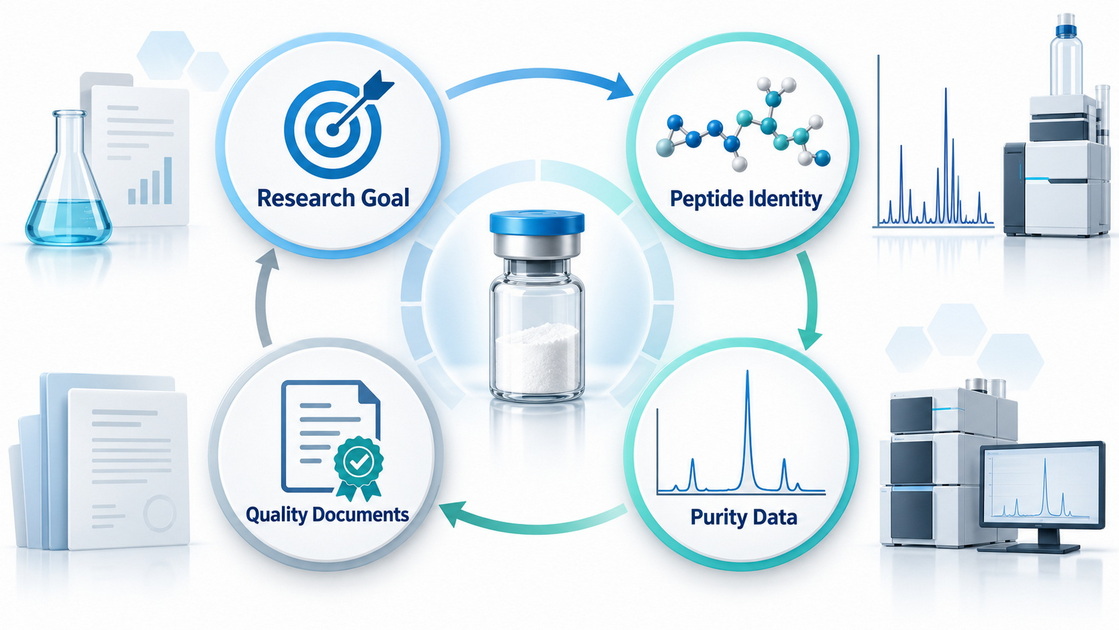
When evaluating peptide suppliers, a stated purity range of 98%–99% is meaningful only when supported by credible analytical documentation. The buyer should understand what the purity number represents, how it was measured, and whether the certificate belongs to the actual batch being purchased.
| Document or Test | Why It Matters |
|---|---|
| Certificate of Analysis | Provides batch-specific identity, purity, lot number, and test summary |
| HPLC Chromatogram | Helps assess chromatographic purity and potential impurity peaks |
| LC-MS or Mass Spectrometry Data | Confirms expected molecular mass and supports identity verification |
| Peptide Sequence Confirmation | Confirms the intended amino-acid sequence |
| Appearance Description | Documents lyophilized powder form and visual quality status |
| Net Peptide Content | Clarifies the amount of actual peptide in the supplied vial |
| Residual Solvent Information | Relevant to synthesis-quality evaluation where applicable |
| Storage Recommendation | Helps laboratories preserve material integrity |
| Reconstitution Guidance for Research | Supports consistent laboratory handling without implying administration use |
| Batch Number and Retest Date | Supports traceability and inventory control |
At Rchemsell, research peptide supply should be built around batch traceability, analytical transparency, and fit-for-purpose customization. For a customer developing an OEM cosmetic research program, that may mean custom sequence synthesis, specific purity targets, selected salt forms, lyophilized vial filling, private-label packaging support, or an agreed documentation package.
For a university or industrial laboratory, it may mean a defined batch specification, HPLC and MS records, storage guidance, and consistent lot management for longer research programs.
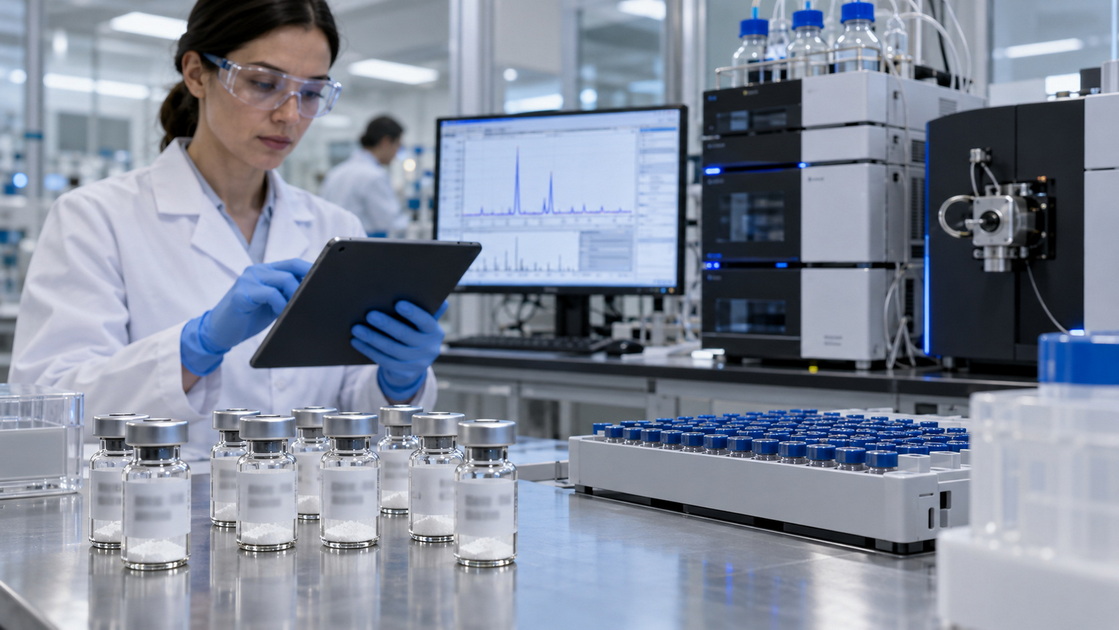
A responsible sourcing process can reduce delays, documentation gaps, and avoidable assay inconsistency.
State whether the material is intended for:
- Analytical reference work
- HPLC or LC-MS method development
- In vitro cell studies
- Stability testing
- Research formulation development
- Cosmetic ingredient screening
- Custom peptide synthesis validation
- Non-clinical comparative research
Do not use vague procurement language such as "recovery peptide" or "healing peptide" when the actual intended use is laboratory research.
Specify:
- Peptide sequence
- Purity target
- Quantity per vial
- Number of vials
- Salt form, if required
- Packaging configuration
- Lyophilized or solution format
- Required analytical documents
- Storage and shipping conditions
- Research-use-only labeling requirements
Before accepting a batch, compare the CoA, HPLC chromatogram, and mass data with the agreed specification.
Check for:
- Correct product name and sequence
- Matching lot number across documents
- Stated purity method
- Expected molecular mass
- Clear test date
- Defined storage condition
- Unusual chromatographic peaks
- Adequate document readability and traceability
After receipt, laboratories should document receiving conditions, storage location, lot number, opening date, and research project allocation. Where relevant, use aliquoting and controlled freeze-thaw practices consistent with your internal protocol.
Your internal documentation should state that the material is intended for research or cosmetic R&D only and is not approved for clinical, therapeutic, injectable, dietary-supplement, or veterinary use.
Cosmetic R&D teams may be interested in peptide chemistry because peptides are widely explored as ingredient concepts for topical formulation research. However, the presence of a peptide in laboratory research does not automatically make it suitable for inclusion in a finished cosmetic product.
Before considering any peptide for cosmetic-industry research, teams should evaluate:
- Target-market cosmetic regulations
- Ingredient nomenclature requirements
- Safety assessment needs
- Stability in the selected formulation base
- Compatibility with emulsifiers, preservatives, fragrances, and active ingredients
- Potential skin-sensitization concerns
- Microbiological-control strategy
- Claims substantiation requirements
- Packaging compatibility
- Local import and labeling rules
BPC-157 and TB-500 should not be described as proven cosmetic actives for skin repair, wound healing, anti-aging, or medical outcomes without robust, product-specific evidence and applicable regulatory review. A responsible supplier can support the material-quality side of the process, but the finished-product brand remains responsible for formulation safety, claims compliance, market authorization requirements, and product testing.
Off-the-shelf peptide supply is not always sufficient for institutional research, OEM programs, or formulation-development projects. A custom peptide manufacturer can help buyers align the supplied material with their project needs.
Potential customization options include:
- Custom peptide sequence synthesis
- Target purity selection
- Scale-up planning
- Lyophilized powder supply
- Customized vial filling
- Packaging configurations
- Batch documentation packages
- Analytical testing support
- Private-label or OEM packaging
- Shipment planning based on stability needs
- Ongoing lot-management support
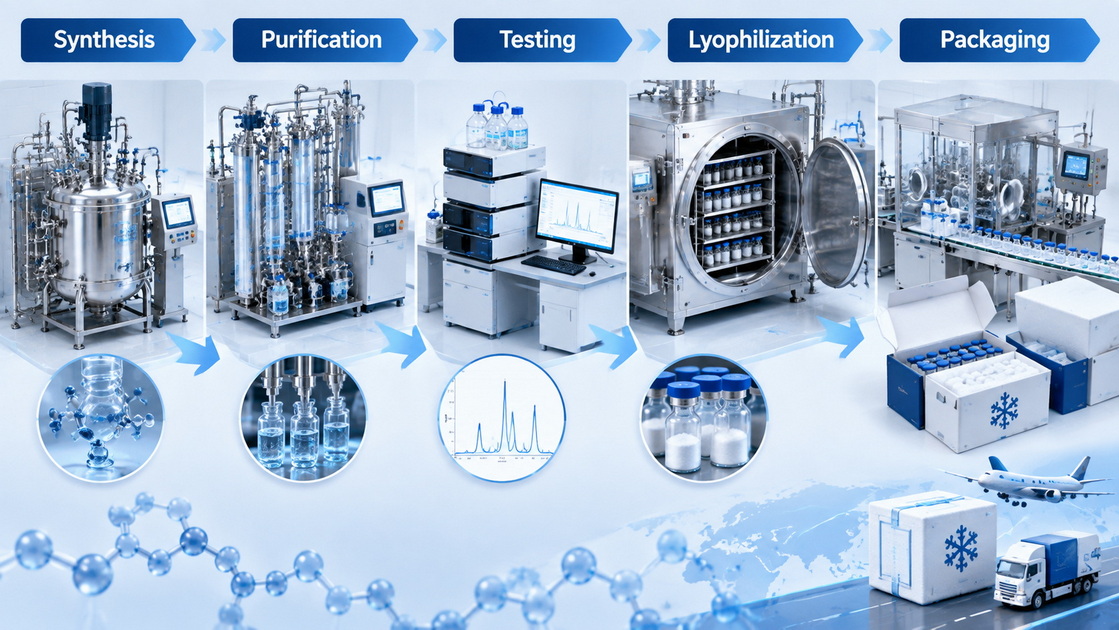
For Rchemsell customers, the goal is to provide an integrated pathway from peptide synthesis through testing, lyophilization, packaging, and shipment. That approach is especially valuable when the buyer requires a consistent quality profile across multiple batches or needs an adaptable supply plan for a developing research project.
TB-500 and BPC-157 are both widely searched investigational peptides, but they differ in sequence length, scientific context, analytical profile, and research rationale.
TB-500 may be relevant where a research program focuses on a short thymosin beta-4-related fragment, cell-migration biology, or short-peptide analytical studies. BPC-157 may be more relevant for laboratories investigating a 15-amino-acid peptide in controlled chemical, stability, cell-based, or exploratory formulation research.
The most important selection criteria are not online popularity or unverified wellness claims. They are:
- A clearly defined research objective
- Batch-specific identity and purity data
- Appropriate analytical documentation
- Reliable storage and packaging
- Traceable quality controls
- Strict research-use-only positioning
- Responsible regulatory awareness
Rchemsell provides custom peptide synthesis, 98%–99% purity research peptide supply, quality testing, lyophilized packaging, OEM/ODM support, and international shipment coordination for laboratory and cosmetic R&D customers.
No. TB-500 is commonly described as a synthetic peptide fragment associated with thymosin beta-4, while thymosin beta-4 is a longer, naturally occurring 43-amino-acid peptide. A related sequence does not mean they are identical in biological behavior, safety, or research application.
TB-500 is commonly described as a seven-amino-acid synthetic peptide fragment related to thymosin beta-4. BPC-157 is a 15-amino-acid synthetic peptide. Their sequence length, research contexts, analytical profiles, and evidence bases differ.
No. Neither TB-500 nor BPC-157 is FDA approved as a finished drug product. FDA has also raised safety and characterization concerns related to compounded products containing these substances.
No. Research peptides supplied for laboratory use should not be represented, marketed, or used as products for human consumption, injection, diagnosis, treatment, prevention, or veterinary use.
The required purity depends on your intended research method. A 98%–99% purity target may be suitable for many research applications, but the critical factor is receiving batch-specific evidence, such as HPLC and mass-spectrometry data, that supports the stated specification.
1. [U.S. Food and Drug Administration — Certain Bulk Drug Substances for Use in Compounding That May Present Significant Safety Risks] — FDA discussion of BPC-157 and thymosin beta-4 fragment LKKTETQ, including concerns involving immunogenicity, impurities, aggregation, API characterization, and limited safety information. [fda]
2. [PubChem — BPC-157 Compound Summary] — Chemical identity, molecular formula, molecular weight, biological activity references, and clinical-trial listing context for BPC-157. [pubchem.ncbi.nlm.nih]
3. [World Anti-Doping Agency — Prohibited List] — Official resource for reviewing prohibited-substance classifications in competitive sport.
4. [FDA Drug Development Process] — Overview of the evidence, safety, efficacy, and regulatory-review steps required before a drug can receive FDA approval.
5. [International Council for Harmonisation — ICH Quality Guidelines] — International quality-guideline resource relevant to analytical methods, impurity control, stability, and quality documentation.
6. [U.S. Food and Drug Administration — Cosmetics] — Information on cosmetic safety responsibilities, regulatory considerations, and marketing requirements in the United States.


