
Views: 242 Author: Rchemsell Publish Time: 2026-11-02 Origin: Site


Content Menu
● Sermorelin vs CJC-1295 vs Ipamorelin at a Glance
● What the Original Comparison Needed to Clarify
● How Sermorelin, CJC-1295, and Ipamorelin Work
>> Sermorelin and the GHRH Receptor
>> CJC-1295 and Extended Exposure
>> Ipamorelin and the Ghrelin Receptor
● CJC-1295 With DAC vs Without DAC
● What Published Human Research Actually Shows
>> CJC-1295: Hormone Changes, Not Established Wellness Outcomes
>> Ipamorelin: A Nonsignificant Postoperative Trial
>> Combination Claims Require Combination Evidence
● Safety and Regulatory Context
● Why 98–99% Purity Does Not Tell the Whole Story
>> HPLC Purity Is Not Total Peptide Content
>> Mass Spectrometry Answers a Different Question
● A Practical Peptide Qualification Workflow
>> 1. Define the Research Requirement
>> 2. Request Batch-Specific Documentation
>> 3. Match Testing to Experimental Risk
>> 5. Control Storage and Shipment
● Comparing Lots With Different Peptide Content
>> 1. Is Sermorelin the Same as CJC-1295?
>> 2. Is Ipamorelin a GHRH Analog?
>> 3. Can CJC-1295 With DAC Data Support a No DAC Product?
>> 4. Does 99% Purity Mean Sterile or Injectable?
>> 5. Are Customer Reviews Useful Scientific Evidence?
Sermorelin vs CJC-1295 vs ipamorelin is not simply a comparison of three interchangeable growth hormone research peptides. Sermorelin and CJC-1295 act through the growth hormone-releasing hormone pathway. Ipamorelin targets the ghrelin receptor. Their molecular structures, duration of action, and supporting evidence differ.
From a peptide procurement perspective, I would begin with identity, not a headline purity percentage. A laboratory cannot interpret results reliably if the supplied molecule, modification, or peptide content differs from its experimental specification.
This guide separates established findings from assumptions and explains how researchers can evaluate materials more rigorously. It is intended for lawful laboratory research and professional sourcing—not self-administration, treatment selection, or dosing.

| Comparison | Sermorelin | CJC-1295 | Ipamorelin |
|---|---|---|---|
| Molecular category | GHRH fragment analog | Modified GHRH analog; exact form must be specified | Synthetic pentapeptide |
| Main receptor pathway | GHRH receptor | GHRH receptor | Ghrelin receptor, GHS-R1a |
| Defining distinction | Based on the first 29 amino acids of human GHRH | Long-acting published formulation incorporates an albumin-binding modification | Structurally distinct GH secretagogue |
| Evidence highlighted here | Historical diagnostic development | Controlled human pharmacokinetic and hormone-response studies | Preclinical selectivity research and a postoperative clinical trial |
| Main interpretation risk | Treating historical pharmaceutical use as approval of any current product | Applying DAC study results to “no DAC” products | Treating selectivity findings as proof of broad human safety |
| Purchasing priority | Sequence and terminal modifications | Exact structure and DAC status | Identity, stereochemistry, and impurity characterization |
None should be selected solely because an online comparison describes it as "stronger," "cleaner," or "more physiological."
The supplied article introduces relevant receptor pathways, but several conclusions require correction or tighter qualification.
First, studies of individual compounds do not establish the safety or effectiveness of their combination. A biological rationale for combining pathways is not equivalent to a controlled combination trial.
Second, long-acting CJC-1295 findings cannot automatically be transferred to products labeled "CJC-1295 without DAC."
Third, the published postoperative ipamorelin trial did not demonstrate a statistically significant improvement in its primary endpoint. Presenting it as a positive efficacy trial changes the meaning of the evidence.
No customer comments or authenticated user reviews were supplied. Consequently, this article does not invent testimonials or use anecdotes as evidence of biological performance.
Sermorelin corresponds to the biologically active, amidated first 29 amino acids of human growth hormone-releasing hormone.
Its receptor pathway stimulates growth hormone release from responsive pituitary cells. However, the response depends on the biological system, including pituitary function and feedback regulation.
Historical pharmaceutical development included diagnostic use. That history does not establish the suitability of a modern research vial for human administration.
CJC-1295 was developed to extend GHRH-like activity.
The long-acting molecule investigated in the principal human study incorporates an albumin-binding modification. This changes its exposure profile substantially compared with an unmodified GHRH fragment.
The procurement implication is straightforward: "CJC-1295" alone is an incomplete purchasing specification when suppliers use the name for different materials.
Ipamorelin is a five-residue peptide that acts through the ghrelin receptor rather than the GHRH receptor.
Early research investigated its ability to stimulate growth hormone release with relative selectivity compared with earlier secretagogues.
That distinction is scientifically interesting. It does not mean ipamorelin is universally free of effects on appetite, metabolism, or other physiological systems.
This naming issue deserves its own section because it can undermine an otherwise well-designed experiment.
"CJC-1295 without DAC" is commonly used commercially for modified GRF(1–29). Buyers should not assume that this material is chemically or pharmacokinetically equivalent to the long-acting CJC-1295 studied in humans.
The albumin-binding chemistry is also more specific than simply describing a reversible association with albumin.
Before ordering, obtain:
- The complete amino acid sequence.
- Terminal modifications.
- The exact conjugation or linker chemistry.
- Molecular formula and expected mass.
- Counterion identity.
- An analytical report matching the ordered structure.
If the supplier cannot resolve the identity clearly, the material is not adequately specified for a comparative study.
A 2006 publication by Teichman and colleagues reported two randomized, placebo-controlled, double-blind studies in healthy adults.
After a single administration of long-acting CJC-1295:
- Mean growth hormone concentrations increased approximately twofold to tenfold for at least six days.
- Mean IGF-I increased approximately 1.5-fold to threefold for nine to eleven days.
- Estimated elimination half-life was 5.8–8.1 days.
After repeated administrations, mean IGF-I remained above baseline for up to 28 days.
These findings establish prolonged pharmacological activity under the study conditions. They do not establish improved strength, sleep, recovery, longevity, or cosmetic outcomes.
The publication reported no serious adverse reactions in those trials. That observation should not be converted into a general statement of long-term safety.
The 2014 postoperative study enrolled 117 patients, with 114 included in the safety and modified intention-to-treat populations.
Median time to the first tolerated meal was:
| Study group | Median time |
|---|---|
| Ipamorelin | 25.3 hours |
| Placebo | 32.6 hours |
The comparison produced \(p = 0.15\), which did not meet the conventional threshold for statistical significance.
The investigators reported no significant differences in the key or secondary efficacy analyses. A numerical difference is not the same as a demonstrated treatment benefit.
GHRH-receptor stimulation and ghrelin-receptor stimulation provide a rationale for studying combined effects.
However, evidence about either compound alone cannot establish the performance of a specific combination, formulation, ratio, or experimental schedule.
Claims of a predictable twofold or threefold advantage should identify the exact study, biological model, comparator, and endpoint. Without that context, the number is not useful evidence.
Growth hormone pathway stimulation is not automatically safe because hormone release originates inside the body.
Feedback regulation does not eliminate adverse effects, and mechanistic selectivity does not establish a complete safety profile.
The FDA's April 2026 safety information identifies concerns involving CJC-1295 and ipamorelin, including peptide-related impurities, characterization complexity, and potential immunogenicity.
For CJC-1295, it notes reported serious adverse events including increased heart rate and systemic vasodilatory reactions.
For ipamorelin, it notes serious adverse events, including death, reported in intravenous gastric-motility research, while also identifying insufficient safety information for certain other injectable routes. Reporting an event does not, by itself, establish that the compound caused it.
Research-grade supply should therefore remain separate from claims about human treatment. A research-use label is not regulatory approval.
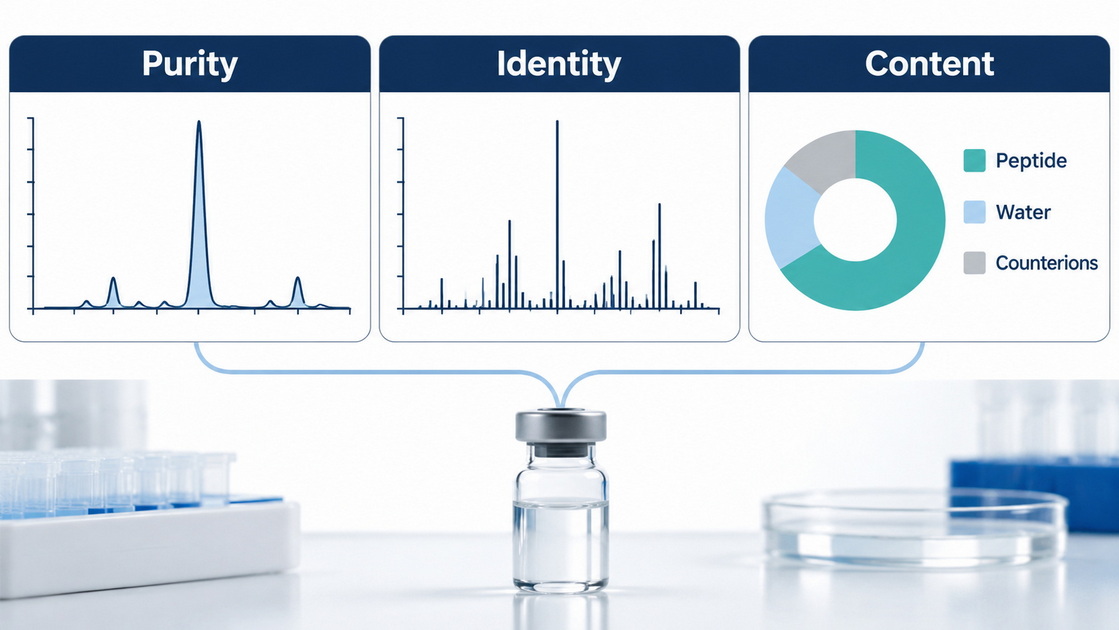
For laboratory buyers, this is one of the most important distinctions in peptide quality control.
An HPLC purity result generally describes the proportion of the principal detected peak relative to other detected peaks under a particular method.
It does not automatically measure water, counterions, residual solvents, or every possible contaminant.
A lyophilized product can therefore have high chromatographic purity while containing less target peptide per milligram than a buyer assumes.
For illustration, a 10 mg gross sample with 80% net peptide content contains 8 mg of peptide material. That figure still needs to be interpreted alongside chemical purity.
This is an analytical example, not a specification for any Rchemsell batch.
Mass spectrometry helps assess whether the observed molecular mass matches the expected material.
It does not, by itself, establish:
- Complete sequence correctness.
- Correct stereochemistry.
- Absence of all related impurities.
- Sterility.
- Endotoxin acceptability.
- Biological activity.
A credible release package uses complementary methods rather than treating one instrument result as universal proof.

Document the sequence, modifications, required quantity, purity method, counterion, and intended laboratory application.
For CJC-1295, resolve DAC status before requesting a quotation.
Ask for a certificate of analysis identifying the actual lot, analytical methods, acceptance criteria, and release date.
Where necessary, request chromatograms and mass spectra rather than only summary percentages.
Depending on the study, additional requirements may include peptide content, water, residual solvents, counterions, endotoxin, bioburden, or a relevant activity assay.
Not every experiment needs the same panel. The specification should follow the application.
Inspect documentation, packaging, and analytical consistency before committing to recurring purchases.
For longer programs, retain reference material and establish change-notification requirements.
Use product-specific stability information to define storage and transport conditions.
Avoid assuming that every lyophilized peptide tolerates the same shipping exposure. Packaging appearance alone cannot establish retained quality.
Two suppliers can both report 99% HPLC purity while delivering materials with different water content, counterion levels, or net peptide content.
If an experiment compares equal gross weights without accounting for those differences, apparent biological variation may partly reflect unequal amounts of peptide.
The safeguard is to document the concentration basis:
1. Gross lyophilized mass.
2. Net peptide content.
3. Chemical purity.
4. The method used to calculate the working concentration.
This is particularly important when comparing suppliers or evaluating a new synthesis lot. Changing suppliers without reconciling these variables can introduce avoidable confounding.
According to the company information supplied for this article, Rchemsell is a Chinese peptide manufacturer serving laboratory research and cosmetic-industry customers.
Its stated services include peptide synthesis, quality testing, lyophilization, packaging, shipping, and OEM, ODM, and custom synthesis support. The company reports product purity of 98–99%.
These are company-provided statements, not independently verified batch results. Buyers should request specifications and documentation for the actual material being quoted.
Serving cosmetic-industry customers does not establish that sermorelin, CJC-1295, or ipamorelin is suitable or authorized for cosmetic use.
No. They share a GHRH-related research context but differ structurally. The long-acting CJC-1295 studied in humans also incorporates albumin-binding chemistry.
No. Ipamorelin is a structurally distinct pentapeptide acting through the ghrelin receptor.
Not automatically. Evidence must match the actual molecule, formulation, route, and study conditions.
No. Chromatographic purity does not establish sterility, endotoxin suitability, pharmaceutical quality, or authorization for administration.
They may highlight communication or packaging issues. They cannot reliably establish molecular identity, clinical effectiveness, or safety.
1. PSPeptides Research Team. "How to Use CJC-1295 Ipamorelin for Growth Hormone Research," April 12, 2026. Supplied source article; evaluated critically rather than treated as primary scientific evidence. [pspeptides]
2. Teichman SL, Neale A, Lawrence B, Gagnon C, Castaigne JP, Frohman LA. "Prolonged Stimulation of Growth Hormone (GH) and Insulin-Like Growth Factor I Secretion by CJC-1295, a Long-Acting Analog of GH-Releasing Hormone, in Healthy Adults." *Journal of Clinical Endocrinology & Metabolism*. 2006;91(3):799–805. DOI: 10.1210/jc.2005-1536. [pubmed.ncbi.nlm.nih]
3. Raun K, Hansen BS, Johansen NL, et al. "Ipamorelin, the First Selective Growth Hormone Secretagogue." *European Journal of Endocrinology*. 1998;139(5):552–561. DOI: 10.1530/eje.0.1390552. [pubmed.ncbi.nlm.nih]
4. Beck DE, Sweeney WB, McCarter MD; Ipamorelin 201 Study Group. "Prospective, Randomized, Controlled, Proof-of-Concept Study of the Ghrelin Mimetic Ipamorelin for the Management of Postoperative Ileus in Bowel Resection Patients." *International Journal of Colorectal Disease*. 2014;29(12):1527–1534. DOI: 10.1007/s00384-014-2030-8. [pubmed.ncbi.nlm.nih]
5. U.S. Food and Drug Administration. "Certain Bulk Drug Substances for Use in Compounding That May Present Significant Safety Risks." Content current April 22, 2026. [fda]
6. U.S. Food and Drug Administration. Clinical pharmacology review for NDA 205598, 2017. Includes historical context for sermorelin/Geref diagnostic use and discontinued marketing status. [accessdata.fda]
7. Bachem. "Quality Control of Amino Acids & Peptides: A Guide." Analytical background on identity, chromatographic purity, water, solvents, counterions, and net peptide content. [bachem]
8. Bachem. "FAQ—Frequently Asked Questions." Explains HPLC purity, gross weight, and net peptide content. [bachem]
9. Rchemsell company background supplied for this article. Source of the manufacturing-service and 98–99% purity statements; no independent company or batch documentation was supplied.


