
Views: 233 Author: Rchemsell Publish Time: 2026-11-07 Origin: Site


Content Menu
● Why There Is No Universal Thymosin Alpha-1 Dosage
>> Clinical Protocols Are Not Personal Recommendations
>> Laboratory Concentrations Require Their Own Rationale
● What Recent Thymosin Alpha-1 Research Actually Shows
>> A Large Sepsis Trial Did Not Establish a Mortality Benefit
>> Pooled Results Need Quality-Based Interpretation
● Regulatory Status and Safety Must Remain Separate From Marketing
● Thymosin Alpha-1 Purity Is Not the Same as Peptide Content
>> What HPLC Purity Can Tell You
>> Why Peptide Content Matters
>> Identity Requires Complementary Evidence
● How to Review a Thymosin Alpha-1 Certificate of Analysis
● Build a More Reproducible Laboratory Workflow
>> Step 1: Define the Scientific Question
>> Step 2: Agree on Material Specifications
>> Step 3: Conduct a Small Qualification Study
>> Step 4: Document Handling Conditions
>> Step 5: Qualify Replacement Lots
● Lyophilized Packaging and Shipping Need Defined Specifications
● What Cosmetic Research Teams Should Consider
● Source TA1 Research Materials With a Clear Technical Brief
>> 1. Is there one standard Thymosin Alpha-1 dosage?
>> 2. Is research-grade TA1 equivalent to a pharmaceutical product?
>> 3. Does 99% HPLC purity guarantee the labeled peptide quantity?
>> 4. What documentation should a TA1 supplier provide?
>> 5. Can TA1 automatically be used in cosmetic products?
Thymosin Alpha-1 dosage is frequently discussed online as though one schedule can apply to every research question or health condition. That is misleading. Published studies investigate different populations, objectives, formulations, and endpoints. Their protocols cannot automatically become personal treatment instructions or specifications for research-grade materials.
For laboratories evaluating Thymosin Alpha-1, also called Tα1 or TA1, the more useful questions concern evidence quality, peptide identity, concentration accuracy, and batch consistency.
From a peptide manufacturing perspective, my first question is not "Which dose is most popular?" It is "What material and documentation does this experiment require?"
Rchemsell supports laboratory research and cosmetic-industry projects through peptide synthesis, quality testing, lyophilized packaging, and shipping coordination. This guide explains how to evaluate TA1 literature and sourcing requirements without confusing research supplies with approved medicines.

Thymosin Alpha-1 is a 28-amino-acid peptide studied for its immunomodulatory properties. Its synthetic pharmaceutical form is commonly called thymalfasin.
However, the same peptide name does not make every product interchangeable.
A clinical study involves a defined formulation, manufacturing specification, administration protocol, and monitored population. A research peptide is supplied against a different specification for a stated laboratory purpose.
| Material Category | What Researchers Should Establish | What It Does Not Automatically Establish |
|---|---|---|
| Synthetic research peptide | Identity, purity, content, and experimental suitability | Suitability for human administration |
| Investigational clinical product | Trial authorization and protocol-specific manufacturing controls | Approval for general use |
| Authorized medicine | Jurisdiction-specific authorization and approved labeling | Permission to transfer its claims to research supplies |
| Cosmetic development material | Ingredient status, safety assessment, and formulation suitability | Therapeutic effectiveness or injectable suitability |
The important distinction is intended use. Documentation must match the application, not merely the molecule's name.
A dose reported in one study belongs to that study's scientific and clinical context.
It reflects the population, disease characteristics, formulation, treatment duration, accompanying therapies, and monitoring arrangements.
Removing those conditions can turn a factual description into misleading advice.
A published trial can show what investigators tested. It does not establish that the same regimen is appropriate for a healthy individual, another condition, or a product purchased from a research supplier.
Clinical decisions also require consideration of contraindications, other medicines, individual risks, and local authorization.
This article therefore does not provide injection instructions, syringe conversions, cycling schedules, or personal treatment recommendations. Decisions about human use belong with appropriately licensed clinicians and authorized products.
For laboratory experiments, the relevant variable may be concentration in a cell-culture system rather than a clinical dose.
Researchers should define:
- The experimental model.
- The biological endpoint.
- Exposure duration.
- Appropriate controls.
- Concentration verification.
- Potential interference from the preparation vehicle.
A human study cannot directly establish the appropriate concentration for an unrelated cell assay.
TA1 has a substantial research history, but scientific interest is not equivalent to proven benefit across conditions.
A useful evidence review includes negative findings and corrections, not only favorable summaries.
A phase 3, multicenter, double-blind, placebo-controlled trial published in 2025 enrolled 1,106 adults with sepsis across 22 centers in China.
Its modified intention-to-treat analysis included 1,089 participants.
The reported 28-day mortality was 23.4% in the TA1 group and 24.1% in the placebo group. The corrected hazard ratio was 0.97, with a 95% confidence interval of 0.76–1.24.
The study found no clear evidence that TA1 reduced 28-day mortality in the overall population.
A subsequent correction updated some analyses. That matters because commercial summaries may continue repeating the original statistics without acknowledging the corrected publication.
A 2025 systematic review included 11 randomized trials involving 1,927 patients.
Its overall analysis suggested a mortality benefit. However, analyses restricted to higher-quality studies or multicenter trials did not show a statistically significant benefit.
These findings illustrate why the number of studies alone is not enough.
Researchers should examine study quality, consistency, population differences, and uncertainty before forming conclusions. Neither a positive pooled estimate nor a biological mechanism justifies broad "immune enhancement" promises.
Regulatory status depends on the jurisdiction, formulation, indication, and manufacturer.
In the United States, TA1 is not an approved medicine. Regulatory discussions about compounding do not make research-grade products approved treatments.
Authorities have highlighted concerns about TA1-related compounded preparations, including:
- Peptide-related impurities.
- Incomplete characterization.
- Potential aggregation.
- Possible immunogenicity.
- Insufficient information to characterize certain safety risks.
These concerns do not prove that every preparation causes harm. They show why purity claims alone cannot establish safety.
Likewise, authorization of a particular medicine in another market does not authorize a research supplier's product for human use. Buyers should verify the applicable requirements directly rather than relying on international approval counts in promotional articles.
This distinction is especially important when evaluating experimental concentration.
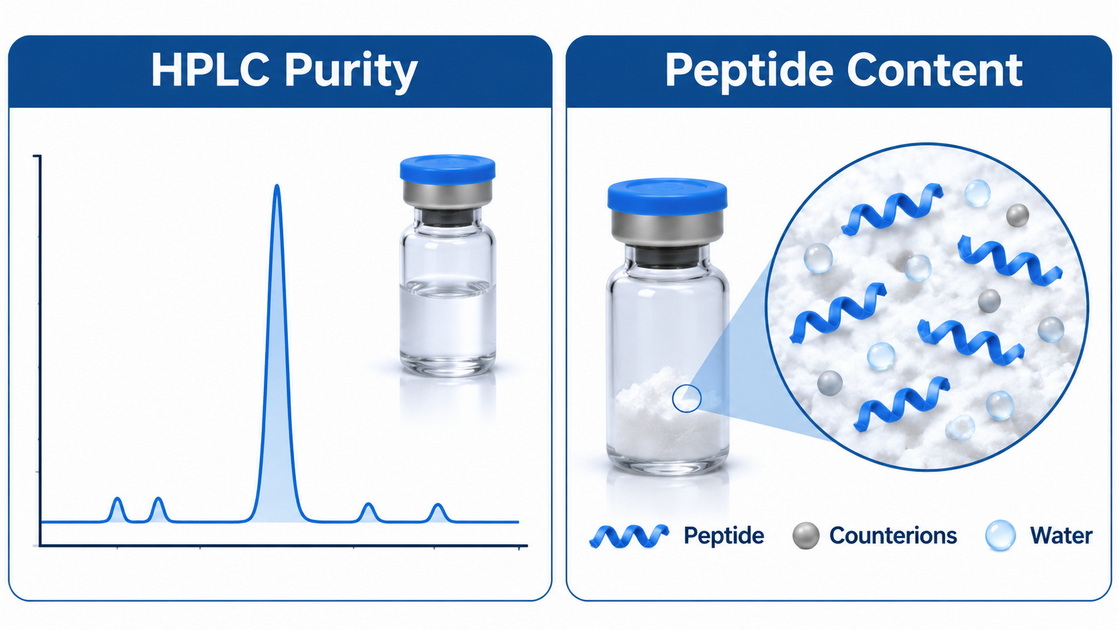
An HPLC purity result describes chromatographic composition under a particular method. It does not necessarily state how much target peptide is present in the total powder.
Analytical HPLC separates components and measures their responses under specified conditions.
A reported purity percentage commonly reflects the target peak relative to detected peaks. Interpretation depends on the separation method, detector settings, and whether impurities are adequately resolved.
A high percentage does not automatically establish:
- Exact target-peptide quantity per vial.
- Absence of residual water or counterions.
- Sterility.
- Low endotoxin.
- Absence of aggregates.
- Biological potency.
Lyophilized peptide material may contain water, counterions, and other specified constituents.
Consequently, total powder mass and target-peptide mass are not necessarily identical.
For quantitative work, ask how the supplied quantity was determined and whether a suitable quantitative assay or content measurement is available.
Also clarify terminology. "Net peptide content" may refer to total peptidic material rather than exclusively the desired sequence. It should not automatically be treated as a target-specific assay result.
Mass spectrometry can support identity by assessing molecular mass. HPLC provides complementary information about chromatographic composition.
Neither test alone answers every quality question.
For demanding applications, additional characterization may be appropriate. The testing strategy should reflect the scientific risk rather than simply producing the longest certificate.
A certificate of analysis should identify the actual batch being purchased.
Avoid accepting a generic example as proof of current inventory quality.
| Quality Attribute | Documentation to Request | Why It Matters |
|---|---|---|
| Identity | Expected identity and observed analytical result | Supports confirmation of the supplied material |
| Purity | Method, result, and chromatogram where available | Shows what the reported percentage represents |
| Quantity basis | Fill basis, assay, or content information | Supports accurate experimental preparation |
| Counterion | Declared salt or counterion form | Helps interpret composition and compatibility |
| Water content | Result when relevant and available | Helps explain powder composition |
| Relevant contaminants | Application-specific testing | Addresses risks that purity testing may miss |
| Traceability | Batch number, test date, and release information | Connects the paperwork to the supplied lot |
| Storage | Product-specific recommendations | Supports controlled handling |
Ask which tests are routine and which require a separate agreement.
For immune-related cell experiments, consider whether endotoxin could interfere with the endpoint. A confounding contaminant may create an apparent biological response unrelated to the intended peptide.
Reliable results depend on how the material is received, prepared, stored, and documented.
Specify the model, endpoint, and acceptance criteria before purchasing.
This prevents a supplier's stock presentation from becoming the default experimental design.
Confirm sequence, terminal modifications, counterion, purity requirement, quantity basis, packaging, and any additional testing.
Where a modified analogue is requested, distinguish it clearly from the reference peptide.
Evaluate suitability in the intended laboratory system before committing to a larger campaign.
Include controls capable of revealing vehicle effects, assay interference, and contamination-related artifacts.
Record receipt condition, batch number, preparation date, solvent system, storage, and freeze–thaw history where applicable.
Use product-specific instructions and laboratory procedures. Do not assume every peptide has the same solution stability.
When changing batches, compare relevant analytical documentation and experimental performance.
Retaining a reference aliquot or suitable benchmark can help investigate unexpected differences.
Lyophilization supports convenient handling, but it does not make every peptide indefinitely stable or sterile.
Packaging requirements should account for moisture protection, container compatibility, shipment duration, and destination conditions.
Before dispatch, agree on:
- Vial quantity and labeling.
- Container and closure format.
- Required transport conditions.
- Supporting shipment documentation.
- Receipt inspection.
- Procedures for delays or damaged packages.
Avoid universal claims that room-temperature or refrigerated shipping is always adequate. Appropriate conditions depend on the material, available stability information, packaging, and transit route.
A visual inspection alone cannot confirm retained purity or biological activity after a temperature excursion.
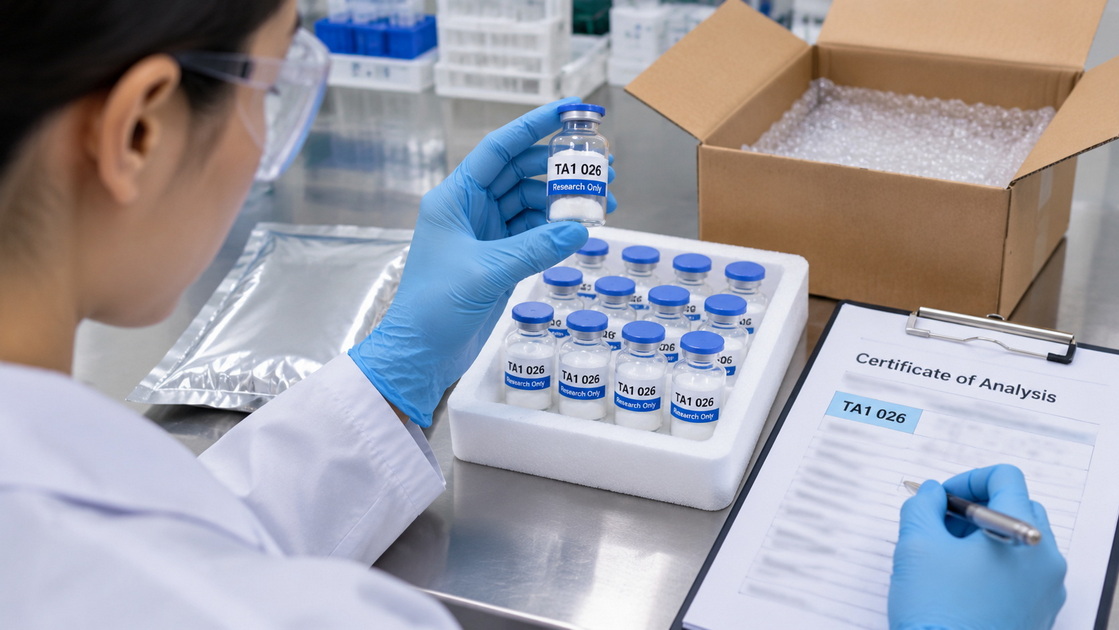
Rchemsell serves the cosmetics industry, but that does not automatically make TA1 an established cosmetic ingredient in every market.
Cosmetic developers must independently assess ingredient eligibility, safety, formulation compatibility, and permitted claims.
Evidence from clinical immune-related research cannot substantiate claims for a topical cosmetic product without relevant supporting data.
Before developing a formula, clarify:
1. The target market and product classification.
2. The ingredient's regulatory position.
3. The intended formulation and exposure conditions.
4. Required safety and stability work.
5. The evidence supporting proposed claims.
Keep research objectives separate from finished-product authorization.
Rchemsell offers peptide synthesis, testing, lyophilized packaging, and shipment coordination, alongside OEM, ODM, and custom synthesis services.
The company reports product purity specifications in the 98%–99% range. Buyers should confirm the specification and batch-specific result for the particular peptide ordered.
Purity should remain one part of a broader technical agreement, not a substitute for identity, quantity, traceability, or application suitability.
No universal regimen applies across conditions, formulations, and research settings. Published protocols describe specific investigations and should not be converted into personal treatment instructions.
No. Research-grade supply does not establish pharmaceutical manufacturing controls, sterility, regulatory authorization, or suitability for human administration.
No. Chromatographic purity and quantitative content are different measurements. Ask how the stated quantity was established and what the result includes.
Request batch-linked identity and purity results, quantity information, declared counterion, storage recommendations, and any additional testing agreed for the application.
No. Ingredient eligibility, safety, formulation suitability, and claims require market-specific assessment. Research interest does not establish cosmetic authorization.
1. PSPeptides. "Thymosin Alpha-1 Dosage: Complete Research Guide 2026." Original article reviewed for topic coverage and claims requiring correction. Its community schedules, self-administration instructions, and purity-to-content equivalence claims are not adopted here. [pspeptides]
2. Wu J, et al. "The Efficacy and Safety of Thymosin α1 for Sepsis (TESTS): Multicentre, Double Blinded, Randomised, Placebo Controlled, Phase 3 Trial." BMJ. 2025;388:e082583. Corrected full-text version supporting the trial population, mortality figures, and interpretation. [pmc.ncbi.nlm.nih]
3. BMJ. "Correction: The Efficacy and Safety of Thymosin α1 for Sepsis (TESTS)." 2025;389:r1098. Documents the updated analyses and corrected hazard ratios. [pmc.ncbi.nlm.nih]
4. "Efficacy of Thymosin α1 for Sepsis: A Systematic Review and Meta-Analysis." Published September 2025. Supports the distinction between the overall pooled result and higher-quality or multicenter subgroup findings. [pmc.ncbi.nlm.nih]
5. U.S. Food and Drug Administration. "Certain Bulk Drug Substances for Use in Compounding That May Present Significant Safety Risks." Includes TA1-specific concerns about immunogenicity, peptide impurities, and characterization. [fda]
6. U.S. Food and Drug Administration. "Thymosin Alpha-1 (Ta1) Related Bulk Drug Substances." Pharmacy Compounding Advisory Committee presentation. Discusses characterization gaps, aggregation, impurities, and safety considerations. [fda]
7. U.S. Food and Drug Administration. Center for Drug Evaluation and Research, Office of Compliance: 2021 Annual Report. Documents the agency's statement that thymosin was not approved to treat or prevent COVID-19 or any other condition. [fda]
8. Bachem. "FAQ—Frequently Asked Questions." Explains HPLC purity, net peptide content, residual water, and counterions. [bachem]


