
Views: 261 Author: Rchemsell Publish Time: 2026-11-03 Origin: Site


Content Menu
● What Are Tendon Repair Peptides?
● BPC-157, TB-500, and GHK-Cu: Research Comparison
● BPC-157 Tendon Repair Research: What the Studies Show
>> Tendon-Cell Migration and Stress Survival
>> Animal Tendon Findings and Their Limits
● TB-500 and Thymosin Beta-4: Why Molecular Identity Matters
>> Do Not Transfer Evidence Between Different Molecules
● GHK-Cu: Collagen Research Without Overstating Tendon Benefits
>> Cosmetic Research Is Not Tendon Treatment Evidence
● Can Combining Tendon Repair Peptides Improve Results?
● Designing More Informative Tendon Peptide Studies
>> Match the Endpoint to the Claim
>> Separate Acute Injury From Chronic Tendinopathy
● How to Evaluate Research Peptide Quality
>> Request Documentation That Matches the Batch
>> Treat Storage as a Product-Specific Question
● Rchemsell: Manufacturing Support for Research and Cosmetic Development
>> 1. What are the best peptides for tendon repair?
>> 2. Has BPC-157 been proven to heal human tendons?
>> 3. Is TB-500 the same as thymosin beta-4?
>> 4. Can topical GHK-Cu repair an injured tendon?
>> 5. Does 99% purity mean a peptide is safe for injection?
Tendon repair peptides attract attention because tendon injuries are difficult to study and often slow to resolve. BPC-157, TB-500, and GHK-Cu feature prominently in this discussion, but their popularity should not be confused with proven clinical effectiveness.
For laboratory researchers, the useful question is not simply which peptide is "best." It is which molecule, experimental model, and measurable endpoint can answer a specific research question.
This guide examines the evidence behind peptides for tendon repair, explains important limitations, and provides a practical framework for evaluating research materials. It also distinguishes tendon-focused investigations from cosmetic peptide development—two fields that may share biological interests but require different evidence and product specifications.
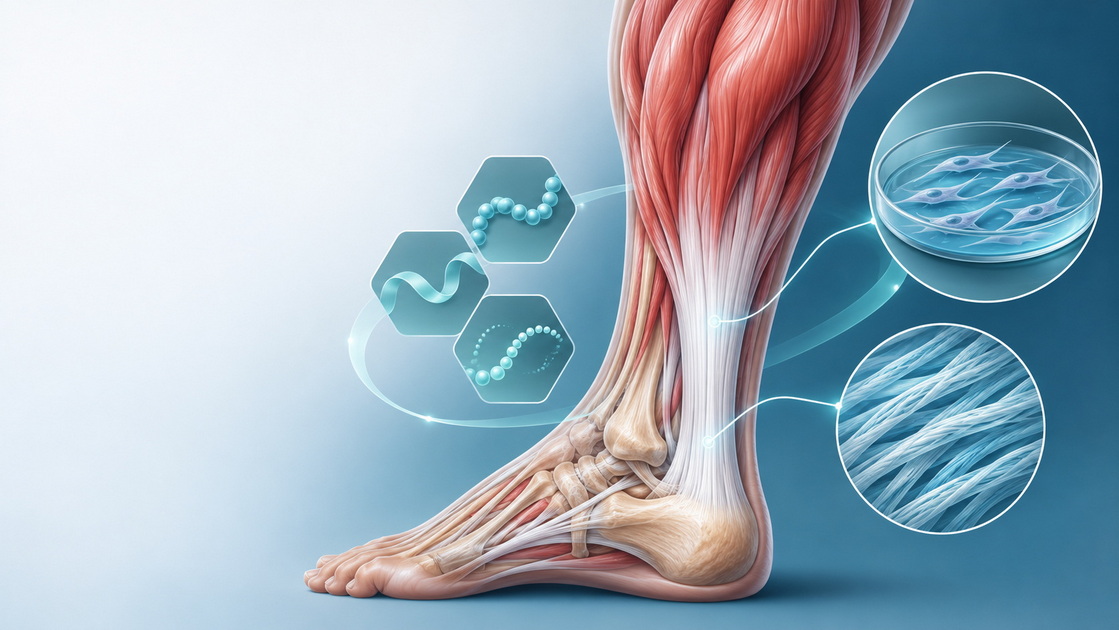
"Tendon repair peptides" is an informal research category, not a recognized class of approved tendon treatments. It generally describes peptides investigated for effects on cell migration, inflammatory signaling, collagen production, or extracellular matrix remodeling.
Tendons transfer force between muscle and bone. Their function depends on more than collagen quantity: collagen fibers must also develop the organization and mechanical properties needed to withstand loading.
Consequently, increased collagen production in a laboratory experiment does not automatically demonstrate stronger tendon tissue. Likewise, faster cell migration does not establish faster recovery in people.
The central distinction is evidence: molecular activity, animal outcomes, and clinical benefit represent different levels of knowledge.
| Peptide | Main research interest | Evidence relevant to this discussion | Important limitation |
|---|---|---|---|
| BPC-157 | Tendon-cell migration, stress survival, and repair-associated signaling | Tendon-cell experiments and animal injury models | Human tendon-healing benefit remains unestablished |
| TB-500 | Biological activity associated with a thymosin beta-4 fragment | Fragment-specific evidence must be separated from full-length protein research | Product names do not reliably establish molecular identity |
| GHK-Cu | Fibroblast activity, collagen production, and matrix remodeling | Skin, connective-tissue, and wound-related research | Skin findings cannot establish repair of deeper tendons |
These compounds should not be ranked solely by online visibility. A meaningful comparison starts with the research question and the exact material tested.
BPC-157 is a synthetic 15-amino-acid peptide investigated in several experimental tissue-repair settings.
A 2011 tendon study examined tendon explants and cultured tendon fibroblasts. Researchers reported increased explant outgrowth, enhanced cell migration, and improved cell survival under experimentally induced oxidative stress.
The findings also implicated FAK-paxillin signaling, a pathway associated with cell adhesion and movement.
Importantly, the study did not establish a universal increase in cell proliferation. This distinction matters: migration, survival, and proliferation are separate biological outcomes and should not be presented as interchangeable benefits.
Animal studies have reported improvements in biomechanical, functional, and microscopic outcomes following experimental tendon injury.
For example, rat Achilles tendon research assessed measures including load to failure, tissue organization, and functional recovery. These endpoints provide more information than appearance alone because they examine whether repaired tissue performs differently under stress.
Nevertheless, a surgically created injury in a rat is not equivalent to chronic human tendinopathy. Species differences, injury mechanisms, exposure conditions, and rehabilitation all complicate translation.
A 2025 systematic review described promising preclinical findings while highlighting the limited clinical evidence. BPC-157 therefore remains an investigational topic, not an established solution for human tendon repair.
One of the most consequential problems in peptide content is treating TB-500 and thymosin beta-4 as interchangeable.
Full-length thymosin beta-4 contains 43 amino acids. The FDA identifies the fragment LKKTETQ, corresponding to residues 17–23, as also known as TB-500. This fragment contains seven amino acids—not 17.
Commercial naming can be inconsistent. Researchers should therefore verify the sequence rather than relying on a product title.
Full-length thymosin beta-4 has been investigated in cell migration, actin regulation, and tissue-repair biology. Those findings do not automatically prove that a shorter fragment produces the same effects.
Before applying a published result to a purchased material, check:
- The complete amino-acid sequence.
- Whether the study used the full-length peptide or a fragment.
- Terminal modifications and salt form.
- Molecular mass and identity confirmation.
- The experimental model and measured outcomes.
From a procurement perspective, an impressive mechanism description is useful only when it describes the molecule actually supplied.
GHK-Cu is a copper complex of the tripeptide glycyl-L-histidyl-L-lysine. Research has examined its effects on dermal fibroblasts, extracellular matrix components, and repair-associated signaling.
Published reviews describe experimental findings involving collagen, elastin, and glycosaminoglycan production. These observations help explain interest in GHK-Cu within skin research and cosmetic formulation.
However, biological plausibility is not proof of tendon recovery.
A topical product that affects skin appearance or dermal markers has not necessarily delivered an active peptide to a tendon.
Molecular weight alone cannot establish meaningful delivery through skin to deeper tissue. Formulation, barrier interactions, chemical stability, and the amount reaching the target all matter.
For cosmetic developers, the appropriate questions concern formulation compatibility, ingredient stability, skin tolerability, and substantiated cosmetic outcomes. Claims about repairing injured tendons require a different standard of evidence.
BPC-157 and TB-500 combinations are sometimes promoted using the nickname "Wolverine stack." The nickname is not a standardized scientific protocol and does not demonstrate effectiveness.
Different proposed mechanisms may justify studying a combination, but they do not establish synergy. They also do not establish compatibility or safety.
A useful combination experiment should include:
1. A vehicle control.
2. Each peptide tested separately.
3. The combination under matched conditions.
4. Prespecified outcome measures.
5. Assessment of material stability and assay interference.
Without single-agent comparisons, researchers cannot determine whether a combination adds value or merely reproduces the effect of one component.
Adding GHK-Cu creates further variables. Copper-containing materials, mixed formulations, and analytical methods require compatibility assessment rather than assumptions about "no known interference."
A stronger study begins with a narrow question—not a broad promise of regeneration.
If the question concerns cell migration, measure migration while accounting for proliferation. If it concerns matrix production, examine relevant matrix markers. If it concerns tissue strength, include mechanical testing.
Useful endpoint categories include:
| Research question | Potential endpoint | Interpretation limit |
|---|---|---|
| Do cells move differently? | Migration assay | Does not establish tissue strength |
| Does matrix production change? | Collagen expression or deposition | Does not establish organized repair |
| Is tissue architecture altered? | Histological assessment | Appearance alone does not prove function |
| Does repaired tissue resist loading? | Load to failure or stiffness | Animal results still require clinical translation |
This approach helps prevent an attractive laboratory signal from becoming an unsupported treatment claim.
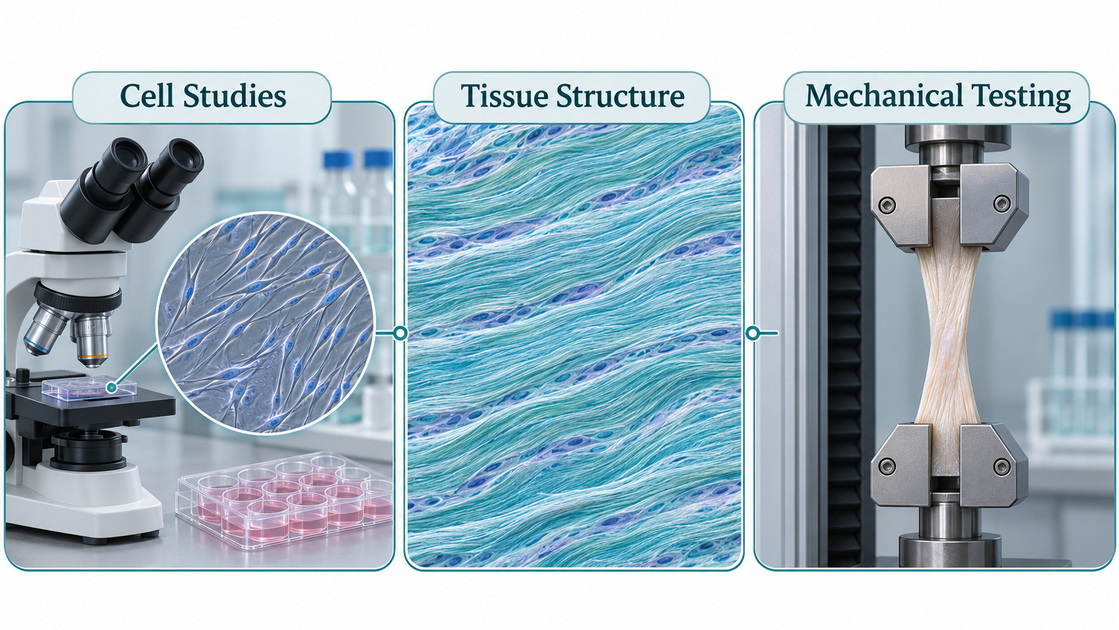
An acute rupture model and chronic degenerative tendinopathy do not represent the same biological problem.
Researchers should document why their chosen model fits the intended question. They should also report exposure conditions, controls, biological replicates, and exclusion criteria clearly enough for another laboratory to assess or repeat the work.
Independent replication is particularly valuable when a literature base contains small studies or repeated findings from closely related research groups.
Purity matters, but a percentage cannot describe the entire product.
A material reported as 99% pure by an HPLC method is not automatically 99% peptide by weight. Chromatographic purity also does not independently establish identity, sterility, endotoxin status, or suitability for a particular experiment.

A practical supplier-review checklist includes:
- Batch-specific certificate of analysis.
- HPLC method information and chromatogram.
- Mass spectrometry identity results.
- Sequence, modifications, and salt form.
- Net peptide content or assay information where required.
- Relevant water, residual-solvent, and counterion information.
- Storage conditions and available stability data.
- Application-specific microbiological or endotoxin testing where necessary.
Not every project requires every test. The specification should reflect the experiment, rather than a generic claim of "research grade."
There is no universal refrigerated shelf life for every reconstituted peptide.
Sequence, concentration, solvent, pH, packaging, and handling can affect stability. Lyophilization may support storage, but it does not eliminate the need for appropriate conditions.
Ask for product-specific instructions and the basis for any stability claim. Avoid assuming that a standard four-week window applies across different molecules or formulations.
Rchemsell is a China-based peptide manufacturer serving laboratory research and cosmetic-industry customers.
According to its company-provided information, Rchemsell offers peptide products with reported purity of 98%–99%, alongside peptide synthesis, quality testing, lyophilized packaging, and shipping support. It also provides OEM, ODM, and custom peptide synthesis services.
For buyers, these capabilities are most useful when translated into a clearly documented project specification.
Before requesting production, define:
- Target sequence and required modifications.
- Intended research or cosmetic-development application.
- Required quantity, purity, and peptide content.
- Analytical acceptance criteria.
- Packaging and aliquot requirements.
- Destination-market documentation and transport needs.
For OEM and ODM projects, clarify which party is responsible for formulation development, stability evaluation, labeling, and application-specific compliance.
Manufacturing capability and analytical quality are essential foundations. Neither independently demonstrates clinical effectiveness or authorizes therapeutic claims.
No peptide can currently be identified as a proven best treatment for human tendon repair from the evidence discussed here. For research, BPC-157 has direct tendon-model literature, while TB-500 requires careful identity verification and GHK-Cu is more closely associated with skin and matrix research.
No. Cell and animal findings are encouraging in some models, but they do not establish reliable clinical tendon healing, an effective human regimen, or a complete safety profile.
Not necessarily. Full-length thymosin beta-4 contains 43 amino acids. The FDA identifies TB-500 with the seven-amino-acid LKKTETQ fragment. Confirm the sequence of any research material before comparing it with published studies.
That conclusion is not supported by the skin and wound literature discussed here. Demonstrating activity in skin does not prove sufficient delivery to a tendon or improved tendon function.
No. Chromatographic purity does not establish sterility, endotoxin control, clinical safety, or authorization for human administration. Research-use materials should not be interpreted as injectable medicines.
1. PSPeptides. "Best Tendon Repair Peptides: Proven Research Guide 2026." Original commercial article reviewed for restructuring and claim assessment. [Read the original article]. [pspeptides]
2. Chang CH, et al. "The promoting effect of pentadecapeptide BPC 157 on tendon healing involves tendon outgrowth, cell survival, and cell migration." Journal of Applied Physiology. 2011;110(3):774–780. DOI: 10.1152/japplphysiol.00945.2010. [Read the study abstract]. [pubmed.ncbi.nlm.nih]
3. Staresinic M, et al. "Gastric pentadecapeptide BPC 157 accelerates healing of transected rat Achilles tendon and in vitro stimulates tendocytes growth." Journal of Orthopaedic Research. 2003. [Read the study abstract]. [pubmed.ncbi.nlm.nih]
4. "Emerging Use of BPC-157 in Orthopaedic Sports Medicine: A Systematic Review." HSS Journal. 2025. Evidence synthesis covering musculoskeletal research and clinical limitations. [Read the review abstract]. [pubmed.ncbi.nlm.nih]
5. U.S. Food and Drug Administration. "Certain Bulk Drug Substances for Use in Compounding that May Present Significant Safety Risks." Includes BPC-157 and thymosin beta-4 fragment LKKTETQ, also known as TB-500. [Read the agency information]. [fda]
6. Pickart L, Margolina A. "Regenerative and Protective Actions of the GHK-Cu Peptide in the Light of the New Gene Data." International Journal of Molecular Sciences. 2018;19(7):1987. DOI: 10.3390/ijms19071987. [Read the full review]. [pmc.ncbi.nlm.nih]
7. U.S. Food and Drug Administration. Pharmacy Compounding Advisory Committee briefing materials, July 23–24, 2026. Discusses BPC-157 characterization, manufacturing-related quality attributes, and limitations in clinical safety information. [Read the briefing materials]. [fda]
8. Rchemsell. Company description supplied for this article: customer sectors, reported 98%–99% purity, synthesis and testing services, lyophilized packaging, shipping, OEM, ODM, and custom synthesis. These company statements were not independently verified; no public source link was supplied.


