
Views: 211 Author: Rchemsell Publish Time: 2026-11-22 Origin: Site


Content Menu
● What Should You Look for in Sports Technology Labs Alternatives?
● Choose Between Catalog Supply and Custom Peptide Manufacturing
>> When Catalog Peptides Make Sense
>> When Custom Peptide Synthesis Is More Appropriate
● Understand What Peptide Purity Actually Measures
>> HPLC Purity Is Not the Same as Peptide Content
>> An Illustrative Procurement Example
● How to Review a Peptide Certificate of Analysis
>> Check Identity, Purity, and Traceability Separately
>> Evaluate Independent Testing in Context
● Separate Research Materials From Cosmetic Ingredients
>> Requirements for Laboratory Research
>> Requirements for Cosmetic Development
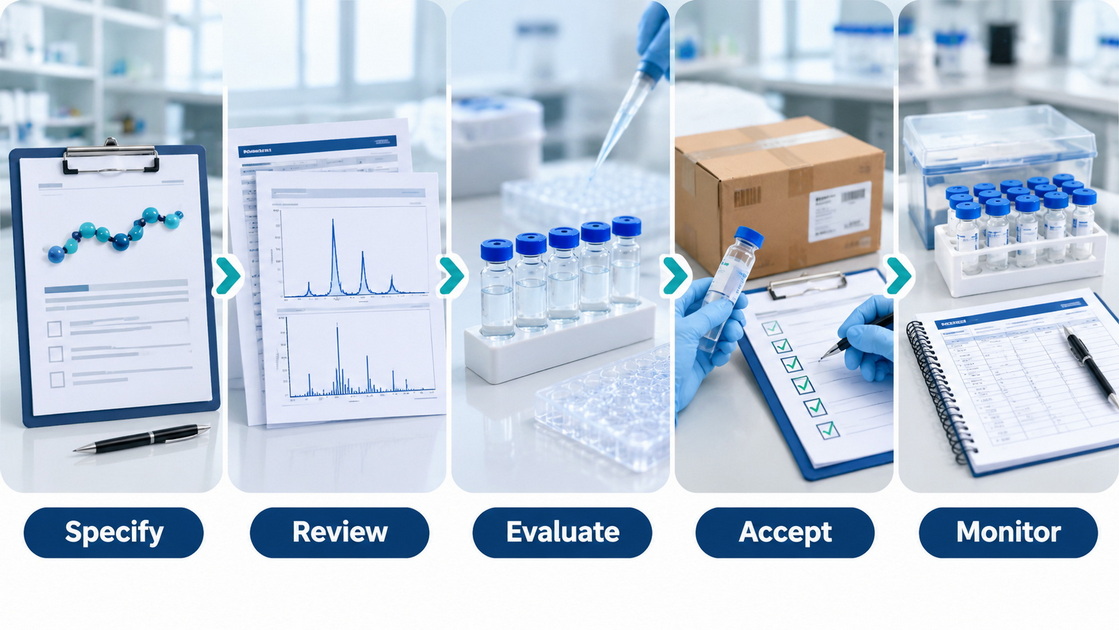
● A Five-Step Process for Qualifying a Peptide Supplier
>> 1. Write a Fit-for-Purpose Specification
>> 2. Review Documents Before Ordering
>> 3. Evaluate a Representative Sample
>> 4. Define Incoming Acceptance
● Compare Total Procurement Cost, Not Just Price per Vial
● Plan Lyophilization, Packaging, and Shipping Together
● What to Define in an OEM or ODM Peptide Project
● Discuss Your Peptide Requirements With Rchemsell
>> 1. What Is the Best Sports Technology Labs Alternative?
>> 2. Is 99% Purity Always Better Than 98%?
>> 3. Does Every Peptide Need Independent Testing?
>> 4. Can Research Peptides Be Used Directly in Cosmetics?
>> 5. What Information Is Needed for Custom Peptide Synthesis?
Evaluating Sports Technology Labs alternatives requires more than comparing catalog prices or advertised purity. For laboratory researchers and cosmetic development teams, the right peptide supplier must provide materials, documentation, and technical support that fit a clearly defined application.
A ready-to-ship research vial, a custom peptide sequence, and a cosmetic ingredient program have different requirements. Treating them as interchangeable can create problems with experimental reproducibility, formulation development, or purchasing specifications.
At Rchemsell, we specialize in peptide research and production for laboratory research and cosmetic industry projects. Our perspective is manufacturing-focused: define the material first, agree on acceptance criteria, and evaluate the delivered batch against those requirements.
This guide explains how to compare suppliers without relying on unsupported rankings or assuming that one company suits every project.

Start by identifying why you need another supplier.
You may need a different sequence, additional analytical documentation, larger quantities, a particular counterion, or support for custom synthesis. These requirements lead to different shortlists.
Do not assume that searching for an alternative means the original supplier has closed or failed. Verify current availability and supplier status directly before making purchasing decisions.
| Purchasing requirement | Suitable supplier capability | Evidence to request |
|---|---|---|
| Catalog research peptides | Consistent product specifications and lot traceability | Batch documentation and representative analytical data |
| Custom peptide synthesis | Sequence review and agreed acceptance criteria | Written specification and feasibility assessment |
| Cosmetic ingredient development | Application-specific technical documentation | Ingredient identity, composition, and relevant safety information |
| OEM or ODM supply | Controlled packaging and specification management | Responsibility agreement and approved label format |
| Repeat bulk procurement | Reproducible manufacturing and change communication | Supply plan and batch comparison approach |
Location alone does not establish quality. Evaluate domestic and international suppliers against the same technical requirements.
Catalog products can simplify procurement when the available sequence, quantity, and specifications match the research protocol.
Before ordering, confirm the exact sequence, terminal modifications, salt form, quantity basis, and available testing.
A familiar product name does not guarantee that materials from different suppliers are equivalent.
Custom synthesis is useful when your project requires a defined sequence, labeling, conjugation, terminal modification, or packaging arrangement unavailable from stock.
A capable discussion should cover sequence feasibility, purification targets, analytical methods, expected deliverables, and potential limitations.
Avoid treating every sequence as equally straightforward. Solubility, aggregation, chemical instability, and purification difficulty can affect feasibility and delivery.
For custom projects, a supplier's willingness to explain limitations is more useful than an unconditional promise.
HPLC purity usually describes the proportion of the target chromatographic peak relative to detected peaks under a specified method.
It does not automatically describe the percentage of the powder's total weight that consists of the target peptide.
Lyophilized material can also contain water, counterions, and residual components that are not represented in the same way by the purity measurement.
Net peptide content addresses a different question: how much of the material is peptidic rather than non-peptidic.
Both measurements may matter when comparing suppliers or preparing accurately defined research solutions.
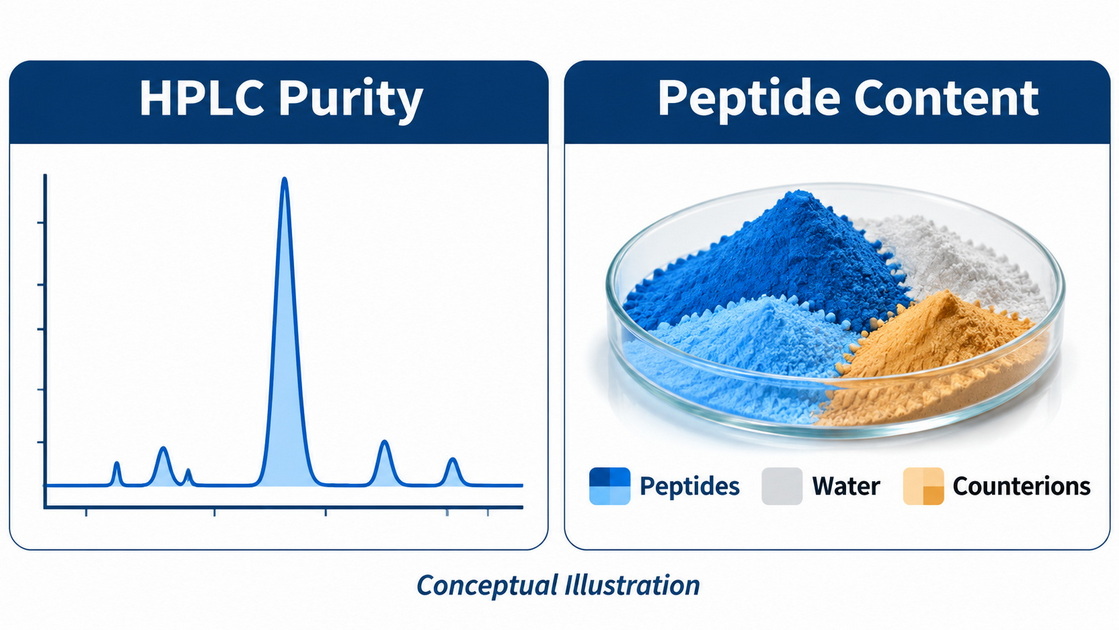
Consider two hypothetical 100 mg samples:
| Sample | HPLC purity | Net peptide content | Approximate target peptide mass |
|---|---|---|---|
| A | 99% | 75% | 74.25 mg |
| B | 98% | 90% | 88.20 mg |
Using the simplified relationship of gross weight × net peptide content × purity, Sample B contains more target peptide despite its slightly lower chromatographic purity.
This comparison is illustrative, not a claim about any supplier. Analytical definitions and methods must be compatible before applying the calculation.
The purchasing lesson is simple: a higher purity percentage does not necessarily mean more usable target material per container.
A Certificate of Analysis should connect the supplied material to an identifiable batch and meaningful test results.
Ask for documentation before committing to a substantial order. Custom-project reports may need to be supplied privately rather than published online.
Review the following:
- Product name and defined sequence.
- Relevant modifications and salt form.
- Unique batch or lot number.
- Test methods and reported results.
- Chromatographic data where supplied.
- Mass spectrometry data supporting molecular identity.
- Reporting dates and document authorization.
- Any agreed content, water, solvent, or counterion measurements.
HPLC and mass spectrometry answer different questions. Neither should be treated as a universal substitute for a complete specification.
Mass consistent with the expected molecule supports identity, but some structural distinctions require additional characterization.
External testing can strengthen verification, especially during supplier qualification or when investigating inconsistent results.
However, a report describes the sample tested. Its usefulness depends on sample identification, method suitability, laboratory competence, and the connection between that sample and the delivered lot.
In-house testing is not automatically invalid, and an external laboratory logo is not automatically sufficient.
Where accreditation is claimed, confirm that the relevant test falls within the laboratory's accredited scope.
A research-use label does not establish suitability for incorporation into a consumer cosmetic.
Likewise, a high purity result does not demonstrate skin safety, formulation stability, sterility, or regulatory acceptance.
Laboratories should define specifications around their experimental system.
Depending on the work, additional considerations may include solubility, peptide content, counterions, or contaminants that could interfere with the assay.
Some cell-based applications may require an endotoxin specification. A low-endotoxin result does not establish sterility, and neither establishes suitability for human administration.
Materials discussed here are not being recommended for self-administration or therapeutic use.
Cosmetic developers need to assess ingredient identity, composition, impurities, intended exposure, formulation compatibility, and relevant safety information.
In the United States, the responsible person must ensure and maintain records supporting adequate safety substantiation of the cosmetic product. Other markets have their own requirements.
Claims also matter. Statements about treating disease or affecting body structure or function can change a product's regulatory classification.
A supplier's ingredient data can support assessment, but it does not replace evaluation of the finished formulation.
State the intended application and define what will be accepted.
Include sequence, modifications, quantity, purity method, content requirements where necessary, packaging, documentation, and delivery expectations.
For cosmetic projects, specify whether you require powder, a defined solution, or a formulated ingredient blend.
Check that the quotation and technical specification describe the same material.
Resolve ambiguous terms such as "99% peptide," "cosmetic grade," or "tested" before purchase.
Ask which tests are standard and which require an additional quotation.
Use a qualification sample to assess the properties relevant to your project.
For research, this may include analytical confirmation and performance in the intended assay. For cosmetic development, it may include compatibility and stability work within the proposed formulation.
Agree on the evaluation plan before interpreting results.
On arrival, check container condition, labeling, lot numbers, supplied documents, and shipping observations.
Quarantine material with unresolved discrepancies rather than introducing it directly into routine work.
Retain appropriate records and reference samples according to your quality procedures.
Qualification is not a one-time event.
Review batch consistency, documentation completeness, complaint handling, and communication about changes. Where continuity is critical, discuss reserve stock or a qualified secondary source.
A low purchase price can become expensive when material is unsuitable or documentation is incomplete.
Compare quotations on an equivalent basis:
- Delivered quantity and its measurement basis.
- Required analytical testing.
- Purification and counterion requirements.
- Packaging and aliquoting.
- Freight, duties, and receiving costs.
- Qualification and repeat-testing expenses.
- Replacement terms and delivery risk.
For custom synthesis, clarify whether the quote is for crude material, purified material, or a guaranteed delivered amount meeting specification.
Do not assume a larger gross powder weight represents better value. Compare the material you actually need for the application.
Lyophilization is a useful supply format, but it does not make every peptide indefinitely stable.
Stability depends on sequence, salt form, residual moisture, packaging, and exposure conditions.
Request product-specific storage and shipping guidance. Avoid applying one temperature or solution-storage period to every peptide.
Good procurement planning should establish:
- Container and closure requirements.
- Protection from moisture and light where needed.
- Appropriate shipment conditions.
- Instructions for receiving and storage.
- A process for evaluating temperature excursions.
- Any supported shelf-life or retest period.
When handling cold containers, follow product guidance to minimize condensation before opening.
Solution stability requires separate consideration. Do not infer it solely from the stability of the lyophilized material.
OEM and ODM arrangements need clear technical boundaries, not just customized labels.
Before production, document who controls:
- Sequence and formulation approval.
- Raw-material and finished-material specifications.
- Analytical release decisions.
- Packaging compatibility.
- Label content and lot coding.
- Change notification.
- Intellectual property and confidentiality.
- Complaints and nonconforming batches.
Clarify whether the project covers synthesis only, packaged research material, or an ingredient intended for cosmetic development.
These arrangements do not automatically establish pharmaceutical manufacturing status, clinical suitability, or market authorization.
Rchemsell is a China-based peptide manufacturer serving laboratory research and cosmetic industry projects.
Our stated capabilities include peptide synthesis, quality testing, lyophilization, packaging, shipping coordination, and OEM, ODM, and custom synthesis services.
We report product purity levels of 98%–99%. Buyers should confirm the applicable method, product-specific specification, and actual batch results rather than treating this range as a universal release guarantee.
There is no universal best option. Choose according to your required material, documentation, customization, and supply needs. Qualify suppliers against the same written specification rather than relying on an undated ranking.
Not necessarily. Compare analytical methods, identity, peptide content, relevant impurities, and application requirements. A one-percentage-point purity difference may be less important than incomplete characterization or an unsuitable salt form.
Testing should follow a risk-based qualification plan. Independent analysis can strengthen confidence, but method suitability, sample traceability, and competent interpretation matter more than whether a report carries an external logo.
Do not assume so. Assess the ingredient and proposed finished product for identity, safety, formulation compatibility, labeling, and market-specific requirements. A research-use designation does not provide cosmetic suitability.
Provide the sequence, modifications, target quantity, purity and content requirements, salt form, intended application, testing needs, packaging, and timeline. Identify any special solubility or compatibility constraints early.
1. PSPeptides. "Best Peptide Companies in 2026: Ranked and Compared." Source page currently displayed at the supplied Sports Technology Labs alternatives URL. Reviewed for supplier-selection topics; its rankings, competitor allegations, and commercial endorsements have not been adopted here. [pspeptides]
2. Bachem. "Quality Control of Amino Acids & Peptides: A Guide." Technical reference for chromatographic purity, molecular-mass analysis, residual components, and the distinction between purity and net peptide content. [bachem]
3. Bachem. "Peptide Content & Concentration Calculator." Provides the gross weight × purity × assay relationship used in the illustrative procurement comparison. [bachem]
4. Bachem. "Handling and Storage Guidelines for Peptides." Supports discussion of moisture exposure, sequence-dependent handling, lyophilized storage, and the separate stability considerations for peptide solutions. [bachem]
5. U.S. Food and Drug Administration. "Modernization of Cosmetics Regulation Act of 2022." Official guidance describing the responsible person's obligation to ensure and maintain adequate cosmetic safety substantiation records. [fda]
6. U.S. Food and Drug Administration. "Is It a Cosmetic, a Drug, or Both? (Or Is It Soap?)" Explains how intended use and promotional claims affect product classification. [fda]
7. U.S. Food and Drug Administration. "Cosmetic Ingredient Suppliers: Fact Sheet." Addresses ingredient-supplier responsibilities, ingredient identification, and distinctions between cosmetic and drug uses. [fda]


