
Views: 266 Author: Rchemsell Publish Time: 2026-09-11 Origin: Site


Content Menu
● BPC-157 vs TB-500 at a Glance
● Understanding BPC-157 Research Models
>> Why BPC-157 Is Often Studied in Tendon Models
>> Potential BPC-157 Research Endpoints
>> BPC-157 for Gastrointestinal and Barrier Research
● Understanding TB-500 and Thymosin Beta-4 Research
>> Why TB-500 Is Often Discussed in Skin and Wound Models
>> Potential TB-500 Research Endpoints
● Which Peptide Fits Different Tissue Research Models?
● A More Rigorous Selection Framework
>> Step 1: Define the Tissue Problem
>> Step 2: Define the Primary Endpoint
>> Step 3: Confirm Peptide Identity Before Biology
>> Step 4: Use Appropriate Controls
>> Step 5: Separate Exploration From Claims
● Quality Considerations for Research Peptides
>> What to Request From a Peptide Manufacturer
● Evidence Limits and Responsible Research Communication
>> 1. Is BPC-157 the same as TB-500?
>> 2. Is TB-500 the same as thymosin beta-4?
>> 3. Which is better for tendon research: BPC-157 or TB-500?
>> 4. Which peptide is more relevant to skin-cell research?
>> 5. Can BPC-157 and TB-500 be studied in the same project?
When comparing BPC-157 vs TB-500, the most useful question is not which peptide is "better." The more rigorous question is: which research candidate better fits the biological process, tissue type, and experimental endpoint being studied?
BPC-157 and TB-500 are frequently discussed together in tissue-repair research. However, they are structurally different peptides with different literature profiles, proposed pathways, and strengths across preclinical models. BPC-157 is most frequently associated with tendon, ligament, muscle, gastrointestinal, and tendon-to-bone research. TB-500, commonly described as a thymosin beta-4 fragment, is more often linked to cell migration, angiogenesis, dermal repair, endothelial biology, and wound-healing models.
For laboratories, cosmetic research teams, and peptide-development organizations, a responsible comparison should focus on experimental design, material characterization, tissue relevance, and evidence limitations. Neither peptide should be presented as an approved treatment, a replacement for clinical care, or a guaranteed regenerative solution. Their value lies in carefully controlled research-use applications.
At Rchemsell, we support research and cosmetic-industry projects with high-purity synthetic peptides, typically specified at 98%–99% purity, along with peptide synthesis, analytical testing, lyophilized packaging, OEM, ODM, and custom peptide synthesis support. The goal is to help global customers obtain fit-for-purpose peptide materials with documentation and quality controls appropriate to their research workflow.
Research-use notice: BPC-157 and TB-500 are discussed here solely in the context of laboratory, preclinical, analytical, and cosmetic research. This article is not medical advice and does not provide dosing, treatment, or administration guidance.

BPC-157 and TB-500 may both appear in tissue-repair discussions, but their scientific starting points are different.
| Comparison Point | BPC-157 | TB-500 |
|---|---|---|
| Common research name | Body Protection Compound-157 | Thymosin beta-4 fragment, often called TB-500 |
| Peptide length | 15 amino acids | Commonly represented as the thymosin beta-4 actin-binding fragment, Ac-LKKTETQ |
| Research focus | Tendon, ligament, skeletal muscle, gastrointestinal tissue, tendon-to-bone interfaces | Dermal wound repair, endothelial biology, cell migration, angiogenesis, soft tissue research |
| Proposed biological themes | Fibroblast migration, angiogenesis-related signaling, nitric oxide pathways, cytoprotection | Actin regulation, cell migration, endothelial activity, angiogenesis, inflammatory signaling |
| Evidence profile | Predominantly rodent and in vitro work, especially musculoskeletal models | Broader thymosin beta-4 literature, but direct TB-500-specific evidence is more limited |
| Useful starting model | Tendon transection, ligament injury, fibroblast migration, tendon explants | Full-thickness dermal wound, keratinocyte migration, endothelial tube formation, vascular models |
| Key research limitation | Limited controlled human evidence | Human evidence is stronger for thymosin beta-4 than for TB-500 specifically |
| Procurement priority | Sequence identity, purity, peptide-related impurity profile, solubility planning | Clear distinction between TB-500 and full-length thymosin beta-4, identity confirmation, stability assessment |
The central lesson is simple: the peptide name alone should never determine model selection. Researchers should begin with the tissue, target cells, injury mechanism, primary endpoint, and required analytical controls.
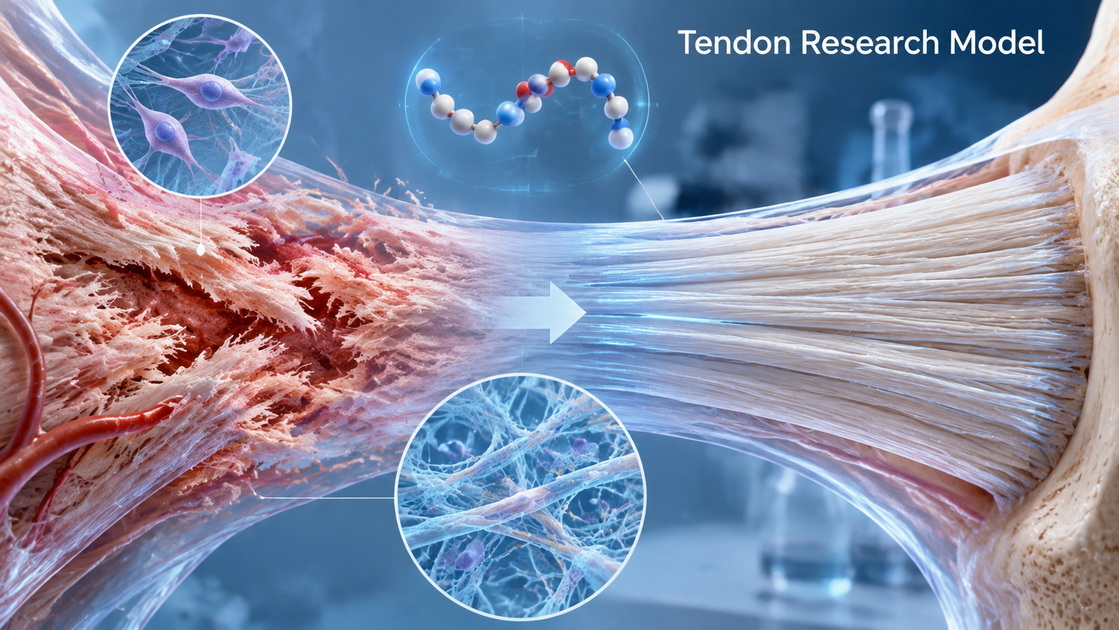
BPC-157 is a synthetic pentadecapeptide that has attracted attention in preclinical tissue-repair studies. Much of the published literature has focused on musculoskeletal injuries, particularly tissues that are relatively slow to repair because of limited blood supply, dense collagen organization, or low cellularity.
Tendon tissue is a logical setting for BPC-157 research because tendon repair requires several coordinated processes:
- Fibroblast survival and migration
- Collagen organization
- Matrix remodeling
- Revascularization
- Mechanical recovery
- Control of local inflammatory activity
Preclinical reports have examined BPC-157 in rodent Achilles tendon, quadriceps tendon, ligament, muscle, and tendon-to-bone injury models. Outcomes often include histology, collagen alignment, biomechanical strength, gait or functional indices, inflammatory cell infiltration, and gene-expression markers.
A practical interpretation is that BPC-157 is often a stronger conceptual fit when the research question centers on organized connective tissue. This includes tendon fibers, ligament architecture, tendon-derived fibroblasts, or tendon-bone integration.
For a well-designed BPC-157 study, researchers may consider endpoints such as:
1. Histological organization
Assess collagen fiber alignment, cellularity, vascular density, and inflammatory infiltration.
2. Biomechanical testing
Measure load to failure, stiffness, elastic modulus, or tensile strength in appropriate animal models.
3. Cell-migration assays
Use tendon fibroblasts, tenocytes, or relevant stromal cells to evaluate migration under controlled conditions.
4. Extracellular matrix markers
Examine collagen I, collagen III, matrix metalloproteinases, tissue inhibitors of metalloproteinases, and related remodeling markers.
5. Angiogenesis-related markers
Measure VEGF-associated pathways, endothelial responses, or vessel density where appropriate.
6. Inflammation and oxidative-stress markers
Evaluate cytokine signaling and oxidative-stress endpoints rather than relying only on gross tissue appearance.
BPC-157 research is not limited to musculoskeletal tissue. Its literature also includes gastrointestinal and mucosal-barrier models. This makes it relevant for research teams studying epithelial integrity, gastric tissue response, intestinal injury models, or inflammation-related barrier disruption.
However, research teams should avoid treating all "healing" models as interchangeable. A peptide that produces a signal in a rodent tendon model may not show the same response in epithelial cells, organoids, skin models, or human tissue explants.
Tissue context matters. Cell origin, injury mechanism, culture conditions, dosage range, route of exposure, and assay timing can all change the observed result.

TB-500 is commonly described as a synthetic fragment associated with thymosin beta-4 biology. Full-length thymosin beta-4 is a naturally occurring 43-amino-acid peptide with established roles in actin binding, cellular movement, angiogenesis, inflammation-related pathways, and tissue repair.
A major scientific distinction is essential here: TB-500 is not identical to full-length thymosin beta-4. Researchers should not automatically transfer findings from full-length thymosin beta-4 to TB-500 without acknowledging that the sequence, conformation, pharmacology, and biological behavior may differ.
The thymosin beta-4 research field has historically included dermal repair, endothelial migration, wound closure, corneal tissue, cardiac injury, and vascular biology. In a classic rat full-thickness wound model, thymosin beta-4 was associated with faster re-epithelialization, greater wound contraction, collagen deposition, and angiogenesis-related effects.
For this reason, TB-500-related research is often considered when the experimental question involves cell movement and soft-tissue repair dynamics, especially where epithelial, endothelial, or stromal-cell behavior is a major endpoint.
A TB-500 or thymosin beta-4-related project may be designed around:
- Keratinocyte migration
- Fibroblast migration
- Scratch-wound closure assays
- Endothelial cell migration
- Tube-formation assays
- Aortic-ring sprouting models
- Dermal collagen deposition
- Re-epithelialization metrics
- Vascular density
- Inflammation-associated cytokine patterns
For cosmetic research, the relevance may be strongest in non-clinical skin-biology studies. Examples include evaluating peptide behavior in reconstructed human epidermis, dermal fibroblast systems, skin-barrier research, cell-migration assays, or ingredient-screening programs.
That said, cosmetic formulators should distinguish between a laboratory observation and a permitted product claim. A positive cell-based result does not automatically support claims such as "heals wounds," "repairs tissue," or "regenerates skin" in consumer-facing marketing.

The best choice depends on the biological question. The table below provides a practical framework for early project planning.
| Research Model or Question | Better Initial Candidate | Why |
|---|---|---|
| Tendon transection or tendon explant research | BPC-157 | More of the BPC-157 literature is concentrated in tendon, ligament, fibroblast, and musculoskeletal repair models |
| Ligament or tendon-to-bone interface study | BPC-157 | The preclinical evidence base more directly addresses connective tissue organization and biomechanical recovery |
| Skeletal muscle injury model | BPC-157 | Frequently explored in broader musculoskeletal injury research |
| Full-thickness dermal wound model | Thymosin beta-4 / TB-500-related comparison | Thymosin beta-4 research has notable links to re-epithelialization, angiogenesis, and wound closure |
| Keratinocyte migration assay | Thymosin beta-4 / TB-500-related comparison | Cell migration and actin-related biology are central to thymosin beta-4 research |
| Endothelial migration or tube formation | Thymosin beta-4 / TB-500-related comparison | Angiogenesis and endothelial activity are prominent themes in the literature |
| Gastrointestinal mucosal or barrier model | BPC-157 | BPC-157 has a more recognizable literature footprint in gastrointestinal and mucosal research |
| Cosmetic skin-cell screening | Depends on endpoint | Use BPC-157 for broader cytoprotection questions; consider thymosin beta-4-related candidates for migration and vascular-related cellular studies |
| Direct comparison project | Both, with matched controls | Useful when the goal is to separate matrix-repair signals from migration or angiogenesis-related signals |
A common mistake is to choose BPC-157 or TB-500 based on online popularity. In a serious laboratory program, selection should be built around a defined hypothesis.
Start with the primary biological system.
- Is the model tendon, ligament, muscle, skin, cornea, gastrointestinal mucosa, or vascular tissue?
- Is the main challenge poor collagen organization, low cell survival, slow epithelial closure, inflammation, or limited angiogenesis?
- Is the model an in vitro assay, an ex vivo tissue explant, a reconstructed skin model, or an animal study?
Avoid vague objectives such as "test healing." Instead, choose measurable endpoints.
Examples include:
- Percent wound closure
- Cell-migration distance
- Collagen I to collagen III ratio
- Tensile strength
- Vessel density
- Cytokine expression
- Fibroblast viability
- Histological scoring
- Gene-expression changes
For peptide research, poor material definition can compromise otherwise well-designed studies. A peptide may be labeled correctly yet still differ in purity, counterion form, residual solvents, moisture content, aggregation tendency, or impurity profile.
Before beginning a study, confirm:
- Peptide sequence
- Molecular mass
- Purity method and reported purity
- Chromatographic profile
- Identity testing method
- Salt or counterion form
- Lyophilized appearance and storage requirements
- Reconstitution guidance
- Batch number and certificate documentation
This is especially important for BPC-157 and TB-500 because peptide-related impurities and aggregation can influence experimental reproducibility.
A reliable study design should include more than an untreated comparison.
Consider:
- Vehicle control
- Positive control where scientifically justified
- Peptide sequence control or scrambled peptide control
- Multiple concentrations
- Independent biological replicates
- Blinded histology scoring
- Batch-to-batch verification for repeat experiments
A research signal is not a therapeutic conclusion. Responsible reporting should state whether findings arise from:
- Cell culture
- Tissue explants
- Rodent models
- Other animal models
- Small human studies
- Controlled human trials
This distinction protects scientific credibility and prevents laboratory findings from being overstated.
For BPC-157 vs TB-500 research, peptide quality is not merely a procurement detail. It is part of experimental validity.
At Rchemsell, a research peptide workflow can be structured from custom synthesis through analytical characterization, freeze-drying, packaging, and shipment coordination. For projects requiring a different sequence, modification, label, purity target, or packaging configuration, custom peptide synthesis can help align the material with the intended assay or product-development workflow.
Researchers and procurement teams should request documentation that supports traceability and repeatability:
- HPLC purity analysis
- Mass spectrometry identity confirmation
- Certificate of analysis
- Batch number and lot traceability
- Storage and reconstitution recommendations
- Custom synthesis feasibility assessment
- Packaging options for laboratory or formulation use
- Confidentiality support for OEM and ODM projects
For skin-care research teams, packaging compatibility and stability planning can be as important as nominal purity. A peptide may perform well in a screening assay but become unstable in a finished formulation because of pH, temperature, oxidation, surfactants, preservatives, or container interactions.
The available evidence should be interpreted carefully. BPC-157 has a substantial preclinical footprint in animal and cell-based musculoskeletal studies, but high-quality human evidence remains limited. TB-500-related discussions also require caution because much of the broader evidence relates to full-length thymosin beta-4 rather than TB-500 itself.
Regulatory and sports-governance considerations are also relevant. The U.S. Food and Drug Administration has identified potential safety concerns and insufficient human safety information for compounded products containing BPC-157 and TB-500-related thymosin beta-4 fragments. The World Anti-Doping Agency also lists BPC-157 and thymosin beta-4 derivatives, including TB-500, among prohibited substances for athletes subject to its rules. These considerations reinforce the need to position both materials as research-focused compounds, not consumer wellness products or performance-enhancement ingredients.
For tissue-repair, skin-biology, or custom peptide projects, the right partner should provide more than a catalog item. The partner should understand sequence-specific synthesis, analytical expectations, packaging requirements, and documentation needs.
Rchemsell supports customers seeking:
- High-purity BPC-157 and TB-500 research peptides
- Custom peptide synthesis for new sequences and analogs
- Analytical testing and quality documentation
- Lyophilized peptide packaging
- OEM and ODM collaboration
- Research and cosmetic-industry peptide development support
- Global packaging and shipment coordination
No. BPC-157 is a 15-amino-acid peptide associated with gastric peptide research, while TB-500 is commonly described as an actin-binding fragment related to thymosin beta-4. They differ in sequence, origin, and proposed biological mechanisms.
No. TB-500 is commonly associated with a short fragment of thymosin beta-4, while full-length thymosin beta-4 contains 43 amino acids. Findings from full-length thymosin beta-4 studies should not automatically be treated as direct evidence for TB-500.
BPC-157 is often the more directly relevant starting point for tendon, ligament, and tendon-to-bone research because its published preclinical literature more frequently examines musculoskeletal connective-tissue models. The final choice should still depend on the assay design and endpoint.
Thymosin beta-4-related research is often relevant to dermal repair, keratinocyte migration, endothelial biology, and angiogenesis. For cosmetic research, researchers should use appropriate in vitro or ex vivo models and avoid translating early findings into unsubstantiated consumer claims.
Yes. A paired study can be useful when the purpose is to compare effects on cell migration, fibroblast behavior, extracellular matrix formation, angiogenesis-related markers, or tissue-specific repair endpoints. The study should use matched controls, comparable peptide characterization, and predefined outcome measures.
1. Vasireddi, N., Hahamyan, H., Salata, M. J., et al. "[Emerging Use of BPC-157 in Orthopaedic Sports Medicine: A Systematic Review]." "HSS Journal", 2025. This review summarizes BPC-157 evidence across musculoskeletal research models and emphasizes that most included studies were preclinical. [pmc.ncbi.nlm.nih]
2. Sikiric, P., et al. "[Gastric Pentadecapeptide Body Protection Compound BPC 157 and Soft Tissue Healing]." "Journal of Orthopaedic Research", 2019. A review examining BPC-157 findings in tendon, ligament, and skeletal-muscle research. [pubmed.ncbi.nlm.nih]
3. Malinda, K. M., et al. "[Thymosin Beta4 Accelerates Wound Healing]." "Journal of Investigative Dermatology", 1999. Reports rat wound-model findings related to re-epithelialization, wound contraction, collagen deposition, angiogenesis, and keratinocyte migration. [pubmed.ncbi.nlm.nih]
4. Smart, N., et al. "[Thymosin Beta4 and Angiogenesis: Modes of Action and Therapeutic Potential]." "Angiogenesis", 2007. Reviews thymosin beta-4 biology in angiogenesis, wound repair, and cardiovascular research. [pubmed.ncbi.nlm.nih]
5. Goldstein, A. L., et al. "[The Actin Binding Site on Thymosin Beta4 Promotes Angiogenesis]." "FASEB Journal", 2003. Describes the relevance of the actin-binding motif to angiogenesis-related activity. [pubmed.ncbi.nlm.nih]
6. U.S. Food and Drug Administration. "[Certain Bulk Drug Substances for Use in Compounding that May Present Significant Safety Risks]." Includes BPC-157 and thymosin beta-4 fragment/TB-500 entries and notes limitations in safety information. [fda]
7. World Anti-Doping Agency. "[The Prohibited List]." Lists BPC-157 and thymosin beta-4 derivatives, including TB-500, under prohibited substance categories applicable to athletes governed by anti-doping rules. [wada-ama]


