
Views: 235 Author: Rchemsell Publish Time: 2026-08-31 Origin: Site


Content Menu
● Why B2B Buyers Need a Qualified Peptide Manufacturer
● What to Look for in a Peptide Manufacturer in China
>> 1. Peptide Synthesis Capability
>> 2. Analytical Testing and Batch Documentation
>> 3. Manufacturing Traceability
>> 4. Lyophilization and Packaging Capability
>> 5. Communication and Project Management
● How Custom Peptide Synthesis Works
>> Step 1: Define the Peptide Specification
>> Step 2: Conduct a Feasibility Review
>> Step 3: Synthesize and Purify the Peptide
>> Step 4: Confirm Identity and Purity
● Quality Control: Beyond a 98% or 99% Purity Claim
>> A Practical Peptide Quality Checklist
● Peptides for Cosmetic Research and Formulation Development
>> What Cosmetic Buyers Should Request
>> A Cosmetic Peptide Development Workflow
● OEM, ODM, and Custom Peptide Services
● Red Flags When Sourcing Peptides
● Why Choose Rchemsell as Your Peptide Manufacturing Partner?
>> 1. What purity level can Rchemsell provide for custom peptides?
>> 2. How do you verify peptide purity and identity?
>> 3. Can Rchemsell provide custom peptide synthesis from a sequence?
>> 4. Do you offer OEM and ODM peptide services?
>> 5. Are your peptides suitable for cosmetic applications?
Choosing a peptide manufacturer in China is no longer simply a price comparison. For laboratories, cosmetic brands, formulation developers, distributors, and OEM buyers, the right supplier must demonstrate reliable custom peptide synthesis, traceable quality control, appropriate packaging, and responsive technical communication.
For Rchemsell, peptide manufacturing means more than supplying a lyophilized powder. We provide an integrated service model covering peptide synthesis, quality testing, lyophilization, packaging, and shipping for laboratory research and cosmetic-industry applications. With typical product purity targets of 98%–99%, plus OEM, ODM, and customized peptide synthesis capabilities, we help global buyers move from a peptide specification to a supply-ready product.
This guide explains how professional buyers should evaluate peptide suppliers, what quality documents to request, how to create a practical sourcing specification, and why a qualified manufacturing partner can reduce risk throughout research and cosmetic-product development.

Peptides are short chains of amino acids. Their sequence, purity profile, molecular identity, salt form, residual solvents, moisture level, stability, and packaging condition can all influence how well they perform in a research workflow or cosmetic formulation-development process.
That is why B2B procurement teams should not judge peptide suppliers only by a stated purity percentage or a quotation price.
A supplier claiming "99% purity" without batch-level analytical documentation does not give a buyer enough information to make a confident purchasing decision. A reliable peptide manufacturer should be able to explain:
- What peptide sequence is being produced
- Which synthesis approach is used
- How identity is confirmed
- How purity is measured
- Which impurities or related substances are monitored
- How the material is lyophilized and packaged
- How the batch is identified and traced
- What storage and transport conditions are recommended
International quality guidance emphasizes the importance of justified specifications, appropriate test procedures, and defined acceptance criteria for chemical drug substances and products. While a research or cosmetic raw-material project may not have the same regulatory status as a finished pharmaceutical product, the underlying quality principle remains highly relevant: buyers should establish clear specifications before production begins.
For Rchemsell customers, the goal is straightforward: make the specification visible, make the quality evidence reviewable, and make the supply process easier to manage.
A professional peptide manufacturer should be assessed through a structured supplier-qualification process. The following criteria are especially important for laboratories, cosmetic ingredient buyers, OEM brands, and distributors.
The supplier should have the technical ability to synthesize the requested sequence and communicate feasibility before accepting the order.
Custom peptides can vary substantially in complexity. Factors that may affect synthesis difficulty include:
- Amino-acid sequence length
- Hydrophobic amino-acid content
- Repetitive sequences
- Aggregation tendency during synthesis
- Disulfide-bond requirements
- Cyclization requirements
- N-terminal or C-terminal modification
- Fluorescent labeling
- PEGylation or lipid modification
- High-purity requirements
- Quantity requirements from milligrams to kilograms
A responsible manufacturer does not promise that every sequence will be equally fast, simple, or low-cost. Instead, the technical team should assess the sequence and identify possible production risks before giving a final timeline.

Testing is one of the clearest indicators of whether a peptide supplier has a mature quality system.
For most research and cosmetic-development peptide projects, buyers should request a Certificate of Analysis, commonly called a COA. Depending on the product and agreed specification, the documentation may include:
| Quality Item | Why It Matters | Common Analytical Approach |
|---|---|---|
| Identity | Confirms that the expected peptide molecular structure is present | Mass Spectrometry |
| Purity | Measures the percentage of the target peptide relative to detectable impurities | HPLC or UHPLC |
| Molecular Weight | Supports confirmation of the expected peptide mass | Mass Spectrometry |
| Appearance | Confirms the physical appearance of the lyophilized material | Visual inspection |
| Water Content | Can affect stability, handling, and net content calculations | Karl Fischer or other validated methods |
| Residual Solvents | Helps evaluate solvents remaining after synthesis and purification | GC or appropriate analytical method |
| Net Content | Confirms delivered quantity | Calibrated weighing |
| Storage Recommendation | Supports correct handling after receipt | Supplier-issued storage guidance |
HPLC purity and mass-spectrometry identity confirmation serve different purposes. HPLC helps characterize purity, while mass spectrometry helps confirm molecular mass and identity. A serious buyer should normally review both rather than treating one result as a substitute for the other.
For Rchemsell peptide products, a typical quality objective is 98%–99% purity, subject to the specific peptide sequence, project specification, analytical method, and agreed acceptance standard. Buyers should confirm the purity basis, analytical method, and batch documentation before placing a production order.
Traceability means the supplier can connect a finished vial or package back to its production batch, test record, and shipment information.
At minimum, the packaging and documents should be aligned on key identifiers such as:
- Product name or internal code
- Peptide sequence or approved specification reference
- Batch or lot number
- Net quantity
- Manufacturing date
- Retest date or recommended storage period, if applicable
- Storage condition
- COA reference number
For recurring orders, buyers should request a stable product code and a documented change-control process. If the supplier changes the synthesis route, raw-material source, salt form, purification method, packaging format, or testing method, the buyer should be informed before the change affects future supply.
Lyophilization removes water from a prepared peptide solution under controlled conditions, helping create a dry peptide format suitable for storage and transportation. However, lyophilization alone does not guarantee stability or quality. The final result depends on the peptide itself, formulation approach, residual moisture, vial integrity, closure system, storage environment, and shipping conditions.
For B2B buyers, packaging questions should include:
- Is the peptide supplied as a lyophilized powder?
- What vial material and closure system are used?
- Is nitrogen flushing available if required?
- What pack sizes are available?
- Can the supplier provide private-label or OEM packaging?
- Can outer labels include customer product codes, lot numbers, or required handling statements?
- How is the product protected from humidity, heat, and light during transportation?
Rchemsell supports one-stop peptide supply from synthesis and testing through lyophilized packaging and international shipping coordination. This reduces handoffs between multiple vendors and helps customers maintain clearer documentation from production through delivery.
A supplier's technical communication often predicts the quality of the working relationship.
Before approving a peptide manufacturer, assess whether the team can answer practical questions clearly:
- Can they review the sequence and quote based on purity, quantity, and modification requirements?
- Can they explain the expected lead time and possible technical risks?
- Can they provide a sample or pilot batch before scale-up?
- Can they supply COAs and supporting test records in English?
- Can they respond quickly if a shipping, customs, or quality-document issue arises?
- Can they support repeat orders with consistent documentation?
For global OEM and ODM customers, communication quality is not a soft factor. It is part of supply-chain control.
Custom peptide synthesis is a collaborative technical process. The buyer supplies the target requirements, while the manufacturer evaluates feasibility, produces the peptide, tests it, and delivers it in the agreed format.
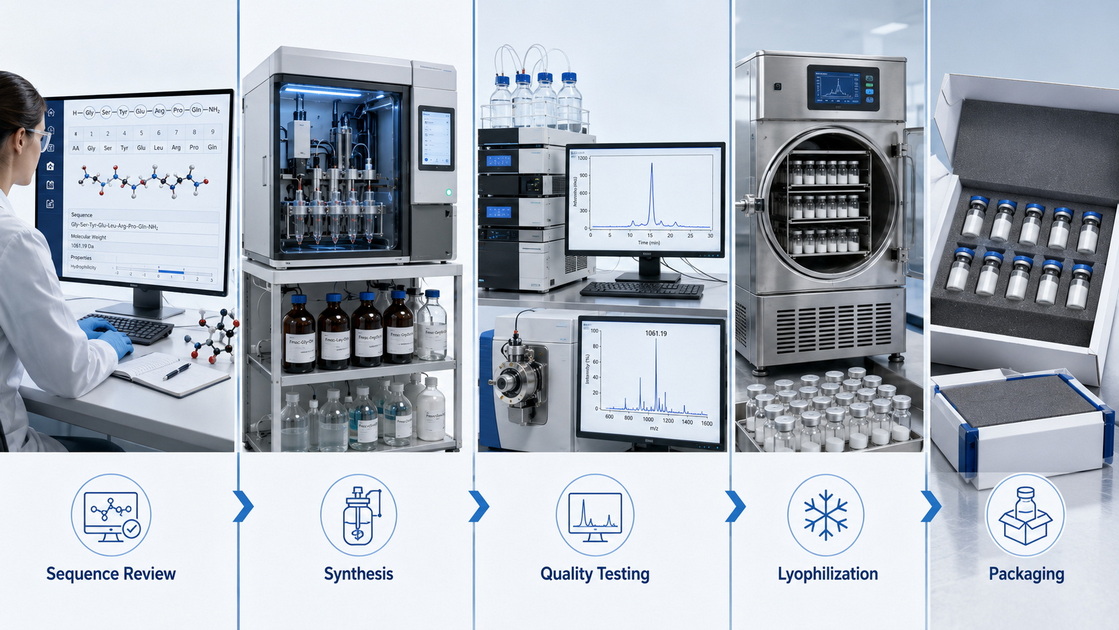
The first step is to provide an unambiguous technical brief.
A useful peptide RFQ should include:
- Peptide sequence in one-letter or three-letter amino-acid notation
- Required purity target, such as 95%, 98%, or 99%
- Required quantity per batch
- Number of batches or expected annual volume
- Required modifications
- Required salt form, if applicable
- Intended application category: laboratory research or cosmetic development
- Required test documents
- Preferred packaging size
- Storage and shipping requirements
- Destination country or region
The manufacturer reviews the sequence and identifies potential challenges. Longer sequences, hydrophobic segments, unusual amino acids, cyclic structures, and demanding purity targets may require additional process development.
At this stage, a transparent supplier should confirm:
- Estimated synthesis feasibility
- Expected purity range
- Recommended scale
- Required development work
- Preliminary lead time
- Proposed analytical package
- Packaging options
- Quotation validity and commercial terms
The manufacturing process commonly includes stepwise peptide synthesis, cleavage from the synthesis support, crude-peptide collection, purification, and drying or lyophilization.
The exact process should be chosen according to the sequence and product requirement. Complex peptides may require additional optimization to obtain a satisfactory purity profile and yield.
After production, the batch is tested against the agreed specification. For a typical custom peptide project, this may include HPLC purity testing and mass-spectrometry confirmation.
Buyers should review the final COA before shipment approval, particularly for first orders, high-value projects, custom modifications, and projects entering a cosmetic formulation-development stage.
After quality release, the peptide is packed in the agreed format and prepared for shipment with relevant documents. Buyers should ensure that the commercial invoice, packing list, product description, and storage instructions match their import and internal receiving requirements.
Purity is important, but it is not the entire quality story.
A peptide with a high HPLC purity result may still require additional scrutiny depending on its intended use. For example, a cosmetic brand developing a premium topical formula may also need to consider molecular identity, solubility, stability in the final formulation, odor, color, compatibility with preservatives, and batch-to-batch consistency.
Similarly, a laboratory team may need a specific counterion, concentration, sequence verification, or packaging configuration for an assay workflow.
Before releasing a purchase order, ask the supplier to confirm:
1. Target sequence: Is the requested sequence written correctly and approved by both parties?
2. Purity basis: Is the stated purity based on a defined HPLC method?
3. Identity testing: Is the expected molecular mass confirmed by mass spectrometry?
4. Batch traceability: Does the COA show a lot number matching the product label?
5. Quantity: Is the quoted amount net peptide content or gross vial weight?
6. Physical format: Is the material lyophilized powder, film, solution, or another format?
7. Storage conditions: What temperature, light, and humidity controls are recommended?
8. Packaging: Is the vial, closure, label, and outer packaging suitable for the transport route?
9. Change control: How will manufacturing or testing changes be communicated on future orders?
10. Application compliance: Does the buyer's intended use align with applicable local laws and product-category rules?
This approach is consistent with the broad principle in ICH quality guidance that specifications should be scientifically justified and supported by appropriate test procedures and acceptance criteria.

Cosmetic peptides are used by formulators and ingredient developers in product-research programs, including skincare concepts focused on appearance, skin-feel, conditioning, and product differentiation. However, the final cosmetic product—not only the peptide raw material—must be assessed for its intended use, formulation compatibility, labeling, safety, and compliance in the target market.
In the United States, the Modernization of Cosmetics Regulation Act, commonly known as MoCRA, established new responsibilities around cosmetic-product safety substantiation. The responsible person must maintain records supporting the safety of the cosmetic product, using tests, studies, research, or analysis appropriate to the product and its intended use.
For cosmetic brands sourcing peptide raw materials, this means that supplier documentation is valuable but does not replace the brand's own finished-formula safety and compliance work.
A cosmetic ingredient buyer should consider requesting:
- Product specification sheet
- Batch-specific COA
- HPLC and mass-spectrometry summary
- Recommended storage guidance
- Solubility or handling information, where available
- INCI-related support where appropriate and applicable
- Safety or technical documentation available for the raw material
- Batch-to-batch consistency commitment
- Sample quantity for formulation compatibility testing
- OEM or private-label packaging options
Imagine a skincare brand developing a premium serum concept using a custom peptide ingredient.
The brand can follow this workflow:
1. Define the desired peptide, target concentration range, and formulation concept.
2. Request a small R&D sample from Rchemsell.
3. Review the sample COA and identity/purity documentation.
4. Test solubility, pH stability, color, odor, and compatibility in the preliminary serum formula.
5. Conduct appropriate finished-product stability, safety, and compatibility assessments.
6. Approve the final ingredient specification, packaging, and recurring supply plan.
7. Scale from pilot quantity to commercial batches under an agreed OEM, ODM, or custom manufacturing arrangement.
This process helps brands avoid a common sourcing mistake: treating a peptide raw-material COA as proof that the finished cosmetic product is automatically compliant or stable. It is not. Finished-formula validation remains essential.
Different customers need different levels of support. Rchemsell can support flexible B2B projects through OEM, ODM, and custom peptide synthesis services.
| Service Model | Best For | Typical Customer Requirement |
|---|---|---|
| Custom Peptide Synthesis | Laboratories and R&D teams | A specific sequence, modification, purity target, and quantity |
| OEM Peptide Manufacturing | Established brands and distributors | Production according to buyer-approved specification and packaging |
| ODM Peptide Development | Brands creating a new product concept | Support from concept selection through technical specification and packaging |
| Lyophilized Peptide Packaging | Buyers needing finished raw-material presentation | Vial filling, lot coding, labeling, outer packaging, and shipping preparation |
| Batch Testing Support | Quality-focused procurement teams | HPLC, mass spectrometry, COA issuance, and batch documentation |
| Repeat-Order Supply | Long-term B2B customers | Consistent specifications, traceable lots, and predictable production planning |
For OEM and ODM projects, successful cooperation depends on a clearly signed specification. The document should define the peptide identity, purity standard, quantity, test methods, acceptance criteria, label information, packaging format, storage conditions, release requirements, and confidentiality expectations.
A low quotation may appear attractive, but poor supplier qualification can create delays, failed formulation work, disputed shipments, or damage to your brand's credibility.
Be careful if a supplier shows any of the following warning signs:
- No batch-specific COA
- No HPLC purity evidence
- No mass-spectrometry identity confirmation
- Unclear product sequence or product code
- A purity claim without a stated test method
- Inconsistent lot numbers across documents and packaging
- No clear production lead time
- No explanation of packaging or storage conditions
- Unrealistically low prices for complex or high-purity custom peptides
- Unsupported therapeutic, disease-treatment, or drug-equivalence claims
- No written quality agreement for recurring OEM or ODM supply
- Unclear responsibility for shipping documents and destination-market compliance
For research-related peptide sourcing, buyers should also avoid suppliers that make inappropriate human-use, dosage, treatment, or prescription-style claims. Regulatory status can vary by molecule, intended use, country, and supply model. FDA policy for compounded products, for example, contains specific restrictions related to drugs that are essentially copies of commercially available products and the use of bulk drug substances in outsourcing facilities.
Rchemsell serves global laboratory and cosmetic-industry customers seeking a dependable Chinese peptide manufacturing partner. Our approach is built around quality visibility, customization, and practical service support.
- Peptide R&D and manufacturing for research and cosmetic-industry applications
- 98%–99% purity targets based on product-specific specifications and quality requirements
- Custom peptide synthesis for defined sequences, modifications, quantities, and packaging needs
- HPLC and mass-spectrometry testing to support purity and molecular-identity evaluation
- Lyophilized peptide packaging for controlled handling and transportation
- OEM and ODM services for brands, distributors, and product-development customers
- One-stop supply support, from technical review through quality documentation and shipment preparation
- English-language B2B communication for international sourcing projects
A successful peptide project starts with a clear specification and an honest technical conversation. Whether you need an R&D sample, a recurring laboratory supply, a cosmetic peptide raw material, or a private-label OEM solution, Rchemsell can help develop a supply plan around your application and commercial requirements.
Rchemsell typically supports peptide products with purity targets of 98%–99%, depending on the peptide sequence, length, modification, scale, analytical method, and agreed specification. For every project, the final purity requirement should be confirmed before production begins.
Peptide purity is commonly evaluated by HPLC or UHPLC, while molecular identity is commonly supported by mass-spectrometry testing. Buyers should request batch-specific documentation showing the test result, lot number, and product identification.
Yes. Rchemsell supports custom peptide synthesis. Buyers can send the peptide sequence, required purity, quantity, modifications, intended application category, packaging requirement, and destination market for a technical feasibility review and quotation.
Yes. Rchemsell provides OEM, ODM, and customized peptide manufacturing services. Support can include peptide production, quality testing, lyophilized packaging, labeling, documentation, and shipping preparation, subject to the agreed project specification.
Rchemsell supplies peptides for cosmetic-industry research, formulation development, and raw-material sourcing projects. The customer remains responsible for evaluating the finished cosmetic formula, its safety, labeling, claims, regulatory requirements, and market compliance in the destination country. Cosmetic safety substantiation requirements apply to the finished product and its intended use.
1. PSPeptides Research Team. "[The Competitive Landscape: Best Peptide Companies 2026]." Accessed August 31, 2026. Reference article reviewed for supplier-evaluation themes, including the importance of transparent documentation, batch-specific COAs, HPLC purity data, mass-spectrometry identity confirmation, operational reliability, and responsible market communication. [pspeptides]
2. U.S. Food and Drug Administration. "[Q6A Specifications: Test Procedures and Acceptance Criteria for New Drug Substances and New Drug Products: Chemical Substances]." Updated April 14, 2020. Reference for principles related to specification setting, test-procedure selection, and justified acceptance criteria. [fda]
3. European Medicines Agency. "[ICH Q6A Specifications: Test Procedures and Acceptance Criteria for New Drug Substances and New Drug Products: Chemical Substances]." November 1, 1999. Reference for international principles of specifications and quality testing for synthetic chemical substances. [ema.europa]
4. International Council for Harmonisation. "[Quality Guidelines]." Accessed August 31, 2026. Reference for the general role of scientifically justified specifications, test methods, and acceptance criteria in quality systems. [ich]
5. NSF. "[MoCRA Cosmetic Testing and Certification]." July 30, 2024. Reference for U.S. cosmetic safety-substantiation responsibilities under the Modernization of Cosmetics Regulation Act. [nsf]
6. Registrar Corp. "[MoCRA Safety Substantiation: A Comprehensive Guide]." December 19, 2024. Reference for the role of valid scientific data and reproducible methods in cosmetic safety substantiation. [registrarcorp]
7. U.S. Food and Drug Administration. "[FDA Clarifies Policies for Compounders as National GLP-1 Supply Begins to Stabilize]." August 4, 2026. Reference for current FDA discussion of restrictions associated with compounding copies of commercially available drugs and bulk drug substances under sections 503A and 503B. [fda]


