
Views: 244 Author: Rchemsell Publish Time: 2026-10-27 Origin: Site


Content Menu
● What Is Retatrutide, and Why Does Its Mechanism Matter?
● Retatrutide Dosage in the Published Phase 2 Obesity Trial
>> What the 48-Week Results Actually Showed
>> Why There Is No Universal Retatrutide Starting Dose
● Phase 3 Retatrutide Results: What TRIUMPH-1 Adds
>> Why 28.3% and 25.0% Can Both Be Correct
● Retatrutide Safety: Read Beyond the Weight-Loss Headline
>> Why Tolerability Belongs Beside Efficacy
● Why Retatrutide, Semaglutide, and Tirzepatide Are Not Milligram-Equivalent
● Peptide Purity vs. Peptide Content: A Critical Procurement Distinction
>> Questions to Ask Before Approving a Batch
● A Five-Step Workflow for Research Peptide Supplier Evaluation
>> 1. Define the Intended Application
>> 2. Agree on Acceptance Criteria
>> 3. Review Batch-Specific Evidence
>> 4. Confirm Handling and Transport Requirements
>> 5. Establish Traceability at Receipt
● How Rchemsell Supports Custom Peptide Projects
● Responsible Interpretation of Research-Use Claims
>> 1. What retatrutide dosage was studied for obesity?
>> 2. Is retatrutide approved for weight loss?
>> 3. What does the 24.2% Phase 2 result mean?
>> 4. Can retatrutide doses be converted from tirzepatide doses?
>> 5. Does 99% purity mean a peptide is injectable?
A retatrutide dosage guide should explain what clinical researchers studied—not turn an investigational medicine into a self-treatment plan. For laboratories and peptide development teams, the useful questions extend beyond milligrams: Which population was studied? How were outcomes calculated? What documentation establishes a material's identity and suitability?
Retatrutide remains investigational. It is not an FDA-approved medicine, and published trial results do not establish the safety or effectiveness of products sold outside authorized clinical development. This article reviews the evidence and explains how professional buyers can separate clinical findings from manufacturing claims.

Retatrutide, also known as LY3437943, activates three receptors:
- Glucose-dependent insulinotropic polypeptide, or GIP.
- Glucagon-like peptide-1, or GLP-1.
- Glucagon.
This distinguishes it from semaglutide, which targets GLP-1 receptors, and tirzepatide, which targets GIP and GLP-1 receptors.
The three-receptor approach is being investigated for its potential effects on body weight and metabolic health. However, a broader receptor profile does not automatically establish superior safety or effectiveness. Those questions require appropriately designed clinical studies.
For researchers, the distinction matters because results depend on the molecule, exposure, population, and experimental conditions—not simply the number of receptors involved.
The foundational Phase 2 obesity trial enrolled 338 adults. Eligible participants had obesity, or overweight with at least one weight-related condition. Researchers evaluated once-weekly subcutaneous retatrutide over 48 weeks.
The study included maintenance-dose groups of 1, 4, 8, and 12 mg. Some groups shared the same maintenance dose but used different starting doses, allowing researchers to investigate tolerability as well as efficacy.
The published results reported the following least-squares mean changes in body weight:
| Study group | Mean body-weight change at 48 weeks |
|---|---|
| Retatrutide 1 mg | −8.7% |
| Retatrutide 4 mg, combined groups | −17.1% |
| Retatrutide 8 mg, combined groups | −22.8% |
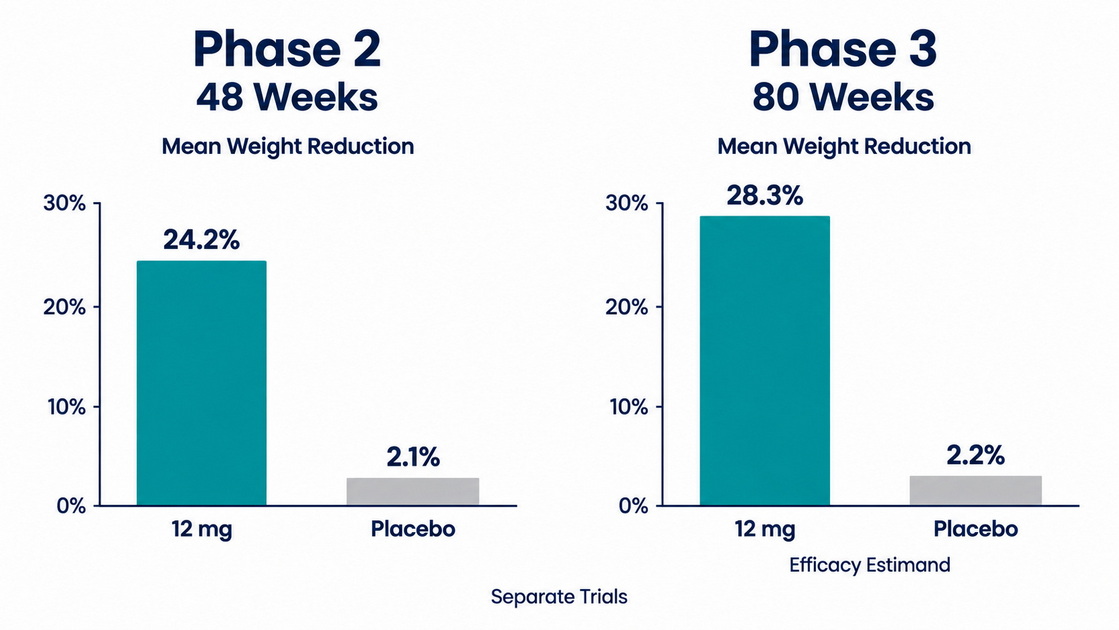
| Retatrutide 12 mg | −24.2% |
| Placebo | −2.1% |
The word "combined" matters. The 4 mg and 8 mg figures summarize groups with different starting doses. They should not be presented as results from one specific escalation pathway.
These are group-level statistical estimates, not predictions for an individual. The trial also identified dose-related gastrointestinal adverse events and increases in heart rate.
The Phase 2 trial did not use one starting dose for every participant. It included a fixed 1 mg group and other groups beginning at 2 or 4 mg.
Lower starting doses partially reduced gastrointestinal adverse events. That supports investigating gradual escalation under supervision. It does not establish a consumer dosing schedule.
A responsible retatrutide dosage discussion must distinguish a starting dose, an intermediate escalation dose, and a maintenance target. Treating those categories as interchangeable can misrepresent the research.
Lilly's May 21, 2026, TRIUMPH-1 announcement described an 80-week Phase 3 study involving 2,339 participants randomized to retatrutide 4, 9, or 12 mg, or placebo.
Participants had obesity or overweight with a weight-related condition and did not have diabetes. The announcement reported these body-weight changes under the efficacy estimand:
| Assigned maintenance dose | Mean body-weight change at 80 weeks |
|---|---|
| Retatrutide 4 mg | −19.0% |
| Retatrutide 9 mg | −25.9% |
| Retatrutide 12 mg | −28.3% |
| Placebo | −2.2% |
The release described stepwise escalation at four-week intervals, beginning at 2 mg. Importantly, its higher-dose pathways used intermediate doses including 6 and 9 mg. They should not be rewritten as a universal "increase by 2 mg until 12 mg" rule.
These details describe a monitored research protocol, not instructions for using commercially marketed peptide powders.
One of the most useful questions to ask about a headline result is: "What exactly was estimated?"
TRIUMPH-1 reported 28.3% mean weight reduction for the 12 mg group under its efficacy estimand. That analysis estimated the effect had participants remained on intervention without initiating prohibited weight-management treatments.
The treatment-regimen estimand considered outcomes regardless of adherence or initiation of those treatments. Under that approach, the corresponding figure was 25.0%.
Neither number should appear without context. They answer different statistical questions, and the distinction helps readers interpret both clinical publications and commercial summaries.
The Phase 2 trial identified gastrointestinal events as the most common adverse events. These were generally mild to moderate, dose-related, and partially mitigated by a lower starting dose.
TRIUMPH-1 also reported nausea, diarrhea, constipation, and vomiting. In its 12 mg group, nausea occurred in 42.4% of participants, while discontinuation because of adverse events occurred in 11.3%.
The announcement additionally reported dysesthesia, an abnormal sensation that may include unpleasant skin sensations.
A useful evidence summary should place these questions together:
1. How much did the measured outcome change?
2. How many participants discontinued treatment?
3. Which adverse events occurred?
4. How long were participants followed?
5. Which population was included?
A higher maintenance dose is not automatically the appropriate choice for every person or research objective. Trial participants received structured oversight that cannot be reproduced by copying a chart from a website.
Comparing peptide doses by milligrams alone creates a misleading impression of relative strength.
These molecules differ in structure, receptor activity, and pharmacological behavior. A numerical dose comparison is not a validated conversion method.
The same caution applies to weight-loss percentages from separate trials. Differences in participants, study duration, analysis methods, and treatment discontinuation can affect the reported outcomes.
The available results establish what happened within each study. Without a relevant direct comparison, they do not independently prove that one treatment is best for a particular individual.
From a manufacturing perspective, a purity percentage is the beginning of a quality discussion—not its conclusion.
Rchemsell describes its peptide portfolio as achieving 98%–99% purity. Buyers should confirm the applicable specification and analytical method for each product and batch rather than assume that one portfolio-level statement covers every shipment.
For procurement, the practical distinction is straightforward:
- Identity asks whether the material matches the intended peptide.
- Purity asks how the target material compares with detected impurities under the stated method.
- Content asks how much peptide is present.
- Suitability asks whether the material meets the requirements of the intended experiment.
A "99% purity" statement should not be interpreted as proof of sterility, exact vial content, clinical suitability, or regulatory approval.
A professional technical review should request:
| Quality question | Documentation to request |
|---|---|
| Does the material match the intended peptide? | Identity-testing results and method details |
| How was purity measured? | Chromatogram, method, and acceptance criterion |
| How was peptide content determined? | Quantitative assay information |
| Can results be traced to this shipment? | Batch number and matching certificate of analysis |
| Are handling conditions supported? | Product-specific storage and stability information |
| Does the material fit the experiment? | Relevant impurity and additional testing specifications |
This is a recommended supplier-review framework, not a statement that every test is automatically included with every Rchemsell order.
For laboratories, the strongest purchasing decision connects the material specification to the experiment.
Specify whether the project involves analytical method development, receptor assays, formulation research, or another lawful laboratory application.
Do not substitute a supplier's general product description for an internally approved experimental specification.
Document the required identity, purity, content, quantity, and packaging requirements before production.
Where additional testing is necessary, agree on methods and acceptance limits in advance.
Check that the certificate of analysis matches the material being shipped. Request clarification when a result, unit, method, or acceptance criterion is unclear.
A generic example report should not replace documentation for the actual batch.
Ask for product-specific handling instructions, packaging details, and the basis for any shipping-temperature claim.
Avoid treating a general peptide storage statement as validated stability evidence for every sequence and formulation.
Record the lot number, receipt condition, storage location, and relevant deviations. This makes later experimental troubleshooting more informative than relying on memory or an order confirmation alone.
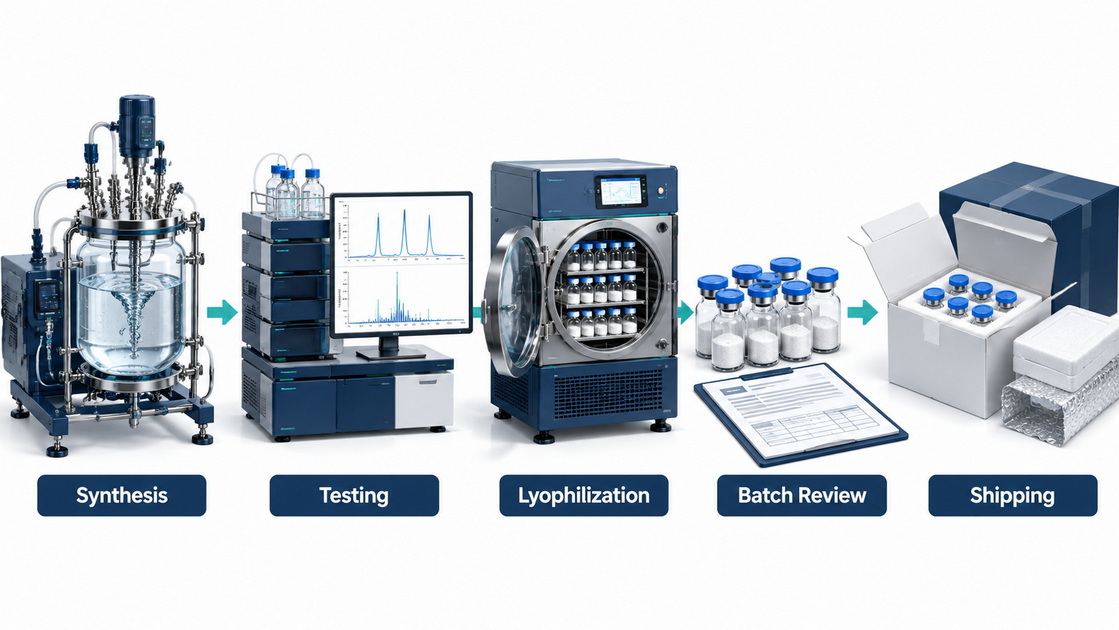
Rchemsell is a China-based peptide research and manufacturing company serving laboratory research and cosmetic-industry customers.
Its stated services cover peptide synthesis, quality testing, lyophilized packaging, and shipping, alongside OEM, ODM, and custom peptide synthesis.
For prospective partners, the useful next step is a technical feasibility discussion. Relevant project inputs include:
- Peptide sequence and required modifications.
- Target quantity and purity specification.
- Intended laboratory or formulation application.
- Analytical documentation requirements.
- Packaging format and delivery destination.
These capabilities should be evaluated at the project level. Supporting cosmetic-industry customers does not establish that retatrutide is an authorized cosmetic ingredient. Likewise, custom synthesis does not establish permission to manufacture or market a patented or regulated molecule.
"Research use only" is not a substitute for lawful intended use.
The FDA states that retatrutide is not a component of an approved drug and cannot be used in compounding under U.S. federal law. It has also warned against products falsely labeled for research while being sold to consumers with human-use dosing instructions.
Consequently, this guide does not provide personal injection schedules, reconstitution volumes, missed-dose instructions, or drug-switching advice. People seeking weight-management treatment should discuss authorized options with a licensed healthcare professional.
The Phase 2 obesity trial studied maintenance doses of 1, 4, 8, and 12 mg once weekly. TRIUMPH-1 evaluated 4, 9, and 12 mg maintenance targets. These were clinical research regimens, not approved prescribing instructions.
No. The regulatory sources reviewed identify retatrutide as investigational, without FDA approval. Promising clinical findings do not themselves authorize commercial treatment or establish the quality of unrelated products.
It was the estimated mean body-weight reduction at 48 weeks in the 12 mg group. It was not a guaranteed outcome, and it should be read alongside participant characteristics, adverse events, and the study's analysis methods.
The evidence discussed here does not establish a validated conversion. Milligram values should not be treated as equivalent across different molecules or used to create a personal switching plan.
No. A purity result alone does not establish sterility, endotoxin control, formulation suitability, clinical safety, or approval. Buyers should evaluate separate specifications for their intended laboratory application.
1. Jastreboff AM, Kaplan LM, Frías JP, et al. "[Triple-Hormone-Receptor Agonist Retatrutide for Obesity—A Phase 2 Trial]." New England Journal of Medicine. 2023;389:514–526. DOI: 10.1056/NEJMoa2301972. Primary source for Phase 2 design, dose groups, efficacy, and safety findings.
2. Eli Lilly and Company. "[Lilly's triple agonist, retatrutide, delivered powerful weight loss in pivotal Phase 3 obesity trial]." May 21, 2026. Sponsor announcement supporting the TRIUMPH-1 results, escalation description, estimand definitions, and adverse-event figures discussed here. These figures are attributed to this announcement rather than represented as independently verified journal findings.
3. U.S. Food and Drug Administration. "[FDA's Concerns with Unapproved GLP-1 Drugs Used for Weight Loss]." Content current as of October 1, 2026. Source for approval status, U.S. compounding restrictions, and warnings about misleading research-use marketing.
4. PSPeptides Research Team. "[How to Use the Proven Retatrutide Dosage Guide]." Original page supplied for restructuring and critical review. Not used as the primary authority for clinical figures.


