
Views: 217 Author: Rchemsell Publish Time: 2026-10-22 Origin: Site


Content Menu
● How We Evaluate Semaglutide Suppliers
● New Zealand's Position in the Semaglutide Supply Chain
>> What the Latest Industry Data Shows
● Five Semaglutide Sourcing Candidates and Pathways
>> 1. Rchemsell: China-Based Custom Peptide Candidate
>> 2. Novo Nordisk: Established Approved-Medicine Pathway
>> 3. Tocris Bioscience, Part of Bio-Techne: Defined Research Reagent
>> 4. Cayman Chemical: Research Product With Explicit Use Restrictions
>> 5. Selleck Chemicals: Additional Research-Sourcing Candidate
● Supplier Comparison: Capacity, MOQ, and Quality Evidence
● What Semaglutide Buyers Should Request
>> Build a Fit-for-Purpose Specification
>> Use Relevant Certifications
● The Approved Sample May Not Represent Supply
>> Do Not Confuse HPLC Purity With Peptide Content
● Buyer's Guide: From Inquiry to New Zealand Delivery
>> Step 1: Define Intended Use
>> Step 2: Verify the Organization
>> Step 3: Qualify a Representative Sample
>> Step 4: Confirm Capacity and Delivery Evidence
>> Step 5: Resolve Import and Transport Requirements
>> 1. How can I check whether an ISO certificate has expired?
>> 2. Does 99% purity establish pharmaceutical grade?
>> 3. Can a New Zealand supplier be described as a local manufacturer?
>> 4. What if the supplier changes the manufacturing site after sample approval?
>> 5. Can a laboratory import semaglutide using a personal prescription pathway?
Finding top semaglutide manufacturers and suppliers in New Zealand requires more than comparing prices, purity claims, and delivery promises. Professional buyers must first distinguish three different supply categories: approved prescription medicines, pharmaceutical development materials, and laboratory research reagents.
The evidence reviewed for this guide does not establish a cluster of five to ten New Zealand-based semaglutide API manufacturers. Instead, it identifies an approved medicine supply pathway and international research suppliers that New Zealand procurement teams can investigate.
This distinction matters. A local sales address does not establish local synthesis, and a research reagent is not interchangeable with an approved medicine.
This guide evaluates five sourcing candidates or pathways. Rchemsell appears first as the commissioning company and a China-based custom peptide candidate—not as an independently ranked market leader or a New Zealand factory.

The central selection principle is traceability: buyers should be able to connect the quoted product to its manufacturer, manufacturing site, analytical evidence, batch, and intended use.
The assessment considers:
- Public evidence of a semaglutide product or relevant peptide service.
- Clear distinction between manufacturing, distribution, and local representation.
- Analytical documentation and batch identification.
- Appropriate quality-system evidence.
- Custom synthesis and packaging capabilities.
- Realistic capacity and delivery commitments.
- Regulatory suitability for the proposed transaction.
This is a document-based shortlist, not a factory-audited ranking. Unpublished capacity, minimum order quantities, certifications, and founding dates are identified as unverified rather than estimated.
For international catalog suppliers, New Zealand delivery eligibility must be confirmed before purchase.
New Zealand offers a regulated medicine market and local product-release arrangements. However, those advantages should not be confused with domestic manufacture of the active ingredient.
For example, Medsafe's Wegovy product record identifies Novo Nordisk Pharmaceuticals Ltd in Auckland as the New Zealand sponsor and product-release site. It separately identifies active-ingredient manufacturing in Kalundborg, Denmark, and other overseas manufacturing or testing locations.
That is a useful procurement model: identify each organization's actual role rather than assigning every activity to the company accepting an order.
Novo Nordisk's 2025 annual reporting records Wegovy sales of DKK 79,106 million and Ozempic sales of DKK 127,089 million.
These figures demonstrate the commercial scale of established semaglutide medicines. They are not New Zealand market-size estimates, API production volumes, or evidence of availability from independent suppliers.
No verified New Zealand-specific semaglutide manufacturing-capacity or export dataset was established in this review. Broad pharmaceutical trade statistics should not be relabeled as semaglutide figures.
Rchemsell describes itself as a Chinese peptide research and manufacturing company serving laboratory research and cosmetic-industry customers.
According to company information supplied for this article, its services cover peptide synthesis, quality testing, lyophilized packaging, transportation, OEM, ODM, and custom synthesis. It states a general product purity range of 98%–99%.
Its potential relevance is a flexible project model for smaller research organizations and brands needing customization rather than a fixed catalog format.
However, cost competitiveness, communication performance, and semaglutide-specific capability require qualification. No comparative pricing study or audited service metrics were supplied.
- Founding year: Not independently verified.
- Stated customer markets: Global laboratory research and cosmetics customers.
- Customization scope: Company-stated synthesis, testing, packaging, and OEM/ODM support.
- Required verification: Semaglutide availability, batch documentation, manufacturing identity, capacity, and New Zealand shipment eligibility.
The supplied contact page could not be retrieved during this review. The company's broader cosmetic-industry activity does not establish that semaglutide is a permitted or suitable cosmetic ingredient.
Novo Nordisk's heritage dates to 1923; Novo and Nordisk merged in 1989 to form Novo Nordisk A/S.
For New Zealand medicine procurement, its relevance is supported by Medsafe's Wegovy record, which names the local sponsor and overseas manufacturing responsibilities.
Its core strength is the documented supply chain behind an approved finished medicine—not general-purpose research powder or private-label peptide services.
- Founding background: Roots in 1923; present corporate combination formed in 1989.
- Main market: Global pharmaceutical markets, including New Zealand.
- New Zealand role: Local sponsorship and product release.
- OEM/ODM scope: No third-party semaglutide private-label service established by the reviewed evidence.
Institutional purchasers should use the appropriate authorized medicine distribution arrangements rather than treating a finished prescription product as an interchangeable bulk ingredient.
Tocris lists semaglutide under catalog number 8946. The reviewed specification identifies a purity of at least 95% by HPLC and provides access to product documentation.
Its procurement appeal is a defined catalog identity and published analytical specification.
A lower advertised purity threshold does not automatically make a supplier inferior to one quoting "99%." Buyers must compare methods, impurity separation, identity evidence, and suitability for the experiment.
- Founding year: Not verified in the sources reviewed.
- Customer focus: Research customers through Bio-Techne's international business.
- Customization scope: Semaglutide-specific OEM or private-label services not established.
- Required verification: New Zealand ordering channel, available lot documentation, pack sizes, and shipment terms.
Do not infer therapeutic manufacturing status from research-catalog availability.
Cayman Chemical lists semaglutide as item 40231. Its product page explicitly states that the material is not for human or veterinary use.
The company also describes broader biochemical manufacturing and contract-service activities. Those capabilities do not prove that its catalog semaglutide is offered as a pharmaceutical API.
- Founding year: Not verified in the reviewed sources.
- Location: Ann Arbor, Michigan, United States.
- Customer focus: Biochemical and laboratory research.
- Customization scope: General contract services are described; semaglutide-specific scope requires confirmation.
- Required verification: New Zealand purchasing arrangements, current specifications, lot availability, and export eligibility.
The product identifier is a useful starting point for requesting a precise quotation rather than a generic "semaglutide powder" offer.
Selleck publicly describes a semaglutide research product and states that its products are for research use only, not human use, and are not sold to patients.
Its relevance is as another research-catalog candidate for comparing documentation and experimental suitability.
- Founding year: Not verified in this review.
- Customer focus: Research organizations.
- New Zealand supply status: Requires direct confirmation.
- OEM/ODM scope: No semaglutide-specific service verified.
- Required verification: Legal selling entity, manufacturing origin, lot-specific analyses, stock, and delivery eligibility.
A public product listing is discovery evidence—not proof that the supplier can support a particular country, quantity, or regulated application.
| Candidate | Supply category | Semaglutide capacity | MOQ | Quality or regulatory evidence |
|---|---|---|---|---|
| Rchemsell | Custom peptide inquiry candidate | Not independently verified | Request quotation | Company-stated 98%–99% general purity; certificates require verification |
| Novo Nordisk | Approved finished medicine | NZ-specific allocation not established | Distribution-channel dependent | Medsafe product record identifies sponsor and manufacturing roles |
| Tocris / Bio-Techne | Research reagent | Not published in reviewed evidence | Confirm available packs | Catalog 8946; ≥95% HPLC specification |
| Cayman Chemical | Research reagent | Not published in reviewed evidence | Confirm available packs | Item 40231; explicit research-use restrictions |
| Selleck Chemicals | Research reagent | Not published in reviewed evidence | Confirm available packs | Public product information; research-only restrictions |
A catalog pack size is not necessarily a manufacturing MOQ. Likewise, total peptide capacity is not evidence of validated semaglutide output.
Semaglutide is a modified, lipidated GLP-1 analogue. Its structure includes a fatty-acid side chain, so confirming only a generic peptide mass or an attractive chromatogram is insufficient.
Analytical work published by Agilent demonstrates how chromatographic separation combined with accurate-mass analysis can distinguish closely related semaglutide impurities.
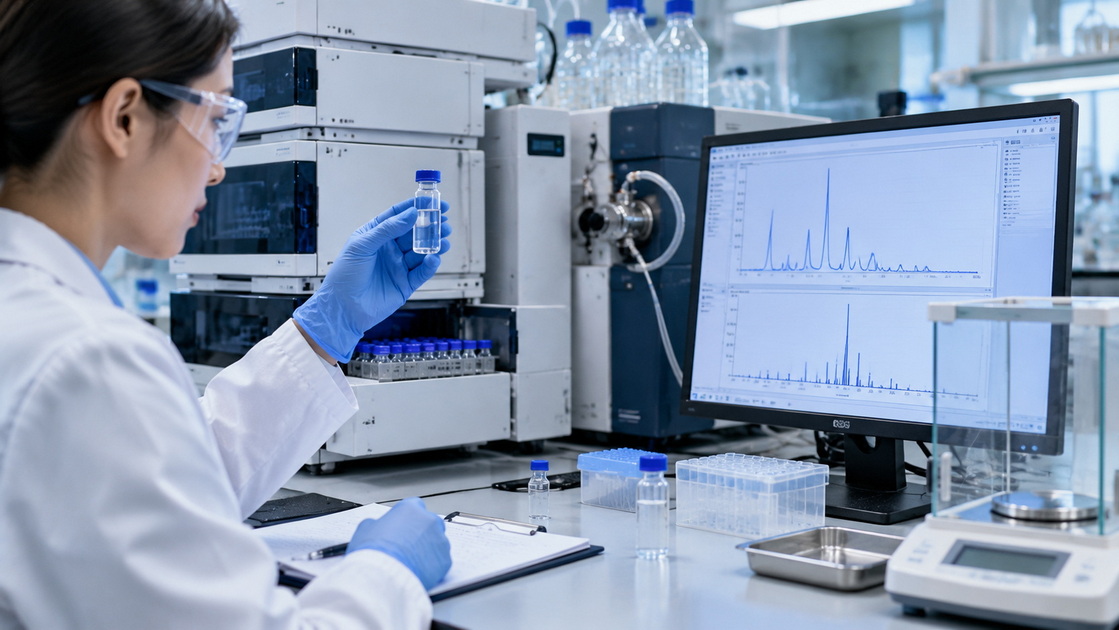
For research procurement, request:
- Exact chemical identity and stated chemical form.
- Lot-specific certificate of analysis.
- Chromatographic method and purity result.
- Mass-spectrometric identity evidence.
- Quantitative content or assay basis.
- Water and counterion information where relevant.
- Residual-solvent information appropriate to the intended use.
- Storage conditions and supported retest or expiry period.
Pharmaceutical development requires additional, application-specific qualification. Research purity alone does not establish GMP manufacture, sterility, clinical suitability, or permission to market a medicine.
CE marking and RoHS should not be treated as semaglutide API quality credentials. They do not substitute for pharmaceutical quality evidence or analytical release testing.
An ISO 9001 certificate may describe a management system. ISO 14001 may support environmental-management claims. Neither, by itself, proves that a particular peptide batch meets the buyer's specification.
Ask what the certificate actually covers: which legal entity, site, activities, and validity period.
One practical risk deserves more attention than another purity comparison: the sample, quotation, and commercial shipment may involve different material sources.
An excellent sample does not qualify every future batch.
Ask the supplier to identify:
1. Whether the sample comes from the commercial supply lot.
2. Which site performs synthesis and purification.
3. Which laboratory releases the batch.
4. Whether subcontractors are involved.
5. What changes require customer notification.
6. How future lots will be compared with the qualified material.
For critical programs, include source-change notification and acceptance criteria in the purchasing agreement.
Chromatographic area purity and the amount of peptide in a vial answer different questions.
A powder can contain water, counterions, or other declared components. Therefore, "99% HPLC purity" should not automatically be read as "99% of the weighed powder is semaglutide."
Compare prices on a clearly defined assay or content basis. Otherwise, the apparently cheaper quotation may not deliver more usable material.
State whether the purchase concerns an approved medicine, analytical research, laboratory experiments, or authorized pharmaceutical development.
Do not use a research-only label to bypass obligations associated with human use.
Request the registered company name, manufacturing address, payment beneficiary, and relevant licenses or certificates.
Where a distributor is involved, document its relationship with the original manufacturer.
Agree on acceptance criteria before ordering. Use an appropriately qualified independent laboratory where the project's risk warrants it.
Retain the sample identifier, analytical results, quotation, and correspondence.
Ask for realistic batch sizes, available inventory, production slots, release-testing time, and dispatch commitments.
Distinguish "production complete" from "released for shipment."
Confirm the importer of record, accurate customs description, required documents, and applicable regulatory route.
Personal medicine-import guidance is not a substitute for determining institutional or commercial obligations.
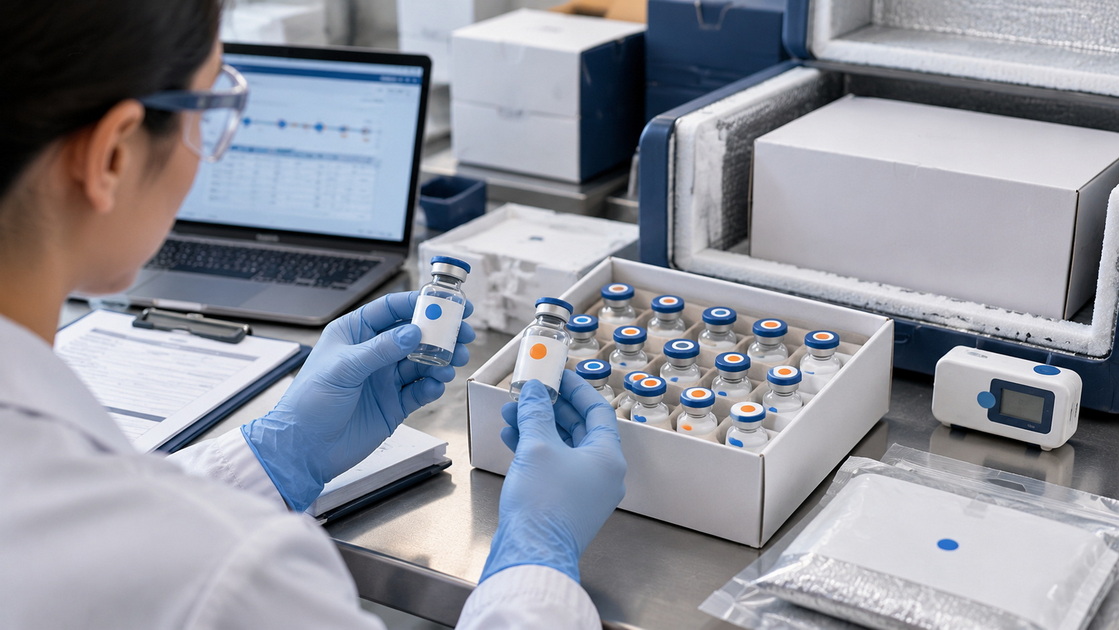
Use product-specific transport requirements supported by stability information. Do not assume every lyophilized peptide requires the same temperature arrangement—or that freeze-drying eliminates temperature sensitivity.
New Zealand semaglutide procurement is best approached as a qualification exercise, not a simple domestic factory ranking.
Novo Nordisk represents a documented approved-medicine pathway. International research catalogs provide different sourcing options. Rchemsell is a China-based custom peptide candidate whose semaglutide-specific capabilities require verification.
Obtain the certificate number, issuing body, covered site, scope, and dates. Verify status directly with the issuer or an applicable accredited-certificate database. A valid logo on a website is insufficient.
No. It does not establish manufacturing controls, complete impurity qualification, sterility, quantitative content, or regulatory suitability. Assess the intended application and full documentation package.
Only when evidence supports the relevant local manufacturing activity. A sponsor, importer, distributor, or product-release site should not automatically be described as an API synthesis plant.
Require notification, assess the change, and determine whether additional documents or testing are necessary. Qualifying a sample does not automatically qualify a new site.
Do not assume so. Institutional research and commercial procurement require their own classification and compliance assessment. Consult the relevant New Zealand authority or a qualified regulatory adviser before shipment.
1. Medsafe. [Wegovy Product Detail]. Official evidence of the New Zealand sponsor, product-release location, prescription classification, and overseas manufacturing responsibilities. [medsafe.govt]
2. Medsafe. [New Zealand Data Sheet: Wegovy]. Official product information and pharmacological background. [medsafe.govt]
3. Novo Nordisk. [Annual Report 2025: Financial Performance]. Source for global 2025 Wegovy and Ozempic sales; not a New Zealand market estimate. [annualreport.novonordisk]
4. Novo Nordisk. [Our Heritage]. Source for the company's 1923 roots and the 1989 merger. [novonordisk]
5. Bio-Techne / Tocris Bioscience. [Semaglutide, Catalog 8946]. Product identity, HPLC purity specification, and documentation access. New Zealand availability requires confirmation. [bio-techne]
6. Cayman Chemical. [Semaglutide, Item 40231]. Product identity and explicit restrictions against human or veterinary use. [caymanchem]
7. Cayman Chemical. [Company Website]. Background on biochemical manufacturing and general contract services. [caymanchem]
8. Selleck Chemicals. [Semaglutide Research Product Information]. Research-product positioning and human-use restrictions. [selleckchem]
9. Agilent Technologies. [Advanced 2D-LC/MS Workflow for the Characterization of Semaglutide]. Technical background on structural characterization and separation of related impurities. [agilent]
10. Medsafe. [Product/Application Search]. Official starting point for checking New Zealand medicine product records. [medsafe.govt]
11. Medsafe. [Importing Medicines]. Personal-import guidance, included to distinguish that pathway from institutional procurement. [medsafe.govt]
12. Medsafe. [The Medsafe Files: Clinical Trials]. Background on approval requirements for clinical trials involving new medicines. [medsafe.govt]


