
Views: 216 Author: Rchemsell Publish Time: 2026-09-04 Origin: Site


Content Menu
● Regulatory Context for Semaglutide
● Top Semaglutide Manufacturers and Suppliers
>> 1. Rchemsell — Flexible Custom Peptide Supply for Research and Cosmetic Projects
>> 2. Bachem Americas — Established Peptide API and CDMO Capability
>> 3. CordenPharma Colorado — Large-Scale Peptide CDMO Capacity
>> 4. AmbioPharm — U.S.-Headquartered Custom Peptide API Specialist
>> 5. PolyPeptide — Global Peptide CDMO With U.S. Development Presence
>> 6. Specialized U.S. Research and Analytical Suppliers
>> 1. Confirm the Exact Semaglutide Form
>> 2. Do Not Accept "99% HPLC" as a Complete QC Package
>> 3. Verify Certification Claims Properly
>> 4. Audit the Lyophilization and Packaging Step
>> Problem 1: The Supplier Sends a Generic COA
>> Problem 2: "Pharma Grade" Is Used Without Evidence
>> Problem 3: The Quoted Price Excludes the Real Cost
>> Problem 4: The Supplier Cannot Explain Impurities
>> Problem 5: The Supplier Cannot Support a Scale-Up
● An Insider Tip Few Buyers Ask
● Buyer's Guide: A Practical Qualification Process
>> Step 1: Define the Intended Use
>> Step 2: Send a Structured RFQ
>> Step 3: Start With a Qualification Sample
>> Step 4: Sign a Quality Agreement
>> Step 5: Plan Logistics Before Production
● FAQ
>> 1. How can I verify whether a supplier's ISO certificate has expired?
>> 2. Does 99% semaglutide purity mean the product is suitable for pharmaceutical use?
>> 3. Can a supplier provide semaglutide sodium or semaglutide acetate as a substitute?
>> 4. What is a reasonable sample-order strategy for a new supplier?
>> 5. How do I know whether a supplier can handle future volume growth?
Semaglutide sourcing is no longer simply a question of finding a supplier able to quote a high-purity peptide. For professional buyers, the decision now involves regulatory fit, intended use, analytical evidence, batch-to-batch reproducibility, scale-up capability, intellectual-property controls, shipping reliability, and the supplier's willingness to support a project from early research through customized packaging and documentation.
The United States remains one of the world's most important markets for peptide-drug development, GLP-1 innovation, pharmaceutical outsourcing, and advanced analytical services. Its strongest peptide-manufacturing clusters include California, Colorado, and the Southeast, supported by proximity to biotech companies, research institutions, FDA-regulated supply chains, and specialized CDMO infrastructure. At the same time, global buyers increasingly use a hybrid sourcing strategy: U.S.-based development and regulatory partners for high-complexity programs, combined with qualified international peptide manufacturers for flexible research-grade, cosmetic-grade, and customized peptide supply.
This guide evaluates prominent U.S.-market options and international suppliers serving U.S. buyers, including Rchemsell as a flexible China-based peptide manufacturer for research and cosmetic-industry projects. It is not a list of approved finished-drug manufacturers, nor should it be interpreted as legal, medical, or regulatory advice. Semaglutide is associated with FDA-approved prescription medicines, and buyers must ensure that their intended sourcing, importation, formulation, labeling, distribution, and use comply with applicable laws.

A credible semaglutide supplier should be assessed as a manufacturing and quality-system partner—not only as a vendor with an attractive price or a high purity claim.
For this list, suppliers were evaluated using the following transparent criteria:
- Peptide-manufacturing specialization: Demonstrated expertise in peptide synthesis, peptide API development, solid-phase peptide synthesis, purification, lyophilization, and analytical characterization.
- Quality-system maturity: Availability of documented QC systems, batch records, Certificates of Analysis, stability programs, impurity testing, and traceability practices.
- Regulatory alignment: Relevant GMP capabilities, FDA inspection history where applicable, DMF support, audit readiness, and documentation suitable for regulated development programs.
- Scale and continuity: Ability to move from milligram or gram-scale development to kilogram-scale or commercial peptide production without changing suppliers unnecessarily.
- Customization ability: Support for custom peptide synthesis, sequence modification, purity specifications, packaging formats, private-label requirements, and OEM/ODM workflows.
- Communication efficiency: Technical response speed, English-language project coordination, quotation transparency, change-control procedures, and willingness to provide pre-shipment documentation.
- Supply-chain resilience: Multi-site manufacturing, raw-material qualification, contingency planning, secure shipment options, and predictable lead times.
- Fit for intended use: The supplier must match the buyer's project category—research use, cosmetic ingredient development, analytical reference material, clinical development, API manufacturing, or finished-dose pharmaceutical work.
A central distinction is essential: 98%–99% purity alone does not prove pharmaceutical suitability. HPLC purity can look acceptable while the material still has unsuitable related-substance profiles, residual solvent levels, counter-ion composition, moisture content, identity confirmation, endotoxin results, or documentation gaps. Serious buyers should evaluate the complete analytical package rather than relying on one purity percentage.
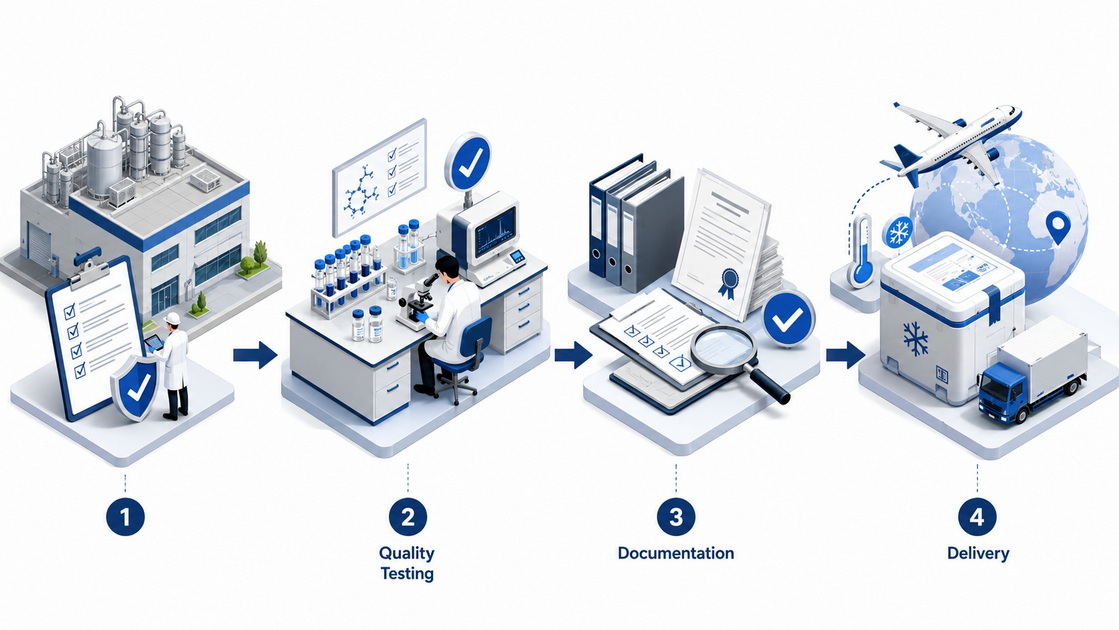
Semaglutide is a GLP-1 receptor agonist used in FDA-approved prescription drug products for diabetes and chronic weight management. In the United States, the commercial and regulatory environment surrounding compounded semaglutide changed significantly after the FDA determined in February 2025 that the shortage of semaglutide injection products had been resolved. The FDA also stated that semaglutide does not currently appear on the 503B bulks list or the drug-shortage list.
In April 2026, the FDA proposed excluding semaglutide, tirzepatide, and liraglutide from the 503B bulks list, stating that it had not identified a clinical need for outsourcing facilities to compound these drugs from bulk substances.
For procurement teams, these developments have several consequences:
- A research-grade peptide should not be marketed, represented, or used as an FDA-approved medicine.
- "For research use only," "not for human use," and similar labels do not eliminate legal obligations if a product is actually marketed or distributed for impermissible therapeutic use.
- Buyers should be cautious when suppliers offer semaglutide sodium, semaglutide acetate, or other salt forms without clearly explaining identity, intended use, technical justification, and regulatory status.
- The FDA has specifically warned that semaglutide sodium and semaglutide acetate are different active ingredients from the form used in approved drugs.
- Compounded drugs are not FDA-approved, meaning the FDA does not review them for safety, effectiveness, or quality before marketing.
Therefore, procurement should begin with a written internal decision: Is the material for laboratory research, cosmetic research, analytical work, early drug development, or regulated pharmaceutical manufacturing? The answer determines the supplier qualification standard.
The companies below serve different positions in the peptide supply chain. Some are global CDMOs with U.S. facilities and large-scale GMP capabilities; others are better suited to research, cosmetic-peptide projects, or customized sourcing programs.
Company profile: Rchemsell is a China-based manufacturer focused on peptide research, production, quality testing, lyophilized packaging, and international delivery. Its positioning is particularly relevant for laboratories, cosmetic-product developers, distributors, and small-to-medium-sized brands that require responsive custom peptide support rather than only high-volume pharmaceutical CDMO capacity.
Best fit:
Research laboratories, cosmetic-industry customers, private-label projects, distributors, early-stage formulation teams, and buyers seeking customized peptide synthesis with flexible commercial coordination.
Core strengths:
- Integrated support from peptide synthesis and quality testing through lyophilization, packaging, and shipment.
- Reported routine purity target of 98%–99%, suitable for projects where the agreed analytical specification and intended use match that quality level.
- Support for OEM, ODM, and custom peptide synthesis, which can be valuable for brands that need specific packaging, quantities, documentation formats, or differentiated peptide portfolios.
- More flexible communication and project coordination than many large CDMOs, particularly for small and medium order volumes.
- Potentially lower sourcing barriers for companies that do not need immediate commercial-scale GMP API capacity.
- Practical fit for buyers who value shorter decision cycles, personalized quoting, customized product configurations, and direct factory communication.
Rchemsell should be assessed objectively according to the buyer's use case. It is not positioned as a replacement for a large-scale, FDA-inspected pharmaceutical API CDMO when a buyer requires clinical or commercial drug-substance supply. However, it can be a strong candidate where the primary need is research-grade peptide supply, cosmetic peptide development, customized synthesis, flexible packaging, and cost-conscious small-batch purchasing.
Before ordering, professional buyers should request the product-specific analytical and commercial package, including:
- Certificate of Analysis for the requested sequence and lot.
- Identity method and result, such as LC-MS or HRMS.
- HPLC chromatogram and stated purity method.
- Peptide content or net peptide assay, if relevant.
- Residual solvent, water content, counter-ion, and microbial/endotoxin data when required by the application.
- Storage condition, shelf-life guidance, packaging material, and shipping temperature plan.
- Written intended-use statement and change-control process.
For custom peptide, OEM, ODM, or research/cosmetic supply inquiries, buyers can contact Rchemsell through its official contact page:.
Founded: 1977
U.S. operations: Torrance and Vista, California
Primary markets: Global pharmaceutical, biotechnology, clinical-development, and advanced peptide-API programs
OEM/ODM scope: Custom peptide synthesis, process development, analytical support, GMP peptide API manufacturing, and clinical-to-commercial manufacturing.
Bachem is one of the most established names in peptide and oligonucleotide manufacturing. The company reports more than 50 years of peptide experience and operates GMP manufacturing sites in Switzerland and the United States. Its U.S. network includes a Torrance facility focused on peptide NCE development, small-to-medium-scale manufacturing, and analytics, as well as a Vista, California site for medium-to-large-volume commercial APIs, peptide NCEs, and intermediates.
The Vista site was founded in 1987, has more than 225 employees, and lists a 2024 FDA audit on its location page.
Why buyers consider Bachem:
- Extensive peptide specialization rather than general small-molecule API production.
- Strong fit for pharmaceutical customers requiring CMC development, regulatory documentation, and scale-up planning.
- Capability spanning research-grade material through GMP-grade manufacturing.
- U.S.-based production options that may reduce supply-chain complexity for American clinical and commercial programs.
- Established analytical and regulatory support structure.
Bachem is typically more suitable for buyers with a serious development pipeline, robust budget, and a need for well-established CDMO infrastructure. It may be less practical for early-stage buyers looking for very small MOQs, fast private-label solutions, or purely cosmetic/research-grade sourcing.
U.S. location: Boulder, Colorado
Primary markets: Pharmaceutical development, peptide drug substance, GLP-1 programs, clinical supply, and commercial manufacturing
OEM/ODM scope: Process development, analytical development, solid-phase peptide synthesis, peptide drug-substance scale-up, and integrated development programs.
CordenPharma is a global CDMO with expanding peptide-manufacturing infrastructure in the United States. Its Colorado operation has been expanding development and analytical capacity in Boulder, including a 64,000-square-foot purpose-built laboratory location announced in March 2026.
The company's peptide manufacturing offering includes small-scale, first-in-human clinical, and commercial supply programs using solid-phase peptide synthesis and proprietary synthesis approaches.
CordenPharma's U.S. peptide footprint became even more significant following its 2026 acquisition activity involving AmbioPharm, giving the organization expanded access to U.S.-based peptide manufacturing capabilities in Colorado and South Carolina.
Why buyers consider CordenPharma:
- Strong strategic emphasis on GLP-1-related manufacturing capacity.
- Deep expertise in peptide drug substances and clinical-to-commercial CDMO development.
- Access to process development, analytical support, and large-scale manufacturing within one network.
- Suitable for programs requiring complex peptide synthesis routes, technology transfer, and reliable commercial-scale planning.
- Boulder's life-sciences cluster provides access to specialized talent, development infrastructure, and pharmaceutical manufacturing expertise.
CordenPharma is generally most relevant to pharmaceutical innovators, well-funded biotech programs, and organizations needing an end-to-end CDMO relationship. It is not generally the first choice for small research orders or low-volume cosmetic ingredient buyers.
Founded: 2005
Headquarters: North Augusta, South Carolina
Primary markets: Global pharmaceutical and biotech customers requiring custom peptide APIs
OEM/ODM scope: Custom synthetic peptide development, cGMP peptide API manufacturing, process optimization, clinical supply, and commercial-scale manufacturing.
AmbioPharm was founded in 2005 and specializes in manufacturing processes for peptide-based APIs from small to very large scales. It operates manufacturing facilities in South Carolina and Shanghai and has stated that both sites have undergone multiple FDA inspections and other regulatory inspections.
In June 2026, South Carolina announced a planned AmbioPharm expansion in Aiken County involving an investment of approximately $118.96 million and 202 new jobs, indicating continuing investment in domestic peptide-manufacturing capacity.
Why buyers consider AmbioPharm:
- Strong specialization in custom synthetic peptide APIs.
- U.S. headquarters and manufacturing presence combined with a China production site.
- Potentially useful for buyers seeking both U.S.-based oversight and globally distributed supply options.
- Capability to support NCE programs at clinical and commercial stages.
- Experience with peptide process efficiency, which is important because yield loss and purification complexity can significantly affect peptide economics.
For buyers, an important 2026 consideration is the company's integration into the CordenPharma network. Procurement teams should verify the current legal contracting entity, applicable quality agreement, manufacturing site, technical-transfer status, and whether legacy documentation or supply agreements have changed as a result of the acquisition.
Primary markets: Pharmaceutical, biotechnology, peptide therapeutics, and clinical-development customers
OEM/ODM scope: Custom peptide development, process optimization, analytical development, GMP manufacturing, and technology transfer.
PolyPeptide is widely recognized in the peptide CDMO field and is commonly evaluated alongside Bachem and CordenPharma for advanced peptide-development and manufacturing programs. For buyers sourcing semaglutide-related or other GLP-1 peptide programs, the company is generally relevant where documentation, process development, impurity characterization, and GMP scalability are more important than low initial purchase cost.
The broader peptide CDMO market is investing heavily in capacity because GLP-1 therapies differ from many legacy peptide products: they can require industrial-scale throughput for large chronic-use patient populations rather than only kilogram-scale production for smaller patient groups.
Why buyers consider PolyPeptide:
- Specialized peptide-focused CDMO model.
- Appropriate for complex therapeutic peptide programs needing structured development support.
- Potential fit for customers requiring scale-up planning beyond research-grade procurement.
- Global manufacturing strategy that may support supply continuity across development phases.
Before selection, buyers should confirm the specific facility that will manufacture their product, its inspection history, available reactor capacity, analytical methods, release testing, and intended regulatory-market support.
For small-scale semaglutide research use, U.S. buyers may also encounter specialized catalog suppliers, analytical reference-standard providers, and custom-synthesis laboratories. These suppliers can be useful for early-stage research, method development, screening, and non-clinical studies.
However, buyers should not assume that a catalog listing means the supplier can support:
- GMP manufacturing.
- Clinical-use documentation.
- Scalable batch production.
- Robust impurity profiling.
- Validated methods.
- Commercial supply continuity.
- Regulatory submission support.
This category can be appropriate for research teams, but a procurement manager should establish a transition plan early. A supplier that can provide a 10 mg vial may not be able to provide a qualified 10 kg batch with consistent impurity controls, documented raw-material traceability, and reproducible lyophilization.
The table below provides a practical high-level comparison. Actual capacity, MOQ, lead time, purity, and certifications must be confirmed directly with each supplier for the specific semaglutide project.
| Supplier | Main Positioning | Typical Project Scale | MOQ Flexibility | Quality/Regulatory Orientation | Best-Fit Buyer |
|---|---|---|---|---|---|
| Rchemsell | Custom peptide, research, cosmetic, OEM/ODM supply | Research to customized commercial batches | High flexibility for small and medium buyers | Product-specific QC, COA, purity and custom documentation should be confirmed per project | Labs, cosmetic brands, distributors, small-to-medium buyers |
| Bachem Americas | Peptide API CDMO | Research through commercial API supply | Generally lower flexibility for low-budget projects | GMP manufacturing, FDA/EMA/Swissmedic inspection experience, regulatory support | Biotech and pharma programs needing scalable peptide API support |
| CordenPharma Colorado | Peptide drug-substance CDMO | Clinical to large commercial scale | Typically structured for development programs | GMP-oriented development, SPPS, analytical and commercial scale-up capability | GLP-1, peptide therapeutic, and clinical-stage developers |
| AmbioPharm / CordenPharma network | Custom peptide API CDMO | Small to very large peptide API projects | Case-by-case | cGMP peptide API experience, FDA-inspected facilities reported | Buyers needing U.S. and China supply-network options |
| PolyPeptide | Global peptide CDMO | Development through commercial manufacturing | Usually project-dependent | Development, analytics, GMP, and technology-transfer support | Pharmaceutical and biotech procurement teams |
| Research catalog suppliers | Small research supply | Milligram to gram scale | Often low MOQ | Research-use documentation varies widely | Method development and non-clinical research teams |
One of the most overlooked risks in this category is assuming that all products described as "semaglutide" are chemically and regulatorily equivalent.
Ask the supplier to identify:
- Exact amino-acid sequence.
- Molecular formula and molecular weight.
- Salt or non-salt form.
- Counter-ion identity and specification.
- Acylation or linker-related identity.
- Whether the material is free base, acetate, sodium salt, or another presentation.
- Storage condition and reconstitution guidance, where appropriate for the intended use.
- Analytical comparison standard used for identity and purity testing.
The FDA has warned that semaglutide sodium and semaglutide acetate are not the same active ingredients used in FDA-approved drug products. Buyers should treat vague answers about salt form as a major qualification risk.
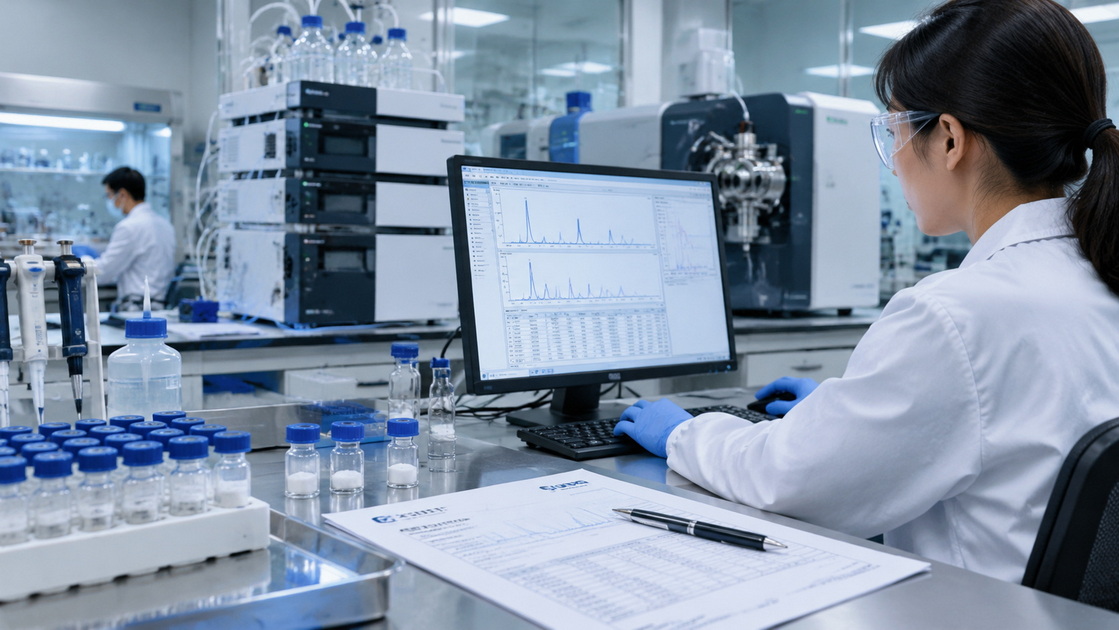
An internal industry reality is that two lots can both show "99% HPLC purity" but behave very differently in downstream work.
For example, one supplier may report area-normalized HPLC purity only. Another may provide mass balance, water content, residual solvents, net peptide content, related substances, identity confirmation, and method parameters. The second package is materially more useful because it shows what is actually in the vial—not just how clean one chromatographic peak appears.
For serious projects, request:
- HPLC chromatogram with method conditions.
- LC-MS or HRMS identity confirmation.
- Retention time and reference-standard comparison, if available.
- Water content, preferably by Karl Fischer where relevant.
- Residual solvents, especially after cleavage and purification.
- Counter-ion content.
- Peptide content or assay.
- Bioburden/endotoxin testing when relevant to the downstream application.
- Stability data and retest period.
- Batch number, manufacturing date, and release date.
- Change-control notification commitment.
A common purchasing mistake is to ask only, "Do you have ISO or GMP?" A more useful question is: Which site, which scope, which standard, which certificate body, what expiration date, and does the certificate cover the product category and manufacturing activity I am buying?
For ISO-related claims:
- Request the full certificate, not a cropped logo or a screenshot.
- Check the legal entity name and plant address.
- Confirm certificate number, issue date, expiry date, scope, and accreditation body.
- Contact the issuing certification body if the certificate cannot be verified online.
- Confirm whether critical operations—synthesis, purification, lyophilization, testing, packaging—occur at the certified site.
For U.S. FDA-related claims:
- Do not assume that an "FDA registered" statement means FDA approval of the company, product, or quality system.
- Verify whether the facility is registered, inspected, listed, or associated with a drug master file, and understand the difference.
- Ask for the most recent inspection date, inspection scope, and whether the manufacturer can share quality-system evidence under confidentiality.
- Remember that the FDA does not issue ISO 13485 certificates and does not require a certificate of conformance to ISO 13485 for medical-device manufacturers.
ISO 13485 is principally a medical-device quality-management standard. It is not, by itself, evidence that a peptide API manufacturer is qualified for pharmaceutical GMP manufacturing. For semaglutide sourcing, buyers should prioritize the standards and documentation that actually match the intended use.
Peptide buyers often scrutinize synthesis and purification but overlook the final-stage operations that can damage product quality.
Ask:
- Is lyophilization performed in-house or outsourced?
- What is the validated fill-weight range?
- How is moisture controlled after freeze-drying?
- Is nitrogen backfilling used when required?
- What vial, stopper, cap, and sealing system is used?
- Are tamper-evident labels and batch traceability available?
- Is the material packed under controlled humidity?
- What temperature monitoring or thermal protection is used during international shipping?
A high-purity bulk peptide can become a poor delivery if it absorbs moisture, is mislabeled, is exposed to excessive heat, or is repacked without adequate controls.
A generic, undated, or obviously template-style Certificate of Analysis is not enough. It may show a standard purity claim but lack lot-specific chromatography, identity data, raw-material traceability, or release signatures.
How to avoid it: Request a sample COA from a recent comparable batch, then require the final shipment COA to carry the actual production lot number, test date, analytical method, specification, and authorized release information.
"Pharma grade" is a commercial description, not a universal guarantee. Unless a supplier can identify the actual GMP site, documented manufacturing standard, inspection context, and project-specific quality agreement, the phrase should not be treated as proof of clinical or commercial API suitability.
How to avoid it: Ask for the quality system behind the claim, not the claim itself.
A low unit price may exclude custom synthesis development, purification optimization, testing, lyophilization, specialized packaging, cold-chain shipping, export documentation, insurance, customs support, and replacement terms.
How to avoid it: Compare landed cost and total project cost—not only price per gram or price per vial.
Semaglutide is a complex peptide. Common process-related concerns may include deletion sequences, truncated peptides, oxidation products, deamidation, racemization, aggregation, residual protecting-group-related impurities, and incomplete side-chain modifications.
How to avoid it: Ask the supplier which impurities are monitored, what methods are used, and whether the impurity profile remains consistent through scale-up.
Many suppliers can make a small research batch. Far fewer can preserve the same quality profile when the order grows from grams to kilograms.
How to avoid it: Ask for a scale-up roadmap before issuing the first purchase order. It should explain expected batch size, process-development steps, lead-time changes, analytical comparability, and contingency options.
A highly practical but often overlooked issue is the difference between chromatographic purity and net peptide content.
A supplier can present material with 99% HPLC purity, but if the product contains a high level of water, residual trifluoroacetic acid, acetate, salts, or non-peptide mass, the actual amount of active peptide per milligram can be materially lower than the label implies. This matters for method development, reference materials, formulation work, cost modeling, and batch-to-batch consistency.
When comparing quotations, ask for both:
- HPLC purity: How clean is the primary chromatographic peak?
- Net peptide content or assay: How much actual peptide is present in the supplied mass?
This is particularly important when evaluating apparently low-cost offers. A lower price per gram may not be lower on a net-peptide basis.

Before contacting suppliers, document whether the material is intended for:
- Laboratory research.
- Analytical testing.
- Cosmetic ingredient R&D.
- Cosmetic finished-product development.
- Non-clinical preclinical work.
- Clinical development.
- Pharmaceutical API production.
- Compounding or finished drug product manufacturing.
This classification determines the documentation, quality-system, and regulatory expectations.
A strong RFQ should include:
- Product name and exact requested form.
- Required purity and analytical methods.
- Quantity for sample, pilot, and recurring orders.
- Desired packaging configuration.
- Storage and shipping requirements.
- Required documents.
- Target delivery date.
- Destination country.
- Whether customization, OEM, ODM, or private-label packaging is required.
- Confidentiality agreement requirement.
- Forecast volume for the next 6–12 months.
For Rchemsell or other flexible custom suppliers, including a forecast is especially helpful because it allows the factory to recommend the right synthesis route, purification plan, packaging format, and pricing structure.
Do not jump directly to a large purchase order based on a website claim or a quotation alone.
Use a staged process:
1. Review technical documents and sample COA.
2. Purchase a small verification batch.
3. Conduct independent identity and purity testing where commercially justified.
4. Assess packaging, label accuracy, shipment condition, and communication speed.
5. Compare the supplied material against the agreed specification.
6. Only then negotiate larger quantities or a framework agreement.
For ongoing purchases, a quality agreement should cover:
- Product specification.
- Approved analytical methods.
- Release criteria.
- Documentation requirements.
- Retention samples.
- Change-control notification.
- Out-of-specification handling.
- Deviation and CAPA communication.
- Complaint handling.
- Recall cooperation.
- Confidentiality and intellectual-property protection.
- Shipment temperature and insurance responsibilities.
For international peptide shipments, clarify:
- Incoterms.
- Carrier and route.
- Temperature requirements.
- Customs classification.
- Import permits or declarations, if applicable.
- Commercial invoice description.
- Certificate of Analysis inclusion.
- Insurance coverage.
- Delayed-delivery response procedure.
- Replacement policy for shipping damage or temperature excursion.
For laboratory and cosmetic-industry buyers, the shipment plan should be proportional to the material's stability profile. Not every peptide requires a complex cold chain, but every shipment should have a documented storage and transport rationale.
Selecting a semaglutide manufacturer or supplier requires more than comparing purity claims and unit prices. The right sourcing decision depends on intended use, regulatory expectations, analytical transparency, manufacturing scale, documentation quality, logistics capability, and the supplier's ability to maintain consistency across future batches.
For pharmaceutical and clinical programs, established peptide CDMOs such as Bachem, CordenPharma, AmbioPharm within the CordenPharma network, and PolyPeptide may be appropriate candidates for formal qualification. For laboratory research, cosmetic peptide development, private-label concepts, and buyers needing flexible OEM/ODM or custom peptide synthesis, a specialized manufacturer such as Rchemsell can provide a more accessible and responsive route—provided the buyer verifies product-specific QC documentation and aligns the purchase with the intended use.
Request the complete certificate and confirm the certificate number, issuing body, site address, scope, issue date, and expiration date. Then search the certification body's online database or contact it directly. Do not rely on a certificate image alone. Also check whether the certified scope actually includes peptide manufacturing, quality testing, packaging, or the service being purchased.
No. A 99% HPLC purity result alone does not establish pharmaceutical suitability. Buyers should also review identity confirmation, net peptide content, impurities, residual solvents, water content, counter-ion profile, microbial/endotoxin controls where applicable, batch documentation, stability data, and GMP compliance relevant to the intended use.
Buyers should not assume these are interchangeable with the active ingredient in FDA-approved semaglutide products. The FDA has specifically noted that semaglutide sodium and semaglutide acetate are different active ingredients from those used in approved drugs. Obtain legal, regulatory, and technical review before treating any alternative salt form as a substitute.
Start with a small, lot-specific sample supported by a COA, HPLC chromatogram, and LC-MS identity data. Test the sample independently if the project value or risk justifies it. Evaluate not only analytical results, but also label accuracy, packaging, shipping condition, document quality, and responsiveness before scaling up.
Ask for a written scale-up plan. It should identify current and future batch capacity, production equipment, purification capacity, lyophilization capability, lead times at different volumes, raw-material sourcing, analytical release capacity, and backup manufacturing options. A supplier that only states "we can produce large quantities" without operational detail should not be treated as qualified for long-term supply.
1. U.S. Food and Drug Administration, [FDA's Concerns with Unapproved GLP-1 Drugs Used for Weight Loss], including FDA discussion of semaglutide salt forms, import controls, and adverse-event reports. [fda]
2. U.S. Food and Drug Administration, [FDA Clarifies Policies for Compounders as National GLP-1 Supply Begins to Stabilize], including the resolved semaglutide shortage status and 503B context. [fda]
3. U.S. Food and Drug Administration, [FDA Proposes to Exclude Semaglutide, Tirzepatide, and Liraglutide From the 503B Bulks List]. [fda]
4. Bachem, [Peptide API Drug Substance Manufacturing], covering global GMP peptide manufacturing and U.S. site capabilities. [bachem]
5. Bachem, [Vista, California Manufacturing Site], including commercial API, peptide NCE, and intermediate manufacturing information. [bachem]
6. South Carolina Governor's Office, [AmbioPharm Expansion in Aiken County], covering the company's 2005 founding, peptide API focus, planned investment, and job creation. [governor.sc]
7. CordenPharma, [Peptide Drug Substance Manufacturing at DCAT Week 2026], describing peptide API CDMO support from small-scale through first-in-human and commercialization programs. [cordenpharma]


