
Views: 230 Author: Rchemsell Publish Time: 2026-10-28 Origin: Site


Content Menu
● How Are the Types of Cyclic Peptides Classified?
>> Main Cyclization Topologies
● Head-to-Tail Cyclic Peptides
● Side-Chain-to-Side-Chain Cyclic Peptides
● Head-to-Side-Chain and Side-Chain-to-Tail Peptides
● Other Important Cyclic Peptide Categories
>> Bicyclic and Multicyclic Peptides
● Cyclic Peptides vs. Linear Peptides: What Actually Changes?
● Can Cyclic Peptides Be Used in Cosmetic Research?
>> A Practical Cosmetic Development Checklist
● Custom Cyclic Peptide Synthesis: From Sequence to Verified Material
>> Why Feasibility Review Matters
● Why Correct Mass Does Not Always Prove Correct Cyclization
>> What to Request Beyond a Mass Result
● Peptide Purity and Peptide Content Are Different Specifications
● Preparing a Custom Peptide Brief for Rchemsell
>> 1. What are the main types of cyclic peptides?
>> 2. Are cyclic peptides always more stable than linear peptides?
>> 3. What is the difference between disulfide and lactam cyclization?
>> 4. Does high purity confirm the correct cyclic structure?
>> 5. Are cyclic peptides automatically suitable for skincare products?
Understanding the types of cyclic peptides starts with two questions: where does the peptide ring close, and what chemical bond holds it together? For laboratory researchers and cosmetic development teams, these distinctions affect synthesis planning, analytical verification, stability testing, and purchasing specifications.
Cyclic peptides are not one uniform product category. Two molecules with similar sequences can behave differently when their ring size, linkage position, or stereochemistry changes. Choosing a suitable structure therefore requires more than requesting a high-purity peptide.
This guide explains the main cyclic peptide structures, their practical limitations, and the information manufacturers need to evaluate a custom project.
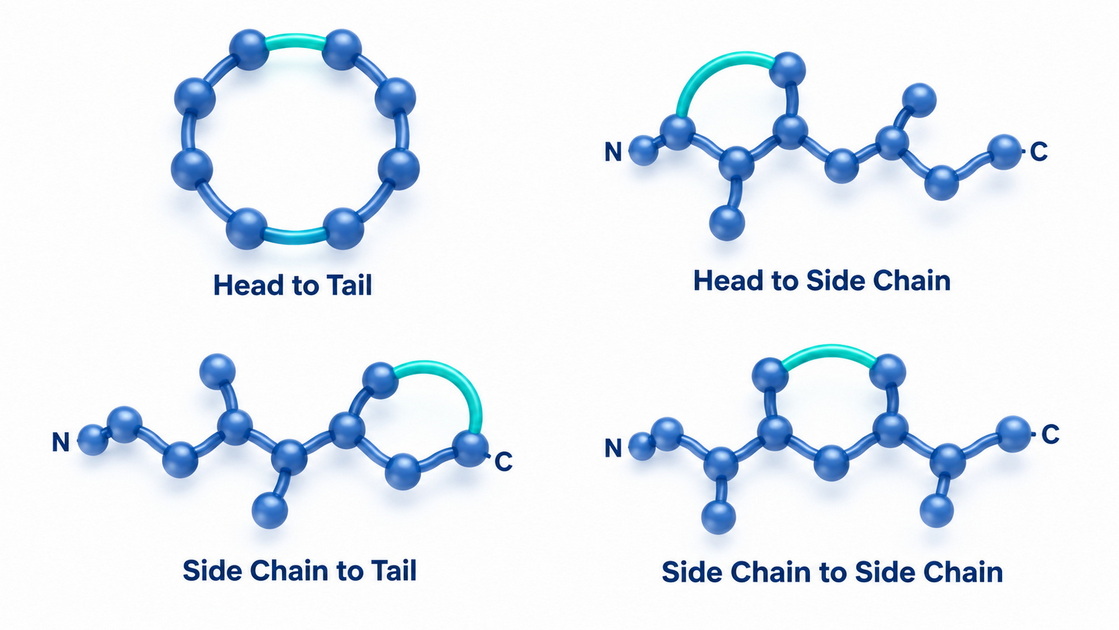
Cyclic peptides contain at least one ring formed by covalently connecting parts of a peptide molecule. That connection may join the backbone termini, two side chains, or a terminus and a side chain.
Cyclization restricts the conformations a peptide can adopt. Depending on the sequence and ring architecture, this can improve target recognition or resistance to enzymatic degradation.
However, ring closure does not automatically improve every property. A constraint that stabilizes one useful conformation may prevent another peptide from binding its target effectively. Published comparisons emphasize that different cyclization strategies produce different outcomes.
The most important concept for buyers is connectivity: the exact atoms joined to create the intended structure.
Two classification systems are especially useful:
- Topology describes where the ring closes.
- Linkage chemistry describes the bond forming the ring.
These systems overlap rather than compete. For example, a side-chain-to-side-chain cyclic peptide may contain a disulfide bond, a lactam bridge, or another chemical linker.
| Cyclization type | Connection formed | Practical consideration |
|---|---|---|
| Head-to-tail | N-terminus to C-terminus | Removes both free backbone termini |
| Head-to-side-chain | N-terminus to a side-chain group | Requires a specified reactive side chain |
| Side-chain-to-tail | Side-chain group to C-terminus | Leaves the N-terminus outside the closure unless modified |
| Side-chain-to-side-chain | Two side-chain groups | May retain both backbone termini |
| Multicyclic | Multiple ring-forming connections | Requires more detailed structural verification |
This classification prevents a common misunderstanding: not every cyclic peptide is a fully closed backbone ring. Some retain terminal segments outside the cyclic region.
Head-to-tail cyclization connects the N-terminal amino group to the C-terminal carboxyl group, commonly through an amide bond.
Because the backbone ends are joined, the resulting structure has no free N- or C-terminus. This can protect against exopeptidases that act at peptide termini, although other degradation pathways remain possible.
Head-to-tail structures are useful when researchers want to constrain the entire sequence rather than one local segment.
A synthesis request should identify:
- The complete sequence.
- Every D-amino acid or nonstandard residue.
- The intended terminal connection.
- Any side-chain modifications.
- Required analytical evidence.
Do not rely exclusively on the shorthand "cyclo" when multiple ring closures are chemically possible. A structural drawing can resolve ambiguities that a sequence alone leaves open.
Side-chain cyclization links reactive groups on selected residues. The backbone termini may remain free or receive separate modifications.
This architecture can constrain a binding motif while preserving terminal positions for labels, conjugation, or other experimental functions.
Disulfide cyclization commonly connects two cysteine thiol groups. It is a familiar approach for reproducing structural constraints found in naturally occurring peptides.
Its practical limitation is redox sensitivity. Whether a disulfide remains intact depends on the surrounding chemical environment.
When a sequence contains several cysteines, specifying "disulfide cyclization" is insufficient. The intended pairing must also be defined. A correct total molecular mass does not independently establish the desired disulfide connectivity.
A lactam bridge is an amide connection that can link an amino-bearing side chain with a carboxyl-bearing side chain.
Unlike a disulfide, the lactam connection is not cleaved by ordinary disulfide-reducing conditions. Nevertheless, changing the linkage changes the molecule. It should not be treated as an interchangeable replacement without testing.
For custom synthesis, identify the participating residues and their positions rather than requesting a generic "stable cyclic version."
These structures connect one backbone terminus to a side chain.
They offer another way to restrict a selected segment while leaving part of the peptide outside the ring. Depending on the sequence, this can preserve a functional group needed for binding or conjugation.
For procurement, terminal status matters. Buyers should clarify whether the remaining terminus is free, acetylated, amidated, or otherwise modified.
These details affect molecular identity and experimental interpretation. Two products with the same nominal sequence are not necessarily equivalent if their closures or terminal modifications differ.
Cyclic depsipeptides contain at least one ester linkage in place of an amide linkage within the ring.
The ester changes the molecule's chemistry and can influence its degradation behavior. It should not be overlooked when defining storage conditions or designing a stability study.
Diketopiperazines are small cyclic dipeptide structures. They illustrate why "cyclic peptide" covers a broad chemical space rather than one standard architecture.
Their size and structural constraints differ substantially from larger peptide macrocycles.
Bicyclic peptides contain two rings; more complex structures may contain additional constraints.
These architectures can provide distinct molecular shapes, but greater structural complexity increases the importance of proving that the intended connections formed. More rings do not automatically mean better activity or easier manufacturing.
A useful comparison avoids absolute claims.
| Property | Linear peptides | Cyclic peptides |
|---|---|---|
| Conformational freedom | Often greater | Restricted by ring architecture |
| Terminal exposure | Depends on modifications | Removed only by certain closures |
| Protease resistance | Sequence-dependent | May improve, but requires measurement |
| Target binding | Depends on accessible conformations | May improve or worsen |
| Membrane permeability | Often challenging | Not guaranteed by cyclization |
| Structural verification | Requires sequence confirmation | Also requires appropriate ring verification |
Cyclization can improve stability and binding in selected systems. However, membrane permeability depends on more than whether a ring exists.
Relevant variables include exposed hydrogen-bonding groups, molecular conformation, lipophilicity, and modifications such as N-methylation. Research also shows that adding more N-methyl groups does not consistently produce better permeability.
Cyclic peptides are relevant to cosmetic ingredient exploration, but their suitability must be established molecule by molecule.
A cyclic structure alone does not demonstrate skin penetration, visible anti-aging performance, formulation stability, or consumer safety.
Laboratory membrane permeability and delivery through intact skin are different questions. Evidence supporting one should not be presented as proof of the other.
Before advancing a candidate, define a testing plan covering:
1. Solubility in the proposed vehicle.
2. Compatibility with the formulation's pH.
3. Stability during processing and storage.
4. Interaction with preservatives and other ingredients.
5. Relevant skin-model performance.
6. Safety assessment for the intended use.
These are development considerations, not evidence that every cyclic peptide is an authorized cosmetic ingredient. The broader permeability literature supports treating delivery as a measurable property rather than an assumed benefit.
A typical development pathway begins with sequence review and selection of a cyclization strategy.
The linear precursor is assembled, the intended connection is formed, and the product is purified and characterized. The detailed route varies with the linkage chemistry and sequence.
For disulfide-containing peptides, published analytical work describes assembling a linear precursor before oxidation and using reduction followed by liquid chromatography–mass spectrometry to support structural verification.
Before quoting a complex project, the manufacturer should examine:
- Competing reactive groups.
- Potential alternative ring closures.
- Required protecting-group strategy.
- Solubility and purification challenges.
- The evidence needed to confirm the final structure.
This review turns "make this peptide" into an agreed technical specification.
One particularly important analytical limitation concerns certain click-cyclized peptides.
In the azide–alkyne cycloaddition examined in published research, the cyclic product and linear precursor have the same molecular mass because the reaction does not eliminate atoms.
Consequently, single-stage mass spectrometry cannot distinguish them solely by intact mass. The researchers investigated additional methods to detect and quantify residual linear material.
This provides a clear procurement lesson: an analytical method must address the actual structural question. A matching mass is useful evidence, but its meaning depends on the chemistry.

For a demanding cyclic peptide project, ask the supplier to explain:
- How identity is established.
- How the intended closure is supported.
- How residual precursor is assessed.
- Whether alternative connectivity requires investigation.
- Which limitations remain in the analytical package.
Not every project requires every advanced technique. The scope should match molecular complexity and experimental risk.
Rchemsell states that its peptide products achieve 98%–99% purity. Buyers should confirm the applicable method, acceptance criterion, and batch-specific result for each order.
A chromatographic purity percentage should not automatically be interpreted as peptide content by weight. Nor does it establish sterility, biological activity, or the correct ring architecture.
For custom cyclic peptides, request documentation appropriate to the intended application:
| Requirement | Information to clarify |
|---|---|
| Identity | Sequence, modifications, and analytical method |
| Ring structure | Closure positions and supporting evidence |
| Purity | Method, chromatogram, and acceptance limit |
| Content | Quantitative basis where required |
| Traceability | Batch number and matching documentation |
| Handling | Product-specific storage and shipping instructions |
This is a proposed purchasing framework, not a claim that every test is included in every Rchemsell order.

Rchemsell is a China-based peptide research and manufacturing company serving laboratory research and cosmetic-industry customers.
According to its company description, services include peptide synthesis, quality testing, lyophilized packaging, shipping, OEM, ODM, and custom synthesis.
The main topologies are head-to-tail, head-to-side-chain, side-chain-to-tail, and side-chain-to-side-chain. Peptides may also contain multiple rings. Classification by linkage chemistry provides a complementary description.
No. Cyclization can improve resistance to certain degradation mechanisms, but the result depends on sequence, linkage, and environment. Stability must be measured under conditions relevant to the intended application.
Disulfide cyclization joins sulfur-containing groups, commonly on cysteine residues. Lactam cyclization forms an amide connection. Their different chemistry means they should not be assumed to provide identical behavior.
Not by itself. Purity and structural identity answer different questions. Certain cyclic products and their precursors can share the same intact mass, making appropriate additional characterization important.
No. A cyclic structure does not establish formulation compatibility, skin delivery, safety, or visible benefits. Cosmetic development requires ingredient-specific evidence and assessment.
1. CAS. "[Trends for Cyclic Peptides in Drug Discovery]." April 29, 2026. Supports classification by linkage chemistry, cyclization topology, and structural categories.
2. "[A Comparative Review of Linear and Cyclic Cancer-Targeting Peptides]." Review indexed in PubMed, 2012. Supports the discussion of stability, selective binding, and the limitations of generalizing cyclization benefits.
3. "[Improvement on Permeability of Cyclic Peptide/Peptidomimetic]." Marine Drugs. 2021;19(6):311. Supports the discussion of conformation, N-methylation, and permeability limitations.
4. "[Characterization of Cyclic Peptides Containing Disulfide Bonds]." Full-text research article available through PubMed Central. Supports the discussion of disulfide peptide synthesis and reduction followed by LC–MS characterization.
5. "[Energy-Resolved Mass Spectrometry and Mid-Infrared …]." Full-text research article available through PubMed Central, 2024. Supports the analytical example involving isomeric click-cyclized peptides and linear precursors.
6. "[Recent Advancements in Disulfide Bridge Characterization]." Review indexed in PubMed, 2024. Supports the discussion of disulfide connectivity and mass-spectrometry-based characterization.
7. Biorunstar. "[Original Page Supplied for Review]." The page could not be retrieved during preparation and was not used to substantiate technical claims.


